
Production Insurance 101: What Every Connecticut Film Shoot Needs Before Cameras Roll
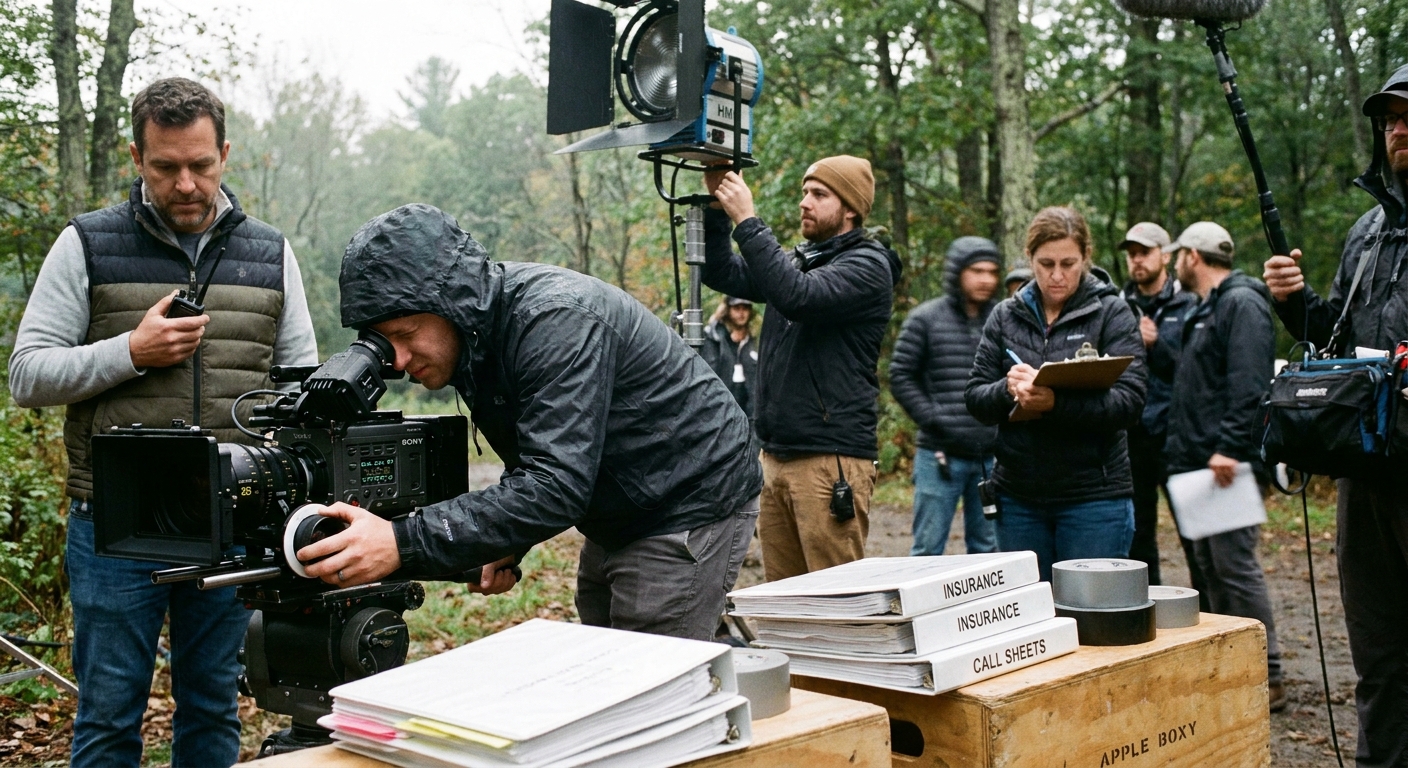
Quick answer: Every Connecticut film production typically needs eight separate insurance policies before cameras roll: a Producer's Package (also called Production Package), General Liability ($1M–$5M minimum), Workers' Compensation, Errors & Omissions, Inland Marine Equipment Floater, Hired and Non-Owned Auto, Drone/UAV Liability, and Umbrella Excess. Total premium ranges from 1.5% to 3% of your production budget for a typical streaming series or commercial — higher for action features and lower for documentary work. Completion bond companies usually dictate the policy form, the named carriers, and the minimum limits, so the cheapest path is building the right tower in pre-production rather than rebuilding it mid-shoot.
If you are producing a film, commercial, episodic, or doc in Connecticut, the tax credit conversation tends to dominate the early planning calls — we covered that in our Connecticut film tax credit pillar guide. The insurance conversation gets less airtime, which is exactly why it's the conversation that quietly blows up productions a week before principal photography.
At iConn Insurance Solutions, we work with production companies running CT shoots ranging from $200K commercials to multi-million-dollar streaming series. The same eight-policy structure underpins every one of them, and every line item has a specific reason for being on the list. This is the producer's plain-English guide to what each policy does, what it costs, and what completion bond companies are going to demand if your project is bonded.
What Is a Producer's Package?
The Producer's Package — sometimes called a Production Package or Entertainment Package — is the umbrella entertainment-specialty form that bundles the production-specific exposures that a generalist commercial policy won't touch. It is the policy non-entertainment brokers most often write incorrectly, and the one a completion guarantor will reject the fastest.
A standard CT Producer's Package includes:
- Negative Film, Videotape and Faulty Stock — covers loss or damage to your raw and finished footage. Even in an all-digital workflow, the language is unchanged from the celluloid era and still controls coverage.
- Cast Insurance — covers extra expense if your principal cast member becomes ill, injured, or dies during production. Required for any project with on-screen talent on a contract, and the policy with the most aggressive medical questionnaire on the page.
- Props, Sets and Wardrobe — physical property used in production.
- Extra Expense — covers the cost of reshoots or schedule extensions caused by a covered peril.
- Third Party Property Damage — covers damage to locations, leased equipment, and rental property under your care.
- Miscellaneous Equipment — production-owned camera, sound, grip and electric gear.
Carriers that write competently in this space are a short list: Chubb, AIG, Travelers, The Hartford, and Allianz / Fireman's Fund for larger budgets. Markel writes the indie tier well. A generalist commercial carrier without an entertainment underwriting unit should not be on your option list.
How Much Does Production Insurance Cost in Connecticut?
Rough premium math for a typical 4–8 week Connecticut shoot:
| Production type | Budget range | Typical insurance spend | As % of budget |
|---|---|---|---|
| National commercial spot | $250K–$1M | $4K–$20K | ~1.5%–2.5% |
| Documentary feature | $500K–$2M | $8K–$30K | ~1.5% |
| Streaming episodic (per ep) | $2M–$8M | $40K–$200K | ~2%–2.5% |
| Action / stunt feature | $5M–$25M | $150K–$750K | ~3%–3.5% |
These are working ranges, not quotes — final pricing depends on cast, stunts, locations, equipment values, prior loss history, and whether the project is bonded. A project with a meaningful stunt sequence in the Litchfield Hills will price differently than a Hartford-based interview doc.
What Insurance Do Connecticut Film Locations Actually Require?
Almost every Connecticut municipal film office, location agent, and venue owner will require:
- $1M per occurrence / $2M aggregate General Liability — the floor.
- $5M+ on state property, hospital locations, schools, and any DOT-controlled location — common for shoots involving CT DOT road closures, public schools, hospitals, and certain state parks.
- Additional Insured endorsement naming the property owner, location agent, and any third-party stakeholder. The certificate has to come from the carrier — not a hand-typed mock-up.
- Waiver of Subrogation in favor of the venue, particularly for sound-stage rentals and historic locations.
- Hired and Non-Owned Auto when picture vehicles or rentals are on the call sheet.
Municipal film offices in Stamford, Hartford, Bridgeport, New Haven, and the smaller shoreline towns each have slightly different documentation requirements. The smart move is to send your line producer with a single COI template that satisfies the strictest one and use it everywhere — it costs nothing extra and removes the day-of-shoot scramble.
Workers' Compensation for Film Crews in Connecticut
Connecticut requires workers' compensation insurance for every employee, including crew on a film set, with no minimum-employee exemption. The system runs through the Connecticut Workers' Compensation Commission under Chapter 568 of the General Statutes, and the penalty for going uninsured can reach $300 per day per employee.
For productions, the wrinkle is loan-out structures. Most below-the-line crew works through their own loan-out corporation or LLC, and most above-the-line talent runs through a personal services corporation. The Connecticut Department of Revenue Services requires loan-out companies to register via Form REG-1, and your tax credit voucher will not issue without confirmation of that registration. The same form is what makes the loan-out's payroll eligible to flow through your workers' comp policy properly classed.
Below-the-line crew is typically classed at NCCI code 7610 (motion picture production) or 9151 (theater and concert — performers and crew), depending on the project. Misclassification at audit is the most common workers' comp surprise on a CT production: a project initially quoted at the office class code ends up reclassified to 7610 mid-policy when the auditor sees set photography of riggers on a 30-foot truss.
Producer's pro tip: set your workers' comp class codes correctly at bind, not at audit. If the policy starts at 8810 (clerical) and your loss runs show 7610 work, the audit will surface a five-figure surprise premium that you cannot retroactively budget around.
Why Errors & Omissions Insurance Is Non-Negotiable
Errors & Omissions (E&O) insurance covers third-party claims related to the content of your production — copyright infringement, trademark infringement, defamation, invasion of privacy, breach of contract relating to underlying material, and rights-clearance disputes. It is not part of the Producer's Package; it is a separate policy with its own form, its own underwriting questionnaire, and its own clearance requirement.
No major distributor or streaming platform will accept delivery of a finished project without a valid E&O policy on the chain-of-title paperwork. Most distributors require $1M / $3M limits as a minimum; bigger streamers and theatrical distributors push to $3M / $5M. The policy term typically runs three years after delivery, and the retroactive date generally needs to reach back to the start of pre-production.
E&O is the policy with the biggest gap between "can we bind something" and "did we bind something a distributor will actually accept." We cover the E&O deep dive in our companion guide on E&O insurance for Connecticut filmmakers — including the clearance work that has to happen before a carrier will quote.

What Do Completion Bond Companies Actually Require?
Productions north of roughly $3 million typically carry a completion guaranty — a financial product issued by a completion bond company that promises the financier the film will deliver or the money will come back. Once a bond company is in the deal, they dictate the insurance form.
In practical terms, the bond company will require:
- Producer's Package on the bond company's approved-carrier list — usually Chubb, AIG, Allianz, or HUB International / Truman Van Dyke as the placing broker.
- Specific endorsements for cast (with named cast members and medical clearance), props, sets, wardrobe, and miscellaneous equipment.
- General Liability minimum $1M/$2M, often $5M for high-risk locations.
- Workers' Comp with statutory limits.
- E&O bound at distribution, with the bond company named as an additional insured.
- A bond-specific umbrella tower (typically $5M–$10M).
- Loss-payee endorsements naming the financier.
Building the policy stack to bond-company specifications in pre-production is meaningfully cheaper than discovering the gap two weeks before the camera test and emergency-binding to fix it.
Drone, Aerial & Specialty Risks
Almost every Connecticut location shoot now includes drone coverage. The standard producer's package does not automatically include UAV/drone liability — it has to be specifically endorsed or written as a separate policy. Standard limits are $1M–$2M, and the operator must be FAA Part 107 certified.
Other CT-specific specialty risks worth pricing separately:
- Animal coverage — for productions using horses, dogs, or other working animals (more common in CT shoreline and Litchfield Hills shoots than producers expect).
- Marine / watercraft — Long Island Sound, the Connecticut River, and shoreline shoots regularly trigger marine endorsements that don't live inside the standard producer's package.
- Pyrotechnics and special effects — require licensed CT operators and specific endorsement.
- Cyber liability — increasingly required for productions handling pre-release digital assets and DCP delivery.
Why an Independent Broker Matters for Film Insurance
Production insurance is a specialty market. Most general commercial brokers can write a $1M general liability policy and a basic auto endorsement; very few can route a producer's package through a carrier that wants the risk at the right form. At iConn Insurance Solutions, we run independent across the entertainment market — which means we can place the producer's package with the carrier that actually fits the project rather than the carrier we have a sales target on.
Working alongside our sister agency at Insure Connecticut LLC, we cover the production-specific entertainment lines plus the standard commercial stack — workers' comp, commercial auto, umbrella, and the cyber and crime layers larger productions require. Single broker, multiple carriers, one renewal calendar.
Key takeaways
- A Connecticut production needs eight separate policies: Producer's Package, GL, Workers' Comp, E&O, Equipment Floater, Auto, Drone, and Umbrella.
- Total insurance premium typically runs 1.5%–3% of production budget; action / stunt features land higher.
- CT workers' comp has no minimum-employee exemption — one crew member triggers the requirement.
- Loan-out companies must register with CT DRS via Form REG-1, or the tax credit voucher will not issue.
- Completion bond companies dictate the policy form — build to bond specs in pre-production, not mid-shoot.
- Generalist commercial brokers without an entertainment unit cannot place this stack competently.
Frequently Asked Questions About Connecticut Production Insurance
How much does film production insurance cost in Connecticut?
Typical Connecticut production insurance costs 1.5% to 3% of total production budget. Commercials and documentary work land at the lower end; streaming episodic at 2% to 2.5%; action and stunt features can reach 3% to 3.5%. Final premium depends on cast, locations, stunts, equipment values, and bond requirements.
What insurance is required to film on Connecticut state property or town locations?
Most CT municipalities require $1M per occurrence / $2M aggregate General Liability with the location owner named as Additional Insured. State property, hospitals, schools, and DOT-controlled locations often require $5M minimum, plus a Waiver of Subrogation endorsement. Certificates must come from the carrier directly.
Do I need workers' comp for a small Connecticut film shoot?
Yes. Connecticut has no minimum-employee exemption for workers' compensation. One crew member on payroll, full or part time, triggers the requirement. Loan-out companies must register with CT DRS via Form REG-1 to flow payroll through the workers' comp policy at the correct class code.
What is the difference between a Producer's Package and General Liability?
The Producer's Package covers production-specific exposures — negative film, cast, props/sets/wardrobe, extra expense, third-party property damage, and miscellaneous equipment. General Liability covers third-party bodily injury and property damage claims from outside parties. Both are required; one does not substitute for the other.
Can a regular commercial insurance broker write film production insurance?
Technically yes, but in practice the placement will struggle. Production insurance requires carrier relationships with entertainment-specialty underwriters at Chubb, AIG, Travelers, Allianz, and Markel. Bond companies maintain approved-broker lists, and a generalist broker is rarely on them.
When should I bind production insurance for a CT shoot?
Bind your Producer's Package at least 30 days before principal photography and finalize General Liability with location-specific endorsements at least two weeks out. E&O is bound just before delivery to the distributor, but the underwriting questionnaire and clearance work should start in pre-production.
Producing in Connecticut? Get the full stack quoted in one call.
Producer's Package, GL, workers' comp, E&O, equipment, auto, drone, umbrella — one independent broker, multiple entertainment-specialty carriers. We'll have a working quote in your hands inside 72 hours of the call sheet.
For more on the broader CT commercial insurance market — workers' comp deep dives, contractor coverage, small-business stacks — our sister agency at Insure Connecticut LLC covers the full P&C and health side across 12 states. Insure Connecticut LLC, iConn Insurance Solutions, and Wealth America, Inc. are independently operated companies under common ownership.