
Dealer Plates vs. Transporter Plates vs. Garage Liability: What's the Difference (and Which Do You Actually Need)?
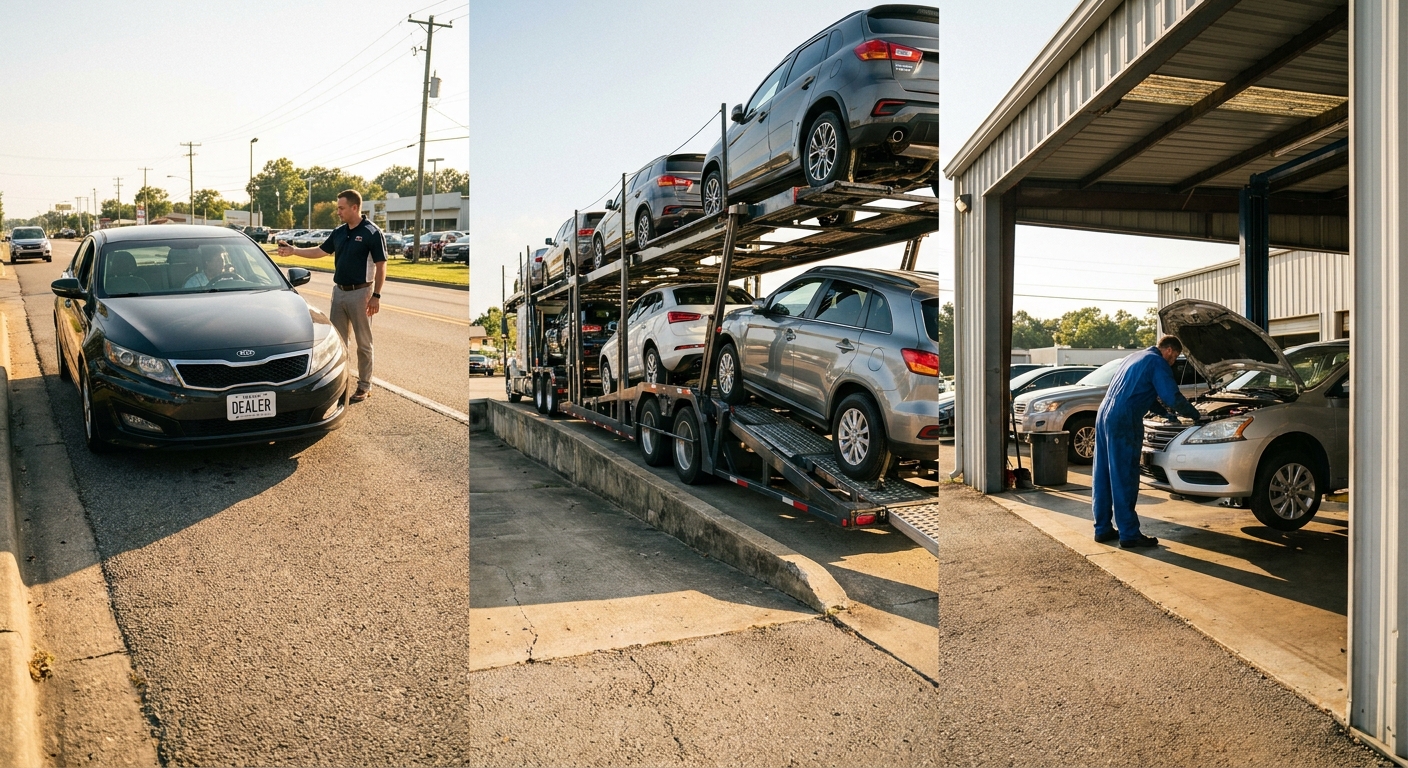
Quick answer: Dealer plates insurance covers the car (test drives, demos, transit of your own inventory). Transporter plates insurance covers a hauler moving vehicles owned by someone else. Garage liability covers the business itself — the lot, the office, the service bay, the customer's car in for repair. They are three separate policies addressing three separate exposures. Used car dealers typically need 1 and 3; wholesalers typically need 1; transporters need 2; service garages with a few dealer plates need a hybrid. Buying any one of them and assuming it covers the other two is the single most common mistake in this class.
If we polled 100 used car dealers, wholesalers, and auto transporters across Connecticut, New York, and Pennsylvania about what their "dealer policy" covers, we would get something like 100 different answers — and most of them would be wrong in expensive ways.
This post is the side-by-side every operator in the class should run against their current policy, with a decision tree at the end to figure out which combination you actually need. If you are coming from the tri-state pillar guide, this is the comparison expansion. If you are landing here cold, the pillar is the better starting point.
What's the Difference Between Dealer Plates Insurance and Garage Liability?
This is the most-asked question in the class — and the most-misunderstood. Here is the cleanest possible distinction:
Dealer plates insurance is about cars in motion. When a vehicle carrying a dealer plate is being test-driven, demonstrated, moved between lots, taken to the auction, or delivered to a buyer, the dealer plate liability policy is what responds to bodily injury, property damage, and (with the right endorsement) physical damage to the unit itself.
Garage liability is about the business and the premises. When a customer slips on ice in your lot, when a customer's vehicle gets damaged while parked on your premises waiting for service, when a porter knocks over a customer's mirror in the back lot, garage liability and its sub-coverages (garagekeepers in particular) are what respond.
The two policies cover entirely different exposures and are typically written on different policy forms by different carrier divisions. A working used car dealer needs both, almost without exception.
Where Transporter Plates Insurance Fits In
Transporter plates insurance is about vehicles you do not own, being moved by you. The license-plate credential itself is issued by the state DMV to a licensed transporter (auto hauler, repossessor, driveaway service) and is attached to a vehicle the transporter is moving on behalf of someone else — an auction, a dealer, a finance company, a private owner.
The insurance has to answer for three separate exposures simultaneously: bodily injury and property damage caused by the transporter while operating the vehicle, on-hook physical damage to the unit being transported, and (for haulers) motor truck cargo damage to the vehicles loaded onto the trailer.
A used car dealer's policy will not respond to any of those exposures, because the dealer policy is built around inventory the dealer owns. The line is bright: if the vehicle is on the dealer's books, dealer plates apply. If it is not, transporter plates apply. We dig further into the trucking-side coverages in the auto transporter specialty spoke.
The Side-by-Side: What Each Policy Actually Covers
| Exposure | Dealer plates | Transporter plates | Garage liability |
|---|---|---|---|
| Customer test drive injury / property damage | Primary | No | Excess only |
| Dealer principal driving inventory to auction | Primary | No | No |
| Employee delivering a sold unit to the buyer | Primary | No | No |
| Hauling cars between auction and dealer (cars not yours) | No | Primary | No |
| Repossession movement (cars not yours) | No | Primary | No |
| Driveaway services for a manufacturer or auction | No | Primary | No |
| Slip-and-fall on the dealer lot | No | No | Primary (premises) |
| Customer's car damaged while in for service | No | No | Garagekeepers |
| Open-lot inventory hail / fire / theft | No | No | Dealer's open lot |
| Hired/non-owned auto (employee using personal car for biz) | Sometimes | Sometimes | Sometimes |
| Drone over the lot for marketing photos | No | No | Endorsement |
Read this table next to your current policy declarations page. If you do not have a line item that matches one of the "primary" columns above for a risk you actually run, that is a coverage gap — and almost always a fixable one at renewal.
Which Policy Combination Do You Actually Need?
Use this decision tree to figure out your minimum stack:
- Independent used car dealer (single lot, retail) → Dealer plates + Garage liability + Open lot
- Independent used car dealer (multi-lot, retail + minor wholesale) → Dealer plates + Garage liability + Open lot + Umbrella
- Buy-here-pay-here (retail with subprime financing) → All of the above + extended garagekeepers + collateral protection
- Auto wholesaler (no retail floor) → Dealer plates + light garage liability (minimal premises exposure)
- Service-only garage with a few dealer plates for road tests → Garage liability + Garagekeepers + small dealer plate endorsement
- Single-truck auto transporter → Transporter plates + Motor truck cargo + On-hook + Commercial auto
- Multi-truck transporter fleet → All of the above + MCS-90 endorsement + Umbrella + FMCSA-compliant filings
- Dealer + transporter (hybrid operator) → Dealer plates + Transporter plates + Garage liability + Open lot + Cargo + On-hook
The good news: a competent specialty broker can package the right combination on a single carrier program for most operator types. The bad news: most generalist brokers cannot, and many of them do not know they cannot.
The Three Most Common Confusions (and What They Cost)
Confusion #1: "My dealer policy covers everything"
It does not. A standard dealer policy covers the car when a dealer plate is on it. It does not cover a customer slipping in your showroom. It does not cover a customer's car parked overnight on your lot getting hit by a hailstorm. It does not cover an employee driving their own car to the bank to deposit the day's receipts.
What it costs: the Insurance Information Institute reports that slip-and-fall verdicts on commercial premises routinely settle into the six figures; uncovered, that comes straight out of retained earnings.
Confusion #2: "I have garage liability so I'm covered for test drives"
You are not. Garage liability is built around premises and operations exposure. The dealer plate liability section is what actually responds to the on-road exposure created when a customer or employee is operating an inventory unit. Carriers will sometimes endorse garage liability with a dealer plate extension, but it is rarely written that way out of the box.
Confusion #3: "Transporter and dealer are the same thing"
They are not. A transporter plate is a separate state credential, on a separate policy form, with its own underwriter and its own coverage sections. A dealer who occasionally moves cars they do not own (say, picking up a unit from a customer for trade-in evaluation) does not have transporter coverage by default, and the dealer plate will not respond to a loss on that movement.
Two Real-World Scenarios
Scenario A: The Saturday Test Drive
A Stamford used car dealer hands the keys to a Honda Pilot to a couple looking at a $28,000 unit. They drive to the highway, the husband misjudges a merge, and the Pilot rear-ends a commercial van. Bodily injury claim: $145,000. Property damage to the van and to the Pilot: $42,000.
The dealer plate liability policy responds primary. The customer's personal auto policy responds secondary (most personal auto policies cover the driver while operating a non-owned vehicle, but only up to the personal policy's limits). The dealer's umbrella sits above the primary tower for anything above the dealer plate limits. Total recovered: $187,000 from the dealer's stack. Out-of-pocket to the dealer: deductible only.
Scenario B: The Hailstorm
The same dealer's lot in Stamford gets hit by a June hailstorm. 47 units on the lot sustain dent damage averaging $3,200 per car in repair cost — $150,400 of inventory loss.
The dealer plate liability policy does not respond. Garage liability does not respond. The dealer's open lot coverage (a section on the garage policy, but it has to be explicitly bought) is what responds — subject to co-insurance and a windstorm/hail deductible that is typically much higher than the comp/collision deductible.
Dealer who has open lot coverage: insured loss minus deductible. Dealer who skipped it to save $1,800 in annual premium: $150,400 self-insured loss.
Agent's pro tip: Read your declarations page and find the "dealer's open lot" or "physical damage on inventory" line. If you cannot find it, you do not have it. The cost to add it on a $1M inventory value account is typically $1,800–$4,200 a year, which is the cheapest insurance you will ever buy. Most CT dealers carrying inventory above $500,000 should not be without it.
Why Carriers Sometimes Bundle These — And Why That Cuts Both Ways
Specialty dealer carriers (Lancer, Universal Underwriters, Federated, GUARD) often write a "dealer's package policy" that bundles dealer plate liability, garage liability, garagekeepers, open lot, hired and non-owned auto, and umbrella under a single program form. Done well, that simplifies coverage and removes gaps. Done poorly, it lulls operators into believing every exposure is covered when one critical section was left off the schedule.
The single best protection against bundling-related gaps is a side-by-side audit of your declarations page against the table above. We do this audit free for prospective accounts; most operators discover at least one missing section.
Get a free side-by-side audit of your current policy.
Send us your declarations page. We'll mark the gaps against the dealer / transporter / garage matrix and tell you exactly which exposures your current coverage is missing.
Why an Independent Multi-Carrier Broker Matters Here
A captive agent will not write multiple policy types unless their carrier writes them all (most don't). A direct-to-carrier purchase forces you to take whatever bundle that carrier offers, even when one section is materially mispriced for your operation.
At iConn Insurance Solutions, we shop the same submission across all six specialty markets and structure the policy combination that actually matches your operator type. A wholesaler does not need the same stack as a buy-here-pay-here retailer, and a multi-truck transporter does not need the same stack as a single-lot dealer. Pretending they do is the captive-agent business model.
Together with our sister agency at Insure Connecticut LLC, we cover the full commercial-lines stack — workers' comp, business interruption, cyber, EPLI — that complements the dealer/transporter program with 12-state reach.
More from this cluster
- Pillar: The Tri-State Operator's Guide to Dealer & Transporter Plates Insurance
- Cost: How Much Does Dealer Plates Insurance Cost in 2026?
- Mistakes: 7 Costly Mistakes Used Car Dealers Make With Their Plate Insurance
- Transporters: Auto Transporter Insurance — Cargo, Liability & On-Hook
Key takeaways
- Dealer plates = car in motion (your inventory). Transporter plates = car in motion (someone else's inventory). Garage liability = the business itself.
- A working used car dealer typically needs dealer plates + garage liability + open lot. A transporter needs transporter plates + cargo + on-hook + auto liability.
- Hybrid operators (dealers who occasionally transport, or transporters with limited resale) need both plate types — on different policy forms.
- "My dealer policy covers everything" is the single most expensive misconception in this class.
- Open lot coverage is a separate, explicit line item — not assumed under dealer plate liability.
- Audit your declarations page against the side-by-side table at least once a year. Most operators find at least one gap.
Frequently Asked Questions About Dealer, Transporter, and Garage Coverage
Do I need both dealer plates insurance and garage liability for a used car lot?
Yes. Dealer plates insurance responds when a unit carrying a dealer plate is in motion (test drive, demo, transit). Garage liability responds to premises exposure (slip-and-fall, customer cars on the lot). Buying one without the other leaves an obvious gap that bites at claim time. Both are typically priced together on a dealer's package policy.
Does a transporter need a dealer policy if they sometimes sell a car?
Only if they hold a dealer license and the resale is regular enough to require it. A pure transporter who very occasionally sells a vehicle (e.g., disposing of a damaged unit they own) is usually fine on transporter plates plus a small commercial auto endorsement. Once resale becomes a regular revenue line, a dealer license and dealer plate program become necessary.
What is garagekeepers coverage and is it the same as garage liability?
Garagekeepers is a sub-coverage of garage liability. It specifically responds to damage to a customer's vehicle while it is in the dealer's or shop's custody — in for service, awaiting pickup, or being moved on the lot. Garage liability covers the premises and operations broadly; garagekeepers is the narrower extension for customer property.
Does my dealer plate cover the car a customer drives off the lot after purchase?
No. Once the title transfers and the customer takes delivery, your dealer plate coverage ends — the buyer's personal or commercial auto policy now responds. Some dealer programs offer a temporary "drive-off" endorsement for the day-of-sale window, but it is not assumed and rarely automatic.
Is open lot coverage included in a standard dealer policy?
No. Open lot (dealer's physical damage on inventory) is a separate line on the policy that must be explicitly bought, with its own limit, co-insurance, and windstorm/hail deductible. Most operators with inventory above $500,000 should carry it. Skipping it to save $2,000 a year is the most common preventable inventory loss in the class.
Can one policy cover all three exposures (dealer, transporter, garage)?
Sometimes — specialty carriers like Lancer, Universal Underwriters, and Federated can write a combined program when the operator runs both a dealer and a transporter operation. Whether they can depends on the carrier, the state mix, and the volume on each side. A single policy makes coverage cleaner and claim handling faster, but it has to be structured correctly to avoid hidden gaps.
Run your declarations page against our matrix.
Most operators discover at least one missing section. We'll do the audit free and tell you what to fix at renewal.
For Connecticut residents and businesses outside the dealer market who want the same independent-broker approach for personal and commercial lines, our sister agency at Insure Connecticut LLC covers the broader CT market across 12 states. Insure Connecticut LLC, iConn Insurance Solutions, and Wealth America, Inc. are independently operated companies under common ownership.