
Dealer & Transporter Plates Insurance: The Tri-State Operator's Guide for Used Car Dealers, Wholesalers & Auto Transporters (2026)

Quick answer: Dealer plates insurance, transporter plates insurance, and garage liability are three different policies — not interchangeable, not optional, and not the same thing. Dealer plate liability covers test drives, demos, and dealer-to-dealer movement on cars carrying a dealer plate. Transporter plate liability covers a hauler driving someone else's inventory between locations. Garage liability is the umbrella that protects the business itself — the lot, the office, the customers walking through the door. Most independent used car lots, wholesalers, and auto transporters across Connecticut, New York, and Pennsylvania need a combination of all three — and most are buying the wrong one.
Walk onto any used car lot in Hartford, Yonkers, or Allentown and the operator will tell you they have "dealer insurance." Ask the next question — "what does it cover when your customer wraps a $40,000 SUV around a telephone pole on a Saturday test drive?" — and the answer gets murky fast.
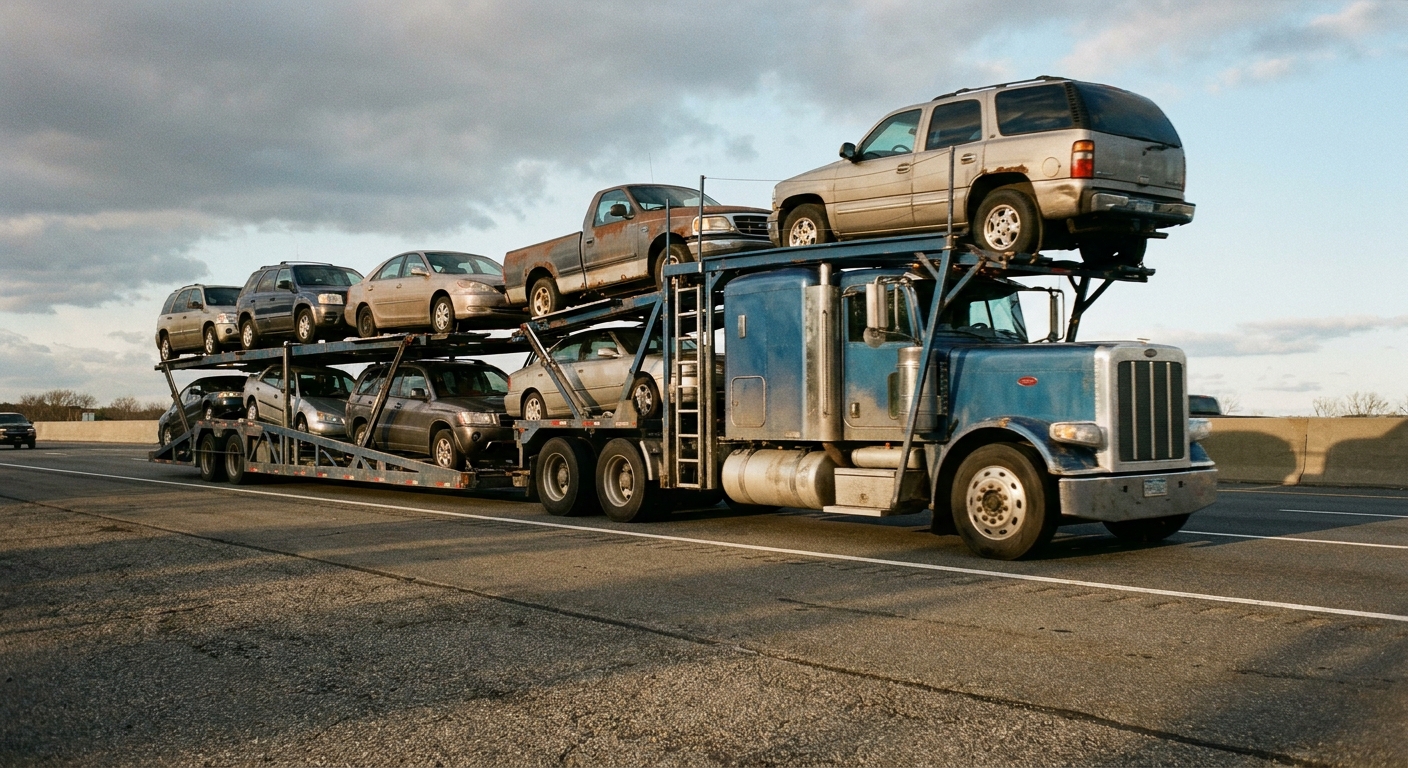
It is the most expensive coverage gap in the dealer business, and it is almost always created by a generalist agent who pieced together a policy out of a personal auto template instead of pricing a true dealer-specialty program. The same pattern shows up on auto transporters — the small operator running a three-car wedge between New Haven and Philadelphia who is one MCS-90 endorsement away from a six-figure exposure they did not know existed.
This is the agent-side guide we wish every independent dealer, wholesaler, and transporter would read before they renew. We walk through what dealer plates and transporter plates actually cover, where garage liability fits in, which carriers write the class in Connecticut, New York, and Pennsylvania, and what you should expect to pay in 2026 — with the catches a brochure will never tell you.
What's the Difference Between Dealer Plates and Transporter Plates Insurance?
This is the single most-Googled question in the class, and the one that trips up the most dealers at claim time. The plate itself is a state-issued credential — the insurance is a separate product priced to the exposure the plate creates.
A dealer plate is issued by the state DMV to a licensed motor vehicle dealer and is meant to be attached to a vehicle in the dealer's own inventory while it is being demonstrated, tested, moved between lots, or used for incidental business purposes (think delivery to the buyer, runs to the auction). It does not cover personal use by the dealer's family, employee commuting, or rental-style loaner programs unless those are specifically endorsed.
A transporter plate is issued to a licensed auto transporter, hauler, repossessor, or driveaway service and is attached to vehicles the transporter is moving on behalf of someone else — an auction, a dealer, a manufacturer, or a private owner. The transporter does not own the vehicles. The insurance on the plate has to answer for cargo damage, on-hook liability while loaded, and bodily injury/property damage caused while the transporter is driving the unit.
Two completely different exposures. Two completely different policy forms. And, in 2026, two completely different carriers writing them well.
| What it covers | Dealer plates | Transporter plates | Garage liability |
|---|---|---|---|
| Customer test drive accident | Yes | No | Excess only |
| Dealer-to-auction transit (own inventory) | Yes | No | No |
| Hauling cars owned by someone else | No | Yes | No |
| Bodily injury on the lot (slip & fall) | No | No | Yes |
| Customer's car in for service | No | No | Garagekeepers |
| Open-lot inventory (theft / hail / fire) | No | No | Dealer's open lot |
Read that table twice. The number of dealer principals who genuinely believe their "dealer policy" covers their open-lot inventory against a hailstorm — when in fact only a dealer's open lot endorsement does — is the reason this article exists.
Who Actually Needs This Coverage? (And in Which State)
If you are running any of the following businesses in Connecticut, New York, or Pennsylvania, you are squarely inside the dealer/transporter plate insurance market:
- Independent used car dealers — single-lot retailers, family-owned multi-lot groups, buy-here-pay-here operators.
- Auto wholesalers — the dealers who buy at auction and sell to other dealers, often holding inventory for 24–72 hours at a time.
- Auto transporters — from single-truck owner-operators running a wedge to mid-size fleets running interstate haul contracts.
- Driveaway / repossession companies — operating under transporter plates to move vehicles for finance companies and auctions.
- Service-only garages with limited resale — a few dealer plates issued primarily for road testing customer cars after repair.
- Auction-affiliated service providers — lane runners, transport coordinators, inspection contractors.
Each state's DMV regulates the plates differently, and the insurance underwriting follows the state's rules. Here is the tri-state lay of the land:
| Requirement | Connecticut | New York | Pennsylvania |
|---|---|---|---|
| Licensing authority | CT DMV Dealers & Repairers | NYS DMV | PennDOT BMV |
| Minimum BI/PD liability | $20K/$40K/$10K (statutory minimum — never enough) | $25K/$50K/$10K | $15K/$30K/$5K |
| Realistic working limits | $1M CSL minimum — $2M–$5M for any dealer doing volume or open lot above ~30 units | ||
| Surety bond required for dealer license | $10,000 ($20K used car dealer) | $10,000 ($50K used wholesale) | $30,000 ($50K wholesale) |
| Transporter plate program | CGS § 14-67 | VTL Article 14 | 67 Pa. Code § 19 |
The state minimums are not coverage benchmarks — they are the absolute legal floor. Any dealer with a real customer base in 2026 is carrying $1 million combined single limit (CSL) at minimum, and any wholesaler or transporter touching auction inventory above $50K per unit is sitting at $2M–$5M with an umbrella stacked on top. The Insurance Information Institute consistently flags commercial auto as one of the fastest-growing severity exposures in the country — verdicts above $1M have climbed sharply over the last decade.
How Much Does Dealer & Transporter Plates Insurance Cost in 2026?
Carriers underwrite this class on a handful of factors: plate count, sales volume, radius of operation, claim history, age and type of inventory, and the operator's experience in the class. Two dealers with identical revenue can pay very different premiums if one is selling 8-year-old commodity sedans inside a 50-mile radius and the other is moving exotic and luxury inventory across state lines.
Here is what we see in the working market across CT, NY, and PA in 2026. These are real ranges for a clean account — meaning no losses, current license, no DUIs on the dealer principal's MVR, no fire-class inventory mix.
| Operator type | Typical annual premium (clean account) |
|---|---|
| Single-lot independent used dealer (5–10 plates, 100 units/yr) | $4,500 – $8,500 |
| Mid-size used dealer (15–25 plates, 300–600 units/yr, $1M open lot) | $9,000 – $22,000 |
| High-volume / multi-location dealer (40+ plates, $3M+ open lot) | $25,000 – $80,000+ |
| Auto wholesaler (5–15 plates, no retail floor) | $3,500 – $9,000 |
| Single-truck auto transporter (1–2 transporter plates) | $6,500 – $14,000 |
| Multi-truck transporter fleet (3–10 power units, interstate) | $28,000 – $120,000+ |
The Spoke 1 article in this cluster goes deep on what drives those numbers up or down — "How Much Does Dealer Plates Insurance Cost in Connecticut?". The headline insight: every unit you do not report is a unit your policy will not cover, and saving a few hundred dollars at quote time is the most expensive trade an operator makes.
Who Writes Dealer & Transporter Plates Insurance in CT, NY & PA?
The dealer / transporter market is a specialty class. The household-name personal auto carriers either do not write it at all or write a thin, transactional version that will be the first to non-renew you after a claim. The carriers that genuinely understand the class are a smaller, more specialized group:
| Carrier | Best for | Notable |
|---|---|---|
| Lancer Insurance | Used car dealers, auto transporters, wholesalers across CT/NY/PA | A.M. Best "A" (Excellent), dealer/transporter specialty, complimentary loss control, 24/7 claims |
| Universal Underwriters Group (Zurich) | Larger independents, franchised crossovers, multi-location | The legacy dealer specialty market — deep program forms |
| Berkshire Hathaway GUARD | Smaller independents, single-lot operators | Competitive on garage liability; selective on transporters |
| Federated Insurance | Mid-size dealer groups affiliated with NIADA / state dealer associations | Loss-control intensive, long renewals, conservative pricing |
| Sentry Insurance | Interstate auto transporters, larger trucking-side risks | Strong on motor truck cargo and on-hook liability |
| Wesco / AmTrust | Hard-to-place risks — new ventures, recent losses, exotic inventory | Pays for it in premium but writes business the standard markets decline |
No single carrier is "best" for every operator. Lancer's specialty focus and tri-state CT/NY/PA footprint make them the natural anchor on a lot of accounts — we'll do a dedicated review of Lancer in Spoke 5 of this cluster. But a wholesaler with thin retail exposure looks very different to underwriters than a 600-unit retailer with a customer-facing showroom, and the carrier that prices one well is rarely the same one that prices the other.
The Three Mistakes That Cost Dealers the Most Money
After years of writing this class, the same three claim patterns keep showing up. Every one of them is avoidable on the policy side — if you know what to ask for.
1. Under-counting plates to save premium
A dealer carries 12 plates but only reports 8 because "we never have more than 8 in motion at once." On the day a customer wrecks unit #9, the carrier discovers the under-reporting and reserves the right to deny coverage or pro-rate the payout. Premium savings of $600 turns into a $40,000 self-insured loss.
2. Buying generic commercial auto instead of true dealer plate liability
Generalist agents will pitch a commercial auto policy with scheduled vehicles. The problem: dealer plates float between vehicles in inventory. A scheduled-vehicle policy does not respond when the plate is on a unit added that morning at auction. True dealer plate liability is written on a "blanket" or "any auto" basis specific to the inventory class.
3. Skipping dealer's open lot coverage
A 2024 hailstorm in the New York shoreline counties produced six- and seven-figure inventory losses on multiple dealer lots that had skipped open-lot coverage on the (very common) assumption that "the cars are insured." They were not. Open lot is a separate coverage section — almost always co-insurance based — that an operator has to buy explicitly.
We cover all seven of the most common mistakes in Spoke 2 of this cluster — "7 Costly Mistakes Used Car Dealers Make With Their Plate Insurance" — but these three alone account for the majority of the bad-day phone calls we take.
Already running a lot, a wholesale floor, or a hauler? Get a real quote.
We work with Lancer, Universal Underwriters, GUARD, Federated, Sentry, and Wesco on the same submission — so your account is priced on the carrier that actually wants your risk, not the one with a sales target this quarter.
Why an Independent Multi-Carrier Broker Matters in This Class
Dealer and transporter insurance is one of the most volatile commercial lines in the country. Carriers enter and exit the class on a multi-year cycle. The standard market that wrote your renewal three years ago may not be writing new submissions at all today, and the specialty carrier that priced you out last year may be back in the market hungry for premium this year.
A captive agent — one who can only place business with a single carrier — will sell you whatever that one carrier offers, even when the program is mispriced for your operation. A direct-to-carrier purchase is the same problem with the salesperson removed.
At iConn Insurance Solutions, we work as an independent multi-carrier broker, which means we shop the same submission across the six (and growing) markets above. For a dealer or transporter, that does two specific things: it gets your business in front of the carrier that genuinely wants your class of risk, and it builds you a renewal floor — we know what the market is paying because we are placing similar accounts every month.
Together with our sister agency at Insure Connecticut LLC, we cover the full commercial-lines stack a dealership or transporter needs across CT, NY, and PA — with 12-state reach for the operators who haul or sell beyond the tri-state corridor.
Explore the rest of this dealer & transporter cluster
- How Much Does Dealer Plates Insurance Cost in Connecticut? — 2026 pricing breakdown by operator size and what moves the needle.
- 7 Costly Mistakes Used Car Dealers Make With Their Plate Insurance — the coverage gaps that bite hardest at claim time.
- Dealer Plates vs. Transporter Plates vs. Garage Liability — the side-by-side every operator should run against their current policy.
- Best Dealer & Transporter Plates Insurance Carriers in 2026 — an independent agent's ranking of the six markets that actually write this class.
- Lancer Insurance Dealer & Transporter Plates Review — an honest look at the specialty carrier's strengths and limits.
- How to Get Dealer Plates in Connecticut: The 2026 DMV & Insurance Walkthrough — license, bond, certificate of insurance, plates.
- Auto Transporter Insurance: Cargo, Liability & On-Hook Coverage — the trucking-side deep dive for CT, NY, and PA haulers.
- What Happens When a Test Drive Goes Wrong — a real-world dealer plate claim walkthrough.
Key takeaways
- Dealer plate, transporter plate, and garage liability are three different policies — most operators buy the wrong combination.
- State liability minimums are a legal floor, not a coverage benchmark — working operators carry $1M–$5M CSL in 2026.
- Single-lot independents pay $4,500–$8,500; mid-size dealers $9K–$22K; single-truck transporters $6,500–$14,000 for a clean account in CT/NY/PA.
- Six carriers actually write the class well: Lancer, Universal Underwriters, GUARD, Federated, Sentry, Wesco.
- Under-counting plates, buying generic commercial auto, and skipping open lot are the three most expensive mistakes in the class.
- An independent multi-carrier broker shops the same submission across all of them — captives and direct-to-carrier do not.
Frequently Asked Questions About Dealer & Transporter Plates Insurance
How much does dealer plates insurance cost in 2026?
A clean single-lot independent used car dealer with 5–10 plates and 100 units a year typically pays $4,500–$8,500 annually in CT, NY, or PA. Mid-size operators ($1M open lot, 15–25 plates) run $9,000–$22,000. High-volume groups push past $25,000 quickly. Transporters run a separate curve based on power units and miles.
What's the difference between dealer plates insurance and garage liability?
Dealer plates insurance covers the car — what happens when a unit carrying a dealer plate is in motion (test drive, demo, transit). Garage liability covers the business itself — bodily injury on the lot, customer cars in for service (garagekeepers), and premises liability. Working dealers need both; one without the other leaves an obvious gap.
Do I need transporter plates insurance if I already have dealer plates?
Yes, if you ever move a vehicle you do not own. Dealer plate liability covers movement of inventory you own. Transporter plate liability covers vehicles you are moving on behalf of someone else — an auction, another dealer, a finance company. They are separate plates, separate policies, and separate exposures.
Does dealer plates insurance cover customer test drives in Connecticut?
Yes — a properly written dealer plate liability policy is built around the customer test drive exposure. The dealer's plate liability sits primary, with the customer's own personal auto policy responding secondary. The catch: the customer must be supervised and the test drive must be a legitimate sales demonstration. Letting a customer take a unit overnight without an endorsement creates a coverage gap.
Who writes dealer & transporter plates insurance in CT, NY, and PA?
The specialty market is led by Lancer Insurance, Universal Underwriters Group (Zurich), Berkshire Hathaway GUARD, Federated Insurance, Sentry Insurance, and Wesco / AmTrust. A working independent broker shops a submission across all of them — the right carrier for a 100-unit retailer is rarely the same one that prices a multi-truck transporter best.
Is the state minimum liability limit enough for a Connecticut dealer?
No. Connecticut's statutory minimum is $20K/$40K/$10K — that is the legal floor for licensure, not a working coverage limit. Any dealer doing volume in 2026 carries $1 million CSL at the absolute minimum, with $2M–$5M and an umbrella stacked on top for any operator selling above ~30 units a month or running open lot above $500,000.
Running a dealer lot, a wholesale floor, or a transporter operation in CT, NY, or PA?
Let an independent multi-carrier broker shop your renewal across Lancer, Universal Underwriters, GUARD, Federated, Sentry, and Wesco on the same submission. You'll see the market, not just one carrier's quote.
For Connecticut residents, contractors, and small businesses who don't run a lot but need the same independent-broker treatment for commercial and personal lines, our sister agency at Insure Connecticut LLC covers the broader CT market across 12 states. Insure Connecticut LLC, iConn Insurance Solutions, and Wealth America, Inc. are independently operated companies under common ownership.