
Driver Hiring & MVR Reviews: The CT Trucking Playbook That Lowers Your Premium
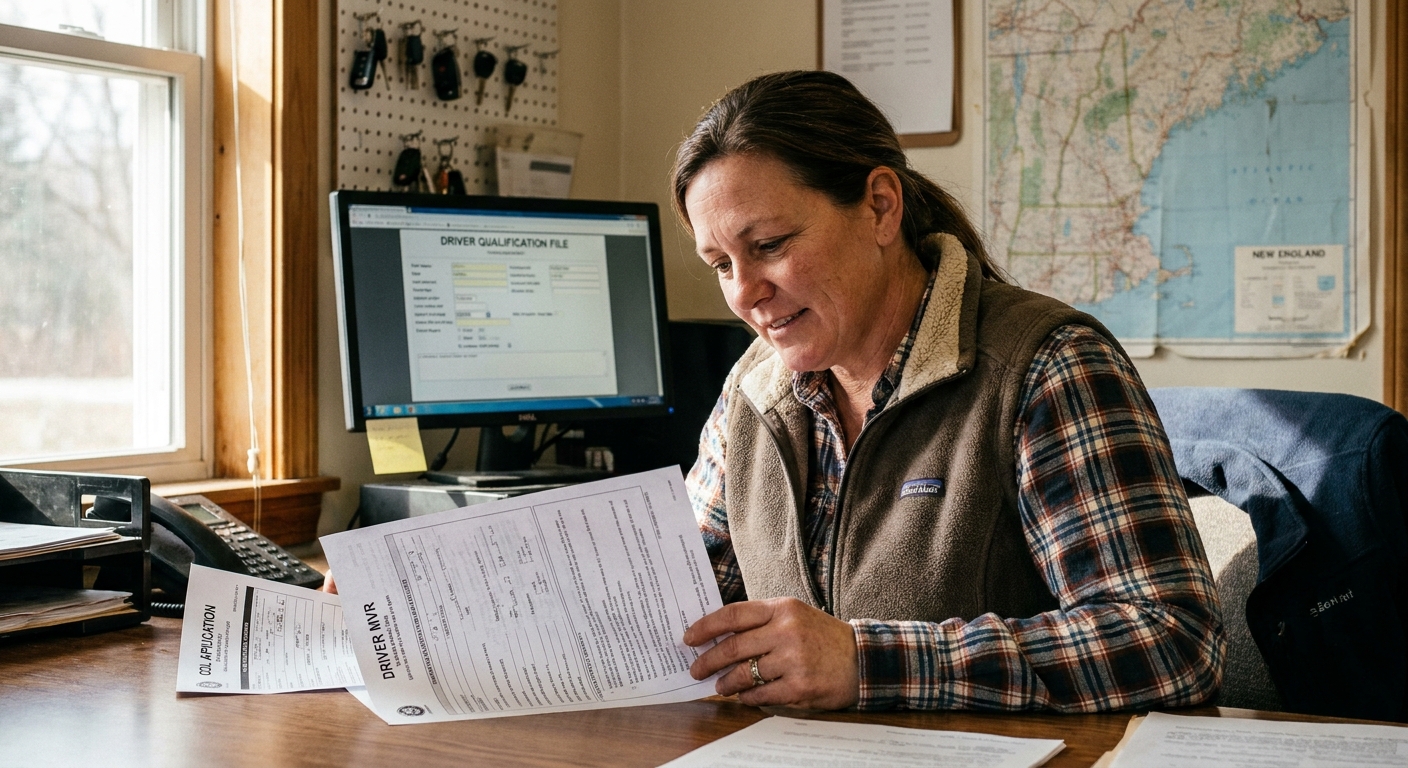
The hard truth about hiring CDL drivers in Connecticut: 70% of trucking insurance claims trace back to driver decisions, and underwriters know it. A single driver with two moving violations in 36 months can disqualify your entire fleet from preferred carriers. The MVR review you skip at hiring becomes the $40,000 premium surcharge at renewal — or worse, the non-renewal letter that pushes you into the excess market.
Every CT trucking owner has hired a driver they shouldn't have. The application looked clean, the CDL was current, the road test went fine — and three months later that driver runs a red light in Waterbury, totals a tractor, and your premium jumps 28% at renewal. The autopsy on these accidents almost always finds the same thing: the MVR (Motor Vehicle Record) was never pulled properly, the prior-employer verification was skipped, or the FMCSA Pre-Employment Screening Program (PSP) report was treated as optional.
At iConn Insurance Solutions, we underwrite CT motor carriers from Hartford to New London and across the Gold Coast. The single fastest way to lower your trucking insurance cost — faster than any deductible adjustment, faster than any safety bonus program — is to hire better. This guide is the driver qualification playbook that preferred carriers like Great West Casualty, Progressive Commercial, and Travelers use to decide whether they'll write your account at all.
How Do Insurance Carriers Score Your CT Trucking Drivers?
Commercial auto underwriters score every driver in your fleet on a 100-point scale weighted across MVR violations, accident history, CDL endorsements, years of experience, age, and time with your motor carrier — and a single driver scoring below 70 can push your entire fleet out of the preferred market. The carrier doesn't average your fleet; they look at your worst driver and decide whether they want exposure to that risk.
Here's the part most fleet owners don't realize: the same MVR that looks "okay" to you reads very differently to an underwriter. Two minor violations in 36 months — say, a speeding ticket and a following-too-close — drops a driver from "preferred" to "standard" tier instantly. Add a CSA-reportable inspection and that driver hits "non-standard," which roughly doubles their portion of your premium. Three minor violations or one major (DUI, reckless, hit-and-run, refusal to test) and most carriers will require the driver be removed from your policy entirely or non-renew the account.
The 70/30 rule: 70% of trucking insurance claims dollars are driven by driver behavior; 30% by everything else (vehicle, route, cargo, weather). Underwriters know this — which is why driver hiring is the single biggest lever you control on premium.
The Three Reports You Must Pull on Every Driver — Every Time
Federal Motor Carrier Safety Regulations (49 CFR §391) require specific records be obtained before a driver is allowed behind the wheel. These aren't optional, and they're not interchangeable. Each report shows a different angle on the driver's history, and your insurance underwriter expects all three to be in the Driver Qualification File.
| Report | What It Shows | How Often to Pull | What Carriers Look For |
|---|---|---|---|
| MVR (Motor Vehicle Record) | State-issued license status, license class, endorsements, restrictions, moving violations, suspensions over the last 3-5 years (state-dependent). | At hire + annually + at every CDL renewal | Clean record 36 months back; no major violations 5 years back; no out-of-state suspension activity. |
| PSP Report (Pre-Employment Screening) | 5 years of FMCSA roadside inspections + 5 years of reportable crashes attributed to the driver across all carriers worked for. | At hire only (covers all prior carriers) | Driver out-of-service violations, log violations, hazmat violations, multiple-event inspection patterns. |
| Prior Employer Verification | Employment dates, accident history, drug/alcohol testing history, and termination reason from every DOT-regulated employer in the last 3 years. | At hire only | Gaps in employment, fired-for-cause indicators, drug-test refusals, accident frequency vs. peer drivers. |
Pull these in the wrong order and you can disqualify yourself from preferred-market carriers without ever knowing it. Pull the MVR after the road test instead of before, and one bad result wastes a full day. Skip the PSP because the application looks clean and you'll miss the roadside inspection record from the driver's last carrier that your underwriter will absolutely find.
The 6 Driver Qualification Habits That Lower Your CT Trucking Premium
These are the operational practices that distinguish accounts underwriters fight to write from accounts they non-renew. Adopt all six and your fleet's insurability — and your renewal pricing — changes within 12 months.
1. Run the MVR Before the Road Test, Not After
Many CT fleets schedule the road test first, then pull the MVR if the driver looks promising. This is backwards. The MVR costs $5-15 per state pull; a road test consumes 90 minutes of dispatcher time plus a tractor. Run the MVR within 24 hours of the application landing, and if the report shows two or more moving violations in 36 months, decline before you ever schedule the road test. Underwriters specifically look for this discipline in audit — it signals an operation that hires on data, not gut feel.
2. Pull PSP Reports on 100% of New Hires — Including Owner-Operators
The FMCSA PSP report is the single most predictive document in the entire hiring stack, and it's available directly from psp.fmcsa.dot.gov for $10 per pull (with driver consent). It shows every roadside inspection the driver was the operator on, every reportable crash they were involved in, and the violations that came out of each — across every carrier the driver has worked for in the last 5 years. Even owner-operators get PSP'd; the report doesn't care who held the authority, only who was driving the truck.
3. Verify Prior Employers in Writing, Not by Phone
49 CFR §391.23 requires you to contact every DOT-regulated employer the driver had in the last 3 years. The standard practice — calling the prior employer's HR line and asking "how was Joe?" — fails the audit and tells you nothing. Use the written-verification process: a signed release from the driver, a faxed/emailed request to the prior carrier listing the eight specific questions FMCSA requires (employment dates, accident record, drug/alcohol testing, reason for termination, etc.), and a written response back. Keep both the request and the response in the Driver Qualification File for at least 3 years after the driver leaves.
4. Set Hard Disqualifiers in Writing Before You Need Them
The biggest hiring mistake CT fleets make is bending their own standards when they're short-staffed. Eliminate the temptation by writing your minimum hiring standards into a one-page document signed by the owner — minimum age (most underwriters require 23 for tractor-trailer, 25 for hazmat), minimum CDL experience (1 year preferred-market, 2 years for hazmat or tanker), and an MVR threshold (no more than 1 moving violation in 36 months, no major violations in 5 years). When the dispatcher is panicking about a Friday delivery, the written policy is what protects the policy.
5. Implement Annual MVR Reviews — and Act on What You Find
The federal minimum is one MVR pull per year (§391.25), but the carriers writing your insurance want to see quarterly monitoring at minimum, and continuous monitoring services (CMS) for fleets over 10 power units. A driver who picks up a speeding ticket in October won't tell you about it; you find out at the next annual pull or — worse — when your underwriter does a mid-term MVR review at renewal time. Continuous monitoring services like SambaSafety push real-time alerts to your dispatcher the moment a violation hits the state DMV system.
6. Document the Pre-Employment Drug Screen Every Time
FMCSA §382.301 requires a DOT pre-employment drug test (5-panel urine) with a verified negative result before the driver performs any safety-sensitive function. The Clearinghouse query is a separate, required step. Skipping either one is a citable violation under FMCSA, and it's the kind of finding that turns a routine new-entrant audit into a "Conditional" rating — which closes the door on most preferred-market insurance carriers for at least 12 months. Keep the chain-of-custody form, the lab result, and the Clearinghouse query response in the Driver Qualification File.
Why Independent Brokers Matter for CT Trucking Fleets
A captive agent works for one carrier. If that carrier doesn't want your fleet — too many drivers under 25, an MVR with a tow-in violation, a CSA score in the wrong BASIC — you're out of luck. An independent broker shops the same risk to Great West, Progressive Commercial, Travelers, Northland, Hudson Insurance Group, and a half-dozen excess-market specialists — and finds the one carrier whose appetite matches your fleet's profile this quarter.
At iConn Insurance Solutions, we specialize in CT motor carriers and place the same driver hiring standards into the front of every account application — because we know what each underwriter weights heaviest. Together with our sister agency Insure Connecticut LLC, we cover commercial trucking accounts across all 12 states in the Northeast and Mid-Atlantic, with carrier appetites updated weekly. If your renewal landed and the number doesn't match the risk you're actually presenting, that's almost always a placement problem, not a fleet problem.
Key Takeaways
- 70% of trucking insurance claims dollars trace to driver behavior — driver hiring is your biggest premium lever.
- Carriers underwrite to your worst driver, not your average. One driver with 2+ moving violations can disqualify the fleet.
- Three reports must be in every Driver Qualification File: MVR (annually), PSP (at hire), prior-employer verification (written, not phone).
- Run the MVR before the road test. Use continuous monitoring services for fleets over 10 units.
- An independent broker shops your account to 6-8 carriers; a captive agent has one shot. The difference at renewal is often 15-25%.
Frequently Asked Questions About CT Trucking Driver Hiring
How much does an MVR cost in Connecticut, and how fast do I get it?
A CT MVR runs $20 through the DMV online portal and returns in under 24 hours. Out-of-state MVRs cost $5-15 each through commercial vendors like SambaSafety or HireRight, and most return within 1-2 business days. Always pull the MVR for every state the driver held a CDL in over the last 3 years, not just Connecticut — the violations don't transfer to the new state automatically.
What's the minimum driver age most CT trucking insurance carriers accept?
Preferred-market carriers require age 23 for tractor-trailer, age 25 for hazmat or tanker, and age 21 for straight-truck or local-only operations. Excess-market carriers will write age 21 for tractor-trailer at a 15-25% surcharge. Drivers under 21 cannot legally drive interstate commerce except under the FMCSA Safe Driver Apprenticeship Pilot Program, which has specific training requirements.
Can one bad driver really push my whole CT fleet out of the preferred market?
Yes — and it happens regularly. Carriers underwrite to the worst driver on the account, not the average. If you have 15 drivers and one of them has a DUI in the last 5 years, most preferred-market carriers will require that driver be excluded by name from the policy. If you refuse the exclusion, the carrier will non-renew the entire account at the next renewal date.
How often does FMCSA require I pull MVRs on existing drivers?
FMCSA §391.25 requires a minimum of one MVR pull per driver per 12-month period, plus an annual review of the driver's qualification file. Your insurance underwriter typically expects more — quarterly pulls for fleets under 10 power units and continuous monitoring (CMS) for fleets over 10. Continuous monitoring services like SambaSafety push real-time alerts the moment a violation hits the state DMV.
What is the FMCSA Clearinghouse and do CT trucking owners have to query it?
The FMCSA Drug & Alcohol Clearinghouse is a federal database of CDL driver drug and alcohol program violations. As a CT motor carrier, you must run a pre-employment "full query" on every CDL applicant ($1.25 per query) and a "limited query" on every existing driver annually. Skipping either is a citable violation that contributes to a Conditional safety rating during audit.
If I find a violation on an existing driver's annual MVR, what should I do?
First, document the violation in the driver's qualification file with the date pulled and the underwriter notification. Second, decide whether the violation triggers a retraining requirement under your company safety policy. Third, notify your insurance broker immediately — surprises at renewal are worse than disclosed issues mid-term. Most carriers will work with you if the violation is reported and managed; they non-renew when they discover it during audit instead of from you.
Ready to take control of your CT trucking insurance? A driver qualification audit is the cheapest underwriting tool we offer — we'll review your existing driver files against the preferred-market standard and flag the specific drivers, gaps, or process changes that are costing you the most premium. Request a free CT trucking insurance review from iConn Insurance Solutions, or visit our sister agency Insure Connecticut LLC for multi-state placement across the Northeast.