
What Does Filming in Connecticut Actually Cost in 2026? A Producer's Line-Item Budget Breakdown
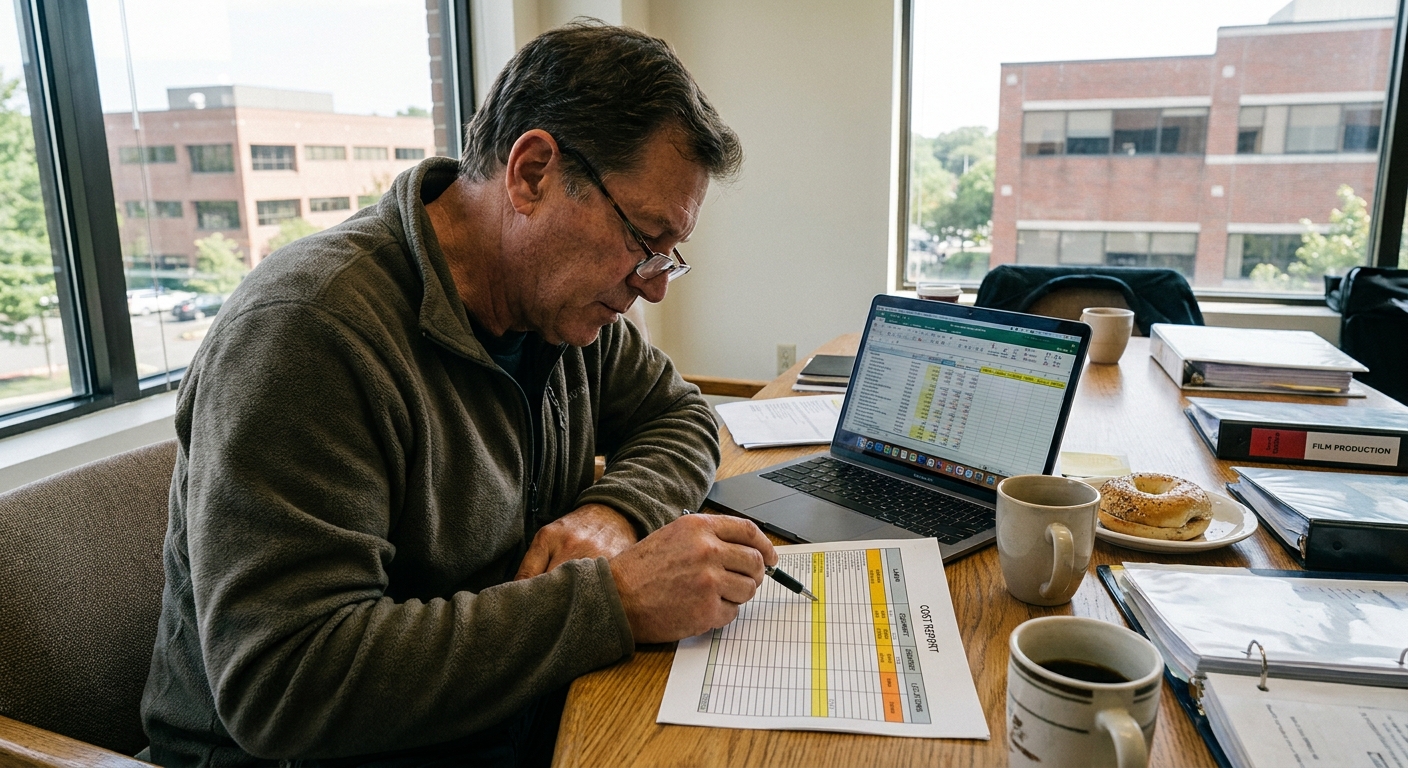
Quick answer: In 2026, an indie feature shooting in Connecticut runs $45,000–$75,000 per shoot day all-in, a mid-tier streaming series episode runs $180,000–$300,000 per day, and a major studio feature lands $400,000–$650,000 per day. The line items: stage and location ($2K–$15K/day), crew ($25K–$120K/day), equipment ($8K–$45K/day), insurance (3–4% of budget total), and post (15–25% of total budget). Connecticut's 30% transferable film tax credit shaves roughly 25–28 cents back on every qualified dollar spent in-state once you account for the secondary-market sale discount on the credit.
Every producer eyeing Connecticut for a 2026 shoot asks the same opening question: "What is this actually going to cost?" The answer depends on production class (indie, mid-tier, major), shoot length, and where the spend lands inside the credit-eligible buckets. This piece walks the full line item with realistic 2026 ranges based on quotes pulled from CT-active vendors and crew rate cards.
If you haven't read the cluster's hub piece yet, start with the Connecticut film tax credit pillar guide — that's where the 30% credit math comes from. The numbers below show what that credit is offsetting.
Stage and Location Costs in Connecticut (2026)
Connecticut has been steadily building stage and qualified-facility inventory over the last five years. Stamford, Hartford, and shoreline locations dominate the rental market.
| Asset | Daily rate (2026) | Weekly rate | Notes |
|---|---|---|---|
| Small sound stage (2,000–5,000 sq ft) | $2,500–$5,500 | $12K–$25K | Includes basic grip/electric package. |
| Mid-size stage (5,000–15,000 sq ft) | $5,500–$11,000 | $25K–$48K | Includes lockup, parking, support spaces. |
| Large stage (15,000+ sq ft, qualified facility) | $11,000–$18,000 | $48K–$75K | Triggers enhanced credit pathway. |
| Practical location (residential interior) | $2,000–$6,500 | n/a | Plus location fees, permits, neighborhood notice. |
| Practical location (commercial / restaurant) | $3,500–$12,000 | n/a | Plus business-interruption rider on insurance. |
| Public/civic location (CT permit) | $500–$3,500 | n/a | Permit fee + officer overtime if required. |
The qualified-facility unlock matters: shooting at least 50% of principal photography at a state-certified qualified production facility lifts the secondary-market 25% transfer cap that constrains how the credit can be sold. That detail can be worth a penny or two on the dollar of credit value — meaningful on a $3M+ certificate.
Crew Labor: The Single Largest Line on Every CT Shoot
Crew is 40–55% of an average Connecticut production budget. Connecticut crew rates fall between New York and regional non-Northeast averages — lower than NYC's IATSE Local 52 rates, higher than Atlanta or Albuquerque.
Above-the-line (ATL) — Director, writers, producers, principal cast
- Indie feature ATL: $150K–$600K total package across director + writer + cast.
- Mid-tier streaming series ATL: $2M–$8M per episode (showrunner, EP block, lead cast).
- Major studio ATL: $5M–$40M+ depending on cast attachment.
Connecticut's tax credit imposes a cap on above-the-line compensation that counts as qualified spend — meaningful detail for productions with large star packages. For more on that constraint, see the pitfalls cluster spoke.
Below-the-line (BTL) — Department heads, crew, day-players
| Position | Daily rate (CT, IATSE-comparable) | Notes |
|---|---|---|
| Director of Photography | $2,000–$5,500 | Plus kit fee, depending on package. |
| 1st AD | $1,500–$3,200 | DGA scale or above. |
| Gaffer / Key Grip | $1,000–$2,200 | 14-hour day basis. |
| Camera Operator | $1,200–$2,500 | Plus camera operator kit if applicable. |
| Sound Mixer | $1,100–$2,200 | Plus kit fee for sound package. |
| Production Designer | $1,500–$3,500 | Weekly rates typical for prep periods. |
| Department day-players | $450–$1,100 | Lighting, grip, art, makeup, wardrobe. |
Multiply across an average 60–75 person CT shoot day and BTL labor lands at $50K–$120K per day before payroll burden. Add 22–28% in payroll taxes, union fringes, and workers' comp; the loaded crew number is $65K–$155K per day on a mid-tier shoot.
Equipment Rental
Connecticut's rental market is anchored by NYC vendors (Panavision, Keslow, ARRI Rental) that ship up the I-95 corridor, plus a growing in-state inventory based in Stamford and Hartford. Daily rates for a mid-tier package:
- Camera package (ARRI Alexa 35 or Sony Venice 2, primes, accessories): $4,500–$9,500/day.
- Lighting/grip truck (3-ton or 5-ton standard package): $2,000–$5,500/day.
- Sound package: $400–$900/day.
- Specialty equipment (Steadicam, gimbal, crane): $1,200–$4,500/day.
- Drone/UAV unit (FAA-licensed operator + insurance): $2,500–$5,500/day.
- Production vehicles (cube trucks, picture cars, generators): $800–$3,000/day.
Equipment typically runs 8–14% of total budget on a CT feature, slightly higher on heavily VFX-driven work where dedicated specialty rigs are required.
Production Insurance — The Required Line
Insurance is 3–4% of total budget on a typical CT production — and it is a credit-eligible cost, meaning every dollar of qualifying insurance premium generates 30 cents of credit at the top tier. For the full anatomy of the production insurance program, see Production Insurance 101 for CT Film Shoots.
| Insurance line | Typical share of premium | Notes |
|---|---|---|
| Producer's Package (cast/props/extra expense) | 40–55% | The core line. |
| General Liability | 15–20% | Required by CT permits and most locations. |
| Workers' Compensation | 10–15% | Required for any CT-paid crew. CT-paid WC premium is credit-eligible. |
| Inland Marine / equipment | 8–12% | Sized to camera and grip package values. |
| E&O Insurance | 5–15% | Required for distribution. See E&O spoke. |
| Auto, Umbrella, Drone, Misc. | 5–10% | Mix depends on shoot specifics. |
Post-Production Costs
Post is 15–25% of total budget on a typical feature. CT post-production spend qualifies for the same 30% credit tier as principal photography — provided it's done at a CT-located post house or a CT-payrolled team.
- Picture editorial: $80K–$350K (indie feature) to $1.5M+ (major).
- Sound design and mix: $35K–$180K (indie) to $600K+ (major).
- Color and finishing: $25K–$120K depending on complexity.
- VFX: highly variable, $0 (drama with no effects) to $20M+ (effects-heavy feature).
- Music score and licensing: $25K–$300K, plus E&O-relevant sync clearances.
All-In Per-Day Cost by Production Tier
| Tier | Per-day all-in | Typical CT shoot length | Total CT spend |
|---|---|---|---|
| Indie feature | $45K–$75K | 18–25 days | $1.5M–$4M |
| Mid-tier streaming series (per ep) | $180K–$300K | 8–14 days/ep | $2M–$5M per ep |
| Major studio feature | $400K–$650K | 45–75 days | $25M–$60M+ |
| Documentary feature | $25K–$45K | variable | $500K–$2.5M |
| Commercial / branded content | $60K–$220K | 2–5 days | $200K–$1.5M |
Producer's pro tip: The credit is real money, but it lands 9–18 months after wrap. Cash-flow your production assuming you finance against the credit (most CT productions do, typically at 6–8% interest) — not assuming the credit drops on day 1. Talk to your lender and your Wealth America financial planning team early about the bridge financing structure.
How the 30% Credit Changes the Math
The 30% credit applies to qualified spend — CT-payrolled labor, CT-vendor equipment and stage rentals, CT-located post production, and CT-resident insurance. On a typical CT shoot, 75–85% of total spend is qualified.
Example: a $3M indie feature spending $2.4M in qualified CT costs earns a $720K credit. Sold on the transferable market at $0.92 per dollar, that's $662K net cash back to the production. Effective net cost of the production: $2.34M — a 22% reduction from gross spend. For the mechanics of how the credit gets sold, see How to Sell a Connecticut Film Tax Credit.
Key takeaways
- Indie features in CT run $45K–$75K per shoot day all-in; mid-tier series $180K–$300K/day; majors $400K–$650K/day.
- Crew labor is 40–55% of total budget — the single largest cost driver.
- Equipment runs 8–14%, insurance 3–4%, post 15–25%.
- The 30% credit recovers roughly 22–25% of effective gross spend after the secondary-market sale discount.
- Cash-flow assuming credit-backed bridge financing — the credit lands 9–18 months after wrap, not on day 1.
Frequently Asked Questions About the Cost of Filming in Connecticut
What does an average shoot day cost in Connecticut?
An indie feature runs $45,000–$75,000 per all-in shoot day in 2026. Mid-tier streaming series episodes run $180,000–$300,000 per shoot day. Major studio features land $400,000–$650,000 per day. Documentary and commercial work is significantly lower.
Is Connecticut more expensive than Georgia or New Mexico for filming?
Yes on labor (CT crew rates run higher than GA or NM) but the differential is partly offset by Connecticut's larger 30% credit on the top tier and more favorable transferable credit market. The full state-by-state breakdown is covered in the CT vs. GA vs. NY comparison.
What percentage of my CT shoot budget actually qualifies for the credit?
On a typical Connecticut feature or series, 75–85% of total spend qualifies for the credit. CT-payrolled labor, CT-vendor equipment and stage rentals, CT-located post production, and CT-resident insurance all qualify. Out-of-state ATL packages and non-CT vendors do not.
How quickly can I get my Connecticut tax credit refund or sale proceeds?
The Department of Economic and Community Development typically issues the Final Production Tax Credit Certificate 6–12 months after wrap, contingent on audit completion. Most productions sell the certificate to a CT taxpayer within 30–60 days of certificate issuance.
Should I bridge-finance my Connecticut film tax credit?
Most productions do. CT-active specialty lenders offer credit-backed bridge financing at 6–8% interest, typically advancing 80–85% of expected certificate value at production close. This converts the credit from a deferred receivable into working capital for the shoot.
What's the minimum CT spend to qualify for the film tax credit?
$100,000 in qualified Connecticut production costs is the statutory minimum to qualify for the 10% tier; $500,000 triggers the 15% tier; $1,000,000 triggers the 30% top tier. See the pillar guide for full tier mechanics.
Budgeting a Connecticut shoot? Let's coordinate the insurance and credit math together.
Production insurance placement and tax-credit-aware budget review, coordinated across iConn Insurance Solutions and our Wealth America financial-planning colleagues.
For the broader Connecticut commercial and personal lines conversation, our sister agency at Insure Connecticut LLC covers the full P&C and health stack for CT businesses, and our colleagues at Wealth America, Inc. handle the financial-planning side — including production entity structuring and credit-monetization strategy. Insure Connecticut LLC, iConn Insurance Solutions, and Wealth America, Inc. are independently operated companies under common ownership.
Contenido relacionado
AI Payment Fraud Incident Response: What to Do First
The first hour after a fraudulent wire can decide whether funds are frozen or lost. Follow this practical response guide for banks, insurers, evidence, law enforcement, and recovery.
Leer artículo →
Hotel and Commercial Property Insurance: Where Should Renewal Savings Go?
A practical guide for hotel and commercial-property owners deciding whether to keep renewal savings, lower deductibles, increase limits or restore coverage.
Leer artículo →AI Fraud Insurance Exclusions: Where Coverage Can Break
A large cyber limit can hide a small social engineering sublimit. Learn how voluntary-transfer language, verification conditions, and overlapping crime coverage can affect AI fraud claims.
Leer artículo →
Connecticut Builders Risk Insurance: 2026 Buyer’s Guide
Connecticut builders risk buyers should update project values, timelines and controls. Learn what to prepare and compare for a 2026 placement.
Leer artículo →