
When a Service Van Catches Fire: A Real-World Electrical Contractor Claim Walkthrough
When a Service Van Catches Fire: A Real-World Electrical Contractor Claim Walkthrough
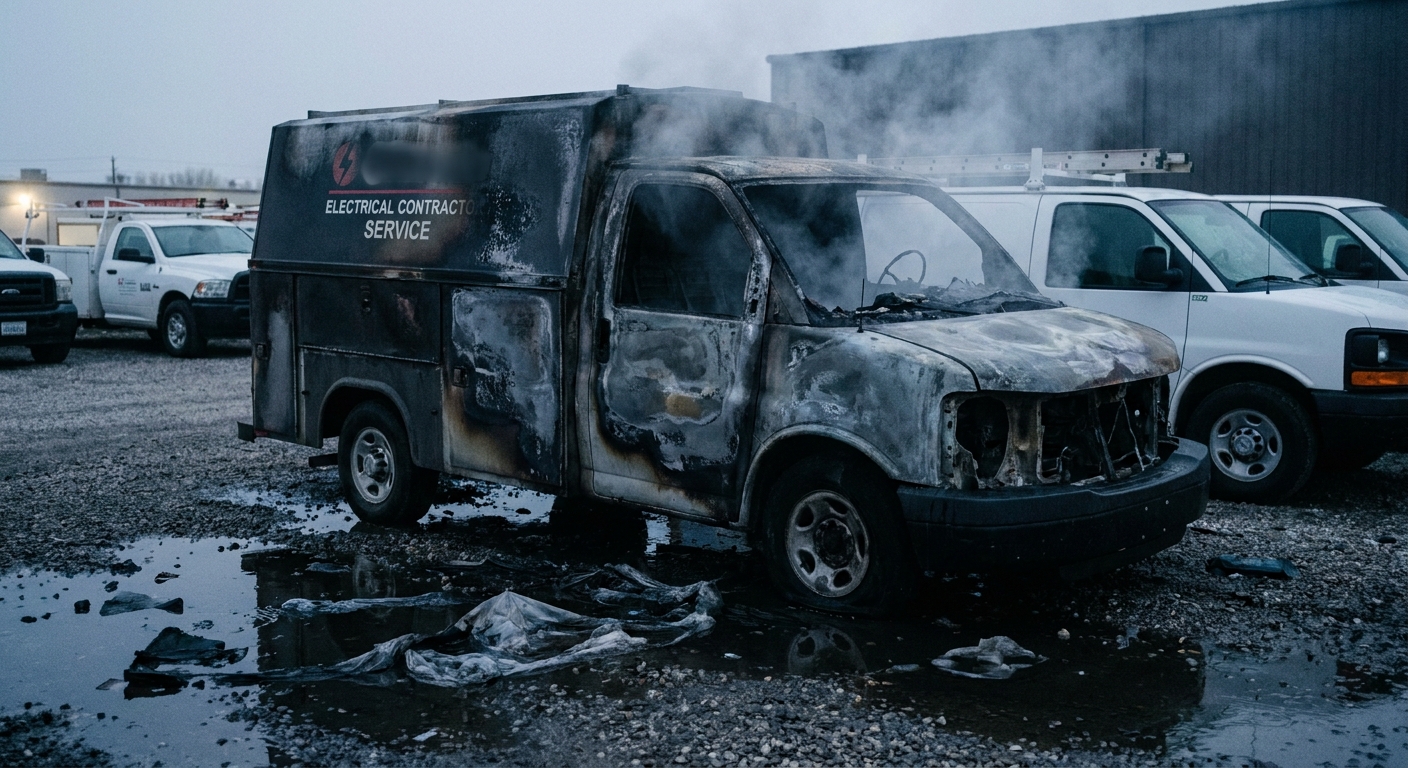
The short answer: In June 2024, a 12-van electrical contractor we work with had a fully-loaded Ford Transit catch fire from a lithium-ion battery thermal runaway in the cargo area while parked overnight at a job site. The van and everything inside it were total losses. The total claim came to $87,400 across four separate policies: the Business Auto Policy paid $34,200 for the van itself, the Inland Marine policy paid $43,100 for the tools and equipment, the BOP paid $4,800 in business-income coverage for the two weeks the contractor was down a van, and the General Liability policy paid $5,300 for the customer's driveway repair where the fire damaged the asphalt. The gap that bit the contractor: he had $25,000 in inland marine when he needed $45,000, and the $18,000 difference came out of his pocket. The whole event is a real-world demonstration of why fleet electricians need the program structure described in our pillar guide — and why each policy matters individually.
The setup
The contractor — we'll call him Mike, because the real one asked us not to use his name — runs a 12-van residential-and-light-commercial electrical service company in Fairfield County, Connecticut. About $3.8M in annual revenue, six journeymen, four apprentices, two service managers, and Mike himself still on the truck a couple of days a week. NCCI WC class 5190. Clean five-year loss history before this. Carrier package was at Travelers Construction (BOP + BAP + WC + Umbrella) with the Inland Marine endorsement attached to the BOP.
His vans are 2022–2024 Ford Transit 250 medium-roofs with Ranger Design buildouts. Each one carries roughly $35,000–$45,000 of tools, meters, cordless platforms, conduit benders, and rolling consumable stock. He'd been quoted an inland marine blanket of $50K per van by us during the prior renewal; he chose $25K per van to save $480/year in premium. We documented the recommendation; he initialed the decline. Standard stuff.
The incident
On a Wednesday in mid-June 2024, one of his journeymen finished a service call at a single-family residence in Westport around 6 PM, parked the van in the customer's driveway with permission, and went home for the night. The plan was to return at 7 AM the next morning to finish the panel-upgrade work.
At approximately 2:47 AM, the customer woke up to a glow outside. The van's cargo area was on fire. Fire department arrived in 8 minutes. By the time they had it out, the van was a total loss, the tools inside were destroyed, and a 12-foot section of the customer's asphalt driveway directly under the van was melted and cracked from the heat.
Cause of fire, per the post-incident investigation: thermal runaway in a single M18 lithium-ion battery stored on the upper shelf of the van. The battery had been damaged a few weeks earlier (visible casing crack), the journeyman had set it aside but never disposed of it properly, and the internal short eventually caught fire. The battery touched off a stored container of brake-cleaner aerosols nearby, which became a small accelerant, and the fire was off to the races.
The phone call
Mike called us at 6:30 AM, after the police and fire reports were done. The conversation was about 20 minutes:
- FNOL the auto claim with Travelers immediately — the van itself, full physical damage, comp loss (fire is comp, not collision).
- FNOL the inland marine claim — the tools and equipment that burned with the van.
- FNOL the GL claim — the customer's driveway damage. Even though the fire was inside Mike's van and not directly caused by his work, the property damage at the customer's home implicates GL.
- Decide on business-income — Mike was now down a van and a journeyman's tools for at least a week. The BOP business-income coverage could pay for the lost revenue if the downtime extended past the waiting period.
- Document everything — photos, the fire report, the police report, the journeyman's statement.
We filed all three claims that morning. Adjusters were assigned within 24 hours.
What each policy paid
Business Auto Policy — the van itself: $34,200
The 2023 Ford Transit 250 medium-roof had been purchased new for $48,500 in late 2022. It had 47,000 miles on it. Mike carried actual cash value physical damage — not stated value, not agreed value. The Travelers adjuster ran the local market comps for a 2023 Transit with similar mileage and condition, and the settlement came in at $34,200.
Gap: If Mike had carried agreed value (or stated amount) at $42,000, the settlement would have been $42,000 instead of $34,200. ACV settlements always feel like a gut punch — the depreciation is real, but it's still hard to replace a van with $34K when the new ones are $52K. Lesson: on vans under 4 years old, the agreed-value endorsement is worth the small extra premium.
Inland Marine — the tools: $43,100 settled, $25,000 paid
This is the bad one. The actual tool inventory in that van, replacement-cost valued, came in at $43,100. Mike's per-van inland marine limit was $25,000. The policy paid $25,000 and the remaining $18,100 came out of Mike's pocket.
What was in the van:
- Full M18 Milwaukee cordless platform (drills, impacts, M18 Force Logic press, batteries, chargers): $6,800
- Greenlee 555DX hydraulic bender: $2,400
- Greenlee Ultra Tugger cable puller: $3,200
- Fluke 1587 megohmmeter + Fluke 87V multimeter + clamp meters: $2,900
- FLIR E60 thermal camera: $4,500
- Klein and Ideal hand tools (insulated set): $3,100
- Rolling stock (THHN, MC cable, breakers, devices, fittings): $4,200
- Two extension ladders + A-frame: $1,400
- Ranger Design buildout (shelving, partition, drawers): $6,400
- Generator + work lights: $1,700
- Misc consumables, fish tape, drain rods, accessories: $2,500
- Journeyman's personal Klein tools (separate claim line under employees' tools extension): $4,000
Total: $43,100. Inland marine limit: $25,000. Out-of-pocket: $18,100.
Lesson: Mike saved $480/year by choosing the lower limit. After three years of "savings" totaling $1,440, the under-coverage cost him $18,100. The annual premium difference to carry the right limit was a rounding error compared to the gap. This is the single most expensive line in the whole claim, and it was entirely preventable. We cover this in depth in Tools, Equipment & Inland Marine: How Electrical Contractors Should Cover the $40K Inside Every Van.
General Liability — the customer's driveway: $5,300
The customer's asphalt driveway had a 12-foot section severely heat-damaged and cracked. The asphalt contractor's repair estimate came in at $5,300. Travelers GL paid the claim under property damage liability — the customer's property damage was a direct consequence of Mike's vehicle (and stored materials) being on the premises.
There was a brief moment where the adjuster wanted to question whether the damaged battery being on the truck constituted "faulty workmanship" (which has GL implications), but our broker advocacy and the fire investigator's report made clear the cause was an accidental thermal event, not negligent work. Claim paid clean.
Lesson: A van fire at a customer's property is not just an auto claim. The GL exposure for property damage at the third-party site is real and often missed in the first FNOL phone call.
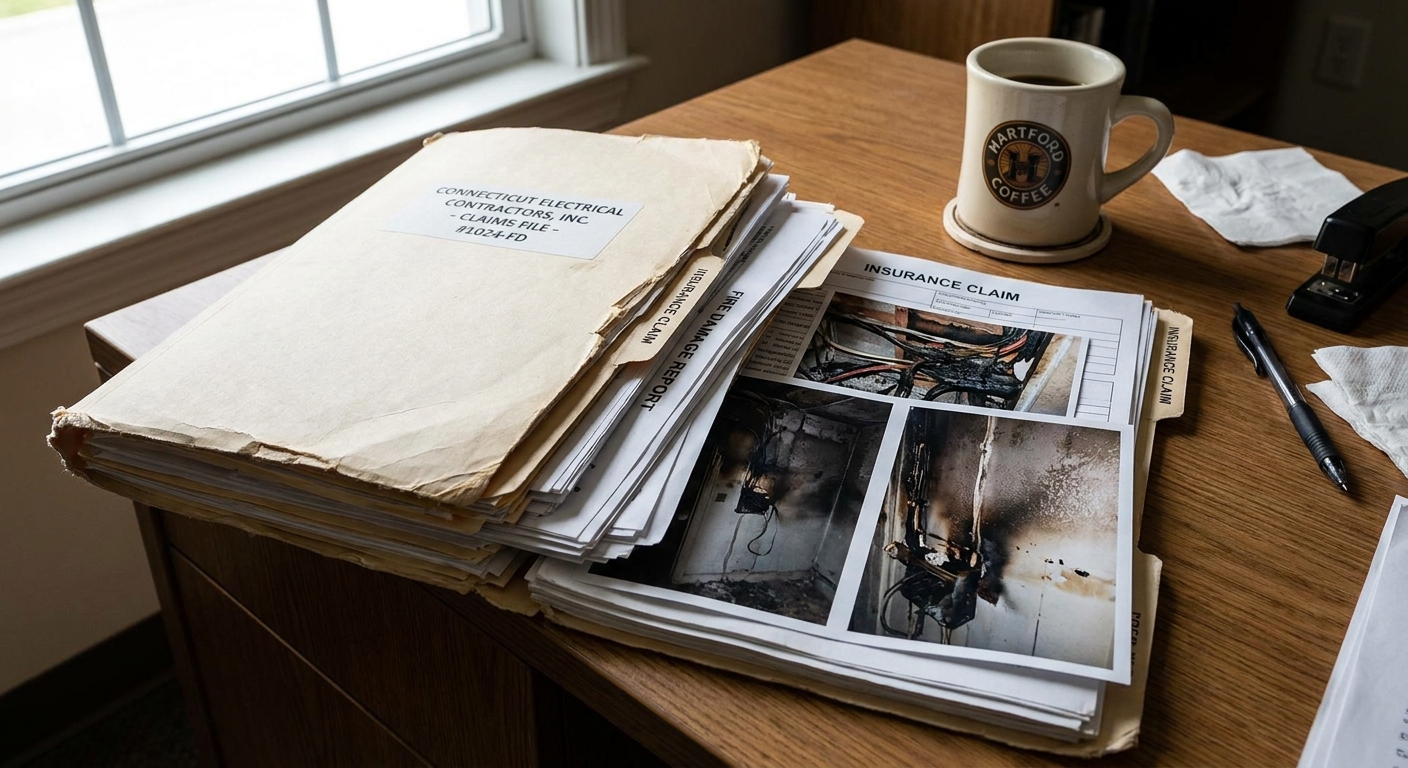
Business Income (BOP) — lost revenue: $4,800
Mike was down a van and a journeyman's full tool kit for 11 business days while the replacement van was sourced and outfitted. The journeyman was deployed as a helper on another truck for 4 of those days, but his typical revenue contribution (he averaged $4,400/week in billable work) was disrupted.
The BOP business-income extension paid $4,800 after the 72-hour waiting period — about half of the gross revenue disruption, netted for the helper-deployment offset. Not a windfall, but a real recovery of cash flow.
Lesson: Many electrical contractors don't realize their BOP has business-income coverage, or they think of it only as "if the shop burns down." It also applies when a major income-producing asset (a van + journeyman's gear) is taken out of service. Always claim it.
What didn't pay (and why)
- Workers' Comp — nobody was hurt. No WC claim filed. If the journeyman had been near the van when it ignited, this could have been a very different conversation.
- Umbrella — none of the underlying claims breached the $1M GL limit (the driveway was $5,300, well under), so the umbrella never engaged. It was there if needed.
- Lost productivity beyond the BI window — for the first 72 hours of the loss, before the BI waiting period elapsed, there's no coverage. That's a deductible-like feature of every BI policy.
- Diminished value on the van — N/A because the van was a total loss. If it had been a partial loss, Connecticut law would let Mike pursue diminished value, but that wasn't relevant here.
The renewal aftermath
What happened at the next renewal, four months later?
- BAP rate: increased 11%. Travelers' actuarial team treated the comp loss as a moderate-severity event. Not catastrophic, but not free.
- Inland marine: Mike re-set the per-van limit to $60,000 across all 12 vans. Premium increased $4,100 annually. He paid it without argument.
- GL: minimal impact — the $5,300 claim was small enough not to materially affect the rate.
- BOP business income: Mike increased the BI limit and reduced the waiting period from 72 hours to 24 hours. Modest premium add.
- WC: unaffected.
- Loss-control consultation: Travelers' risk-control team scheduled a free visit. Came out, audited his battery-storage and aerosol-storage practices across all 12 vans, identified three other vans with damaged batteries that hadn't been disposed of, and produced a written best-practices manual that Mike implemented immediately.
Total renewal premium increase across the program: roughly 14%. Without the rate hardening, it would have been roughly +4% market trend. Net impact of the claim on Mike's program: about $7,800/year for three years before the loss falls off the experience rating window. Total carry cost of the loss event over three years: ~$23,400 in increased premium plus the $18,100 inland marine gap = $41,500 in net pocket cost from a single overnight fire.
What this case study actually teaches
- Inland marine limits matter more than BAP limits. Mike's BAP was correctly sized. His IM limit was 40% short. The gap cost him $18,100 — more than two years of his entire commercial auto premium.
- One incident touches four policies. If any one of BAP, IM, BOP-BI, or GL had been missing or thin, the recovery would have been materially worse.
- Agreed value beats ACV on newer vans. The $7,800 ACV-vs-agreed-value gap on the van itself was a second pocket cost that the right endorsement would have eliminated.
- Documented battery handling is a real risk-control measure. Travelers responded to a clean post-loss remediation by stabilizing the rate. A contractor with no documented response would have faced a much harder renewal.
- The right broker FNOLs all four claims on day one. A contractor who'd called the carrier directly might have filed only the auto claim and missed the IM, GL, and BI claims. The broker's role at FNOL is to identify every policy that should engage.
Beyond insurance: the business-continuity layer
One additional point worth making — and the reason we built our cousin site WealthAmerica.com alongside iConn Insurance Solutions. Mike's claim was recoverable because he had four policies and a broker who knew how to use them. But what if the fire had been worse? What if the journeyman had been inside the van? What if Mike himself had been the one taking the call to a hospital instead of a fire department?
Insurance covers property and liability. It doesn't cover continuity of the business if the owner is incapacitated or worse. That's a different conversation — key-person life insurance, buy-sell funding, disability income for owner-operators, and succession planning. For an electrical contractor where the owner is the rainmaker and the bank's primary guarantor, the continuity layer is at least as important as the property layer.
If you want to think about the continuity side — what happens to the business, the family, and the employees if the owner is out for 6 months or permanently — that's the conversation we have on the wealth side. WealthAmerica.com is built for it.
Frequently Asked Questions
Does commercial auto insurance cover a vehicle fire?
Yes. Fire is covered under comprehensive (sometimes called "other than collision") on a Business Auto Policy. The settlement is paid at actual cash value or agreed value depending on the endorsements on the policy.
Does my BAP cover the tools that were inside the van when it burned?
No. The BAP covers the vehicle. Tools and equipment inside the vehicle are covered under a separate Inland Marine policy or endorsement. This is the single most common coverage gap in electrical contractor claims.
Can a customer file a property damage claim against me if my van damages their driveway?
Yes. Your commercial General Liability policy responds to third-party property damage your operations or vehicles cause at a customer's site — even when the cause is an accidental fire rather than negligent work.
What's the difference between actual cash value and agreed value on a commercial vehicle?
ACV pays the depreciated market value of the vehicle at the time of loss. Agreed value pays a pre-determined amount stated in the policy regardless of depreciation. On vans under 4 years old with significant outfitting, agreed value is materially better and worth the small extra premium.
Will my insurance rates go up after a single van fire?
Probably, by 5–15% on the affected lines for 2–3 years before the loss falls off the experience rating window. Documented post-loss remediation (better safety practices, broker-facilitated risk-control consultation) can soften the renewal materially.
How fast can a service van be replaced after a total loss?
For a clean total-loss settlement at Travelers, expect a check in 10–18 days after claim filing. Sourcing and outfitting a replacement Transit takes another 1–4 weeks depending on dealer inventory and your shelving installer's queue. Total downtime is usually 3–6 weeks.
The bottom line
This was a survivable claim. Mike still has a 12-van business, his journeyman wasn't hurt, his relationship with Travelers stayed intact, and his program at renewal was rebuilt properly. But the $18,100 inland marine gap and the $7,800 ACV-vs-agreed-value gap together cost him $25,900 in pocket money that better coverage construction would have eliminated. That's the whole point of having a real broker conversation before something burns down — not after.
If you're an electrical contractor with a fleet and you've never actually walked through what each of your policies would pay in a real scenario, that's the conversation worth having. Contact iConn Insurance Solutions and we'll spend an hour pressure-testing your program against the kind of event that happened to Mike. Better to find the gaps now than at 6:30 AM after a phone call from a journeyman.
Contenido relacionado
AI Payment Fraud Incident Response: What to Do First
The first hour after a fraudulent wire can decide whether funds are frozen or lost. Follow this practical response guide for banks, insurers, evidence, law enforcement, and recovery.
Leer artículo →
Hotel and Commercial Property Insurance: Where Should Renewal Savings Go?
A practical guide for hotel and commercial-property owners deciding whether to keep renewal savings, lower deductibles, increase limits or restore coverage.
Leer artículo →AI Fraud Insurance Exclusions: Where Coverage Can Break
A large cyber limit can hide a small social engineering sublimit. Learn how voluntary-transfer language, verification conditions, and overlapping crime coverage can affect AI fraud claims.
Leer artículo →
Connecticut Builders Risk Insurance: 2026 Buyer’s Guide
Connecticut builders risk buyers should update project values, timelines and controls. Learn what to prepare and compare for a 2026 placement.
Leer artículo →