
Earned Premium Explained: What Every Small Business Owner Needs to Know About Insurance Policies

Understanding your insurance premiums starts with knowing how they're earned over time.
Earned premium is the portion of an insurance premium that an insurer has "earned" by providing coverage over a specific period. For small and mid-size businesses, understanding how earned premium works is essential for managing cash flow, budgeting for renewals, and making smarter decisions about your commercial insurance program.
If you own or manage a small to mid-size business, chances are you pay insurance premiums every year without thinking much about how those payments actually work behind the scenes. You write the check, your coverage kicks in, and life moves on.
But here's what many business owners don't realize: the premium you pay upfront isn't fully "earned" by your insurer the moment you hand it over. It's earned gradually, day by day, as your policy provides coverage. This concept — called earned premium — has real implications for your business, from how refunds are calculated if you cancel a policy to how insurers determine your rates at renewal time.
In this guide, we'll break down everything you need to know about earned premium and insurance policies in plain, jargon-free language that actually makes sense for business owners.
What Is an Insurance Premium and How Does It Work?
Before we dive into earned premium, let's start with the basics. An insurance premium is the total amount of money you pay to an insurance company in exchange for coverage over a specific period — usually 6 or 12 months. Think of it as the price tag on your insurance policy.
For a small business, this could include premiums for:
- General liability insurance — protects against third-party claims of bodily injury or property damage
- Commercial property insurance — covers your business property, equipment, and inventory
- Workers' compensation — covers employee injuries and illnesses on the job
- Business owner's policy (BOP) — bundles general liability and property coverage
- Professional liability (E&O) — protects against claims of negligence or inadequate work
Your premium amount is determined by several factors, including the type and size of your business, your claims history, location, number of employees, and the specific risks associated with your industry.
What Is Earned Premium in Insurance?
Now here's where it gets interesting. When you pay your annual premium — say, $12,000 for a general liability policy — the insurance company doesn't consider that entire amount "earned" the moment you pay. Instead, the premium is earned proportionally as time passes and the insurer fulfills its obligation to cover you.
Your business pays $12,000 for a 12-month general liability policy starting January 1. After 6 months (June 30), the insurer has earned $6,000 — that's half the premium for half the coverage period. The remaining $6,000 is considered unearned premium because the insurer still owes you 6 more months of coverage.
The formula is straightforward:
The Earned Premium Formula
Earned Premium = (Total Premium ÷ Policy Term in Days) × Number of Days Elapsed
Or, more simply: Earned Premium = Total Premium × (Time Elapsed ÷ Total Policy Term)
This might seem like a technical accounting detail, but it directly impacts your business in several practical ways.
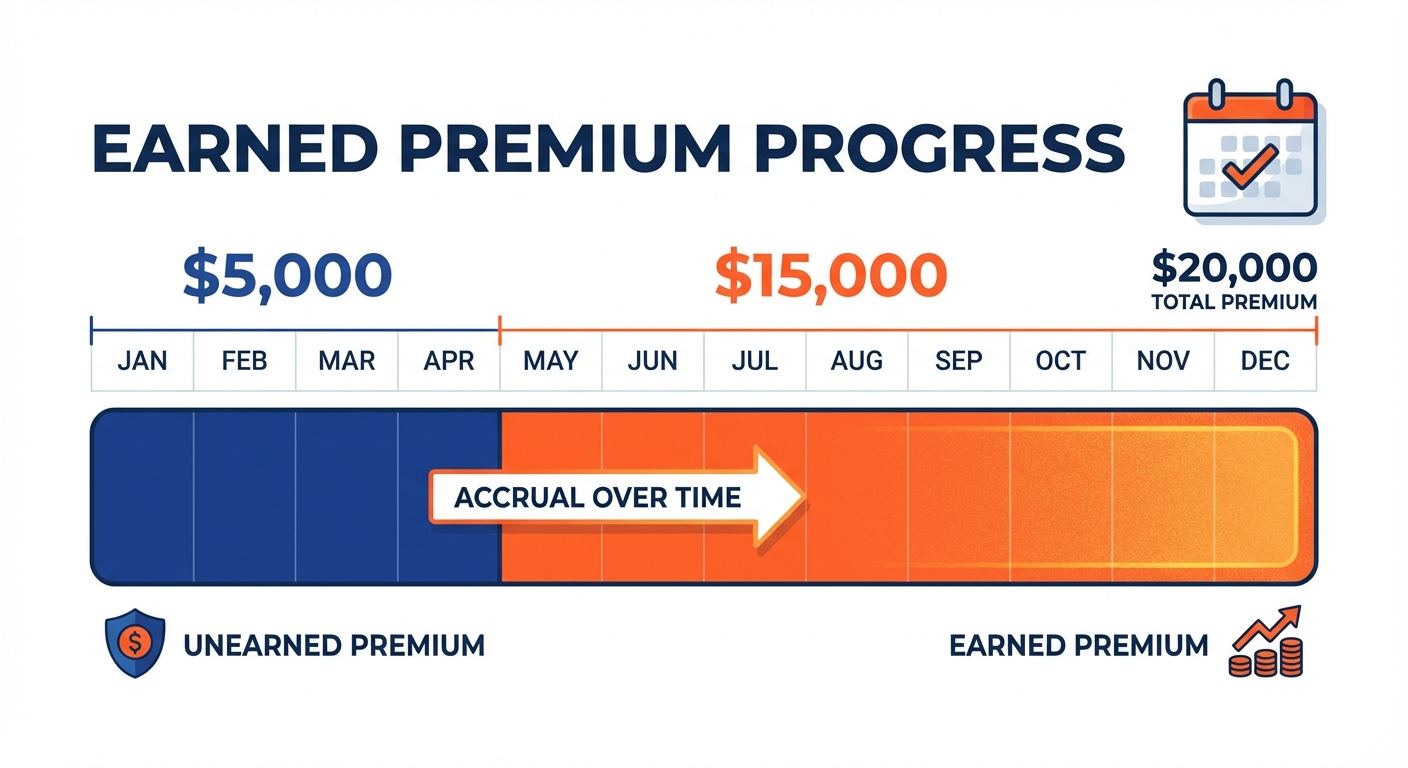
Earned premium accumulates day by day as your insurer provides coverage throughout the policy term.
What Is the Difference Between Earned and Unearned Premium?
These two terms are two sides of the same coin. Understanding both is critical for business owners who want to stay informed about their coverage and finances.
Earned Premium
The portion of the premium the insurer has already earned by providing coverage up to the current date. This money belongs to the insurer — it has been "used" to protect your business.
Unearned Premium
The portion of the premium that covers the remaining time on your policy. If you were to cancel your policy today, the unearned premium is the amount you could potentially receive as a refund.
Important for business owners: If you cancel a policy mid-term, most insurers will refund the unearned premium — but some may apply a short-rate cancellation penalty, meaning you'd get back less than the full unearned amount. Always read your cancellation terms carefully before making changes.
Why Does Earned Premium Matter for Small Businesses?
You might be wondering: "Why should I care about earned premium? I just need my business covered." Fair question. Here are four reasons this concept directly impacts your bottom line:
1. Mid-Term Cancellations and Refunds
If your business circumstances change — perhaps you close a location, sell a division, or switch insurers — understanding earned vs. unearned premium tells you exactly how much refund to expect. Without this knowledge, you might be caught off guard by a refund that's smaller than anticipated.
2. Policy Audits and Premium Adjustments
Many commercial policies, especially workers' compensation and general liability, are subject to year-end audits. Your initial premium is based on estimated payroll or revenue, but the final premium is calculated using actual figures. The earned premium concept determines whether you owe additional premium or receive a return.
3. Cash Flow Planning
When budgeting for insurance costs, understanding that premiums are earned over time helps you align your insurance expenses with your accounting periods. If you pay annually upfront, the expense is recognized gradually on your books — matching the way the insurer earns it.
4. Comparing Quotes and Negotiating Renewals
When shopping for insurance or negotiating a renewal, understanding how earned premium is calculated gives you leverage. You can ask informed questions about rate calculations, loss ratios (which are based on earned premium), and how your claims history influences your pricing.
How Is Earned Premium Calculated?
While the basic concept is simple — premium earned proportionally over time — there are a few nuances every business owner should know.
Pro-Rata Calculation
The most common method is pro-rata, which divides the premium evenly across the policy period. If your 12-month premium is $12,000, each day of coverage costs approximately $32.88. After 90 days, you've earned $2,959 in premium.
Short-Rate Calculation
Some policies use a short-rate method when a policyholder initiates a cancellation. This applies a penalty — typically 10% — meaning the insurer retains a larger portion of the premium. Short-rate calculations protect insurers from the administrative costs of processing short-term policies.
Your $12,000 policy is canceled after 3 months. Under pro-rata, you'd receive a $9,000 refund. Under short-rate (with 10% penalty), the refund drops to approximately $8,100. That $900 difference is the short-rate penalty.
Exposure-Based Earning
For some commercial lines — particularly workers' compensation and commercial auto — premium can be earned based on actual exposure (like payroll dollars or miles driven) rather than time alone. This is why auditable policies might have significant adjustments at year-end.
How Do Loss Ratios and Earned Premium Affect Your Insurance Rates?
Insurance companies use a metric called the loss ratio to measure profitability — and it's built directly on earned premium.
The Loss Ratio Formula
Loss Ratio = (Claims Paid + Reserves) ÷ Earned Premium × 100
A loss ratio of 60% means that for every dollar of earned premium, the insurer pays out 60 cents in claims.
Why this matters to you: Your individual loss ratio — your claims compared to your earned premium — is one of the biggest factors in your renewal pricing. A high loss ratio signals to insurers that you're a higher risk, which usually means higher premiums. A low loss ratio can earn you discounts and more favorable terms.
Here's a practical takeaway: if your business pays $20,000 in annual premium and files $15,000 in claims, your loss ratio is 75%. That's considered high. Keeping claims low relative to your earned premium is one of the most effective ways to control insurance costs over time.
How to Lower Your Insurance Premiums as a Small Business

Proactive risk management is the most effective way to keep your insurance premiums in check.
Understanding earned premium gives you a foundation. Here's how to use that knowledge to save money and manage risk more effectively:
- Review your policies before renewal. Don't auto-renew. Look at your earned premium, loss ratio, and claims history. Use this data to negotiate or shop for better rates.
- Understand your audit exposure. If you have auditable policies (workers' comp, GL based on revenue), track your actual payroll and revenue throughout the year so you're not hit with a surprise additional premium at audit time.
- Time your cancellations wisely. If you need to switch carriers, try to do it at renewal time to avoid short-rate penalties. If mid-term cancellation is unavoidable, ask if a pro-rata refund is available.
- Invest in risk management. Implement safety programs, train employees, and maintain your property. Fewer claims mean a lower loss ratio, which translates directly to lower premiums over time.
- Work with an independent agent. An experienced commercial insurance agent can help you understand your earned premium breakdown, compare quotes across multiple carriers, and find coverage that's tailored to your business needs.
- Consider payment plans carefully. Paying annually often saves money (no installment fees), but monthly payments can be easier on cash flow. Understand that regardless of how you pay, the premium is earned the same way.
What Insurance Policies Does a Small Business Need?
Now that you understand how premiums work and how they're earned, here's a quick overview of the key insurance policies your business likely needs — and how earned premium applies to each:
General Liability Insurance
Protects against claims of bodily injury, property damage, and advertising injury. Premium is typically earned pro-rata over the policy term. Many policies are auditable based on revenue or square footage.
Workers' Compensation Insurance
Required in most states for businesses with employees. Premium is based on payroll and job classification codes. This is one of the most commonly audited policies — your final earned premium may differ significantly from your estimated premium.
Commercial Property Insurance
Covers your building, equipment, inventory, and furniture. Premium is earned pro-rata and is typically based on the replacement value of your assets and your location's risk profile.
Business Owner's Policy (BOP)
Combines general liability and property coverage at a discounted rate. Ideal for small businesses. The earned premium applies to the entire bundled premium.
Professional Liability (Errors & Omissions)
Protects service-based businesses against claims of negligence or failure to deliver promised services. These policies are often "claims-made," meaning the earned premium calculation can differ from standard occurrence-based policies.
Key Takeaways
- Earned premium is the portion of your insurance payment that the insurer has earned by providing coverage over time — it's not all earned on day one
- Unearned premium is the remaining balance that covers future coverage and may be refundable if you cancel
- Understanding loss ratios — claims relative to earned premium — helps you negotiate better renewal rates
- Always check whether cancellations are pro-rata or short-rate to avoid unexpected penalties
- Auditable policies like workers' comp can result in additional premium or refunds based on actual exposure
- Investing in risk management and safety programs is the most effective way to lower your premiums long-term
Need help understanding your business insurance? Whether you're reviewing an upcoming renewal, dealing with a policy audit, or shopping for better rates, our team at Insure Connecticut can walk you through your earned premium, loss ratio, and coverage options — at no cost. Reach out today for a free commercial insurance review.
Frequently Asked Questions About Earned Premium
What happens to my earned premium if I cancel my policy early?
When you cancel a policy mid-term, the insurer keeps the earned premium (the portion covering the time you were insured) and refunds the unearned premium. However, if you initiate the cancellation, some insurers apply a short-rate penalty that reduces your refund. If the insurer cancels the policy, you'll typically receive a full pro-rata refund of the unearned premium.
What is the difference between earned premium and written premium?
Written premium is the total premium charged when a policy is issued or renewed — it's the full amount on your declarations page. Earned premium is the portion of that written premium that has been "used up" by providing coverage. On day one, your written premium might be $12,000 but your earned premium is $0. By year-end, they're equal.
Can earned premium change during an active insurance policy?
Yes. If you make mid-term changes to your policy — such as adding a new location, increasing coverage limits, or adding vehicles — your total premium changes, and the earned premium is recalculated accordingly. Policy endorsements can increase or decrease your overall premium.
Why do I owe additional premium after a workers' compensation audit?
Workers' compensation policies are based on estimated payroll at the start of the term. At year-end, an audit compares your actual payroll to the estimate. If your actual payroll was higher, more premium was earned than originally charged, so you owe the difference. If payroll was lower, you receive a refund.
How does earned premium affect insurance renewal pricing?
Insurers look at your loss ratio — total claims divided by earned premium — when setting renewal rates. A lower loss ratio indicates fewer claims relative to what you paid, making you a more attractive risk. This can lead to lower premiums or better coverage terms at renewal.
What is the best way for a small business to lower insurance premiums?
Focus on risk management: implement workplace safety programs, maintain your property, train employees on proper procedures, and address hazards promptly. A strong claims history lowers your loss ratio, which directly impacts your premiums. Additionally, work with an independent agent who can shop multiple carriers, bundle policies for discounts, and review your coverage annually to eliminate gaps or redundancies.
Is earned premium the same across all types of insurance policies?
The concept is the same, but the calculation method can vary. Most policies earn premium on a pro-rata (time-based) method. However, auditable policies like workers' compensation and some general liability policies earn premium based on actual exposure (payroll, revenue, etc.). Claims-made policies like professional liability may also have unique earning patterns.
Related Content
AI Payment Fraud Incident Response: What to Do First
The first hour after a fraudulent wire can decide whether funds are frozen or lost. Follow this practical response guide for banks, insurers, evidence, law enforcement, and recovery.
Read post →
Hotel and Commercial Property Insurance: Where Should Renewal Savings Go?
A practical guide for hotel and commercial-property owners deciding whether to keep renewal savings, lower deductibles, increase limits or restore coverage.
Read post →AI Fraud Insurance Exclusions: Where Coverage Can Break
A large cyber limit can hide a small social engineering sublimit. Learn how voluntary-transfer language, verification conditions, and overlapping crime coverage can affect AI fraud claims.
Read post →
Connecticut Builders Risk Insurance: 2026 Buyer’s Guide
Connecticut builders risk buyers should update project values, timelines and controls. Learn what to prepare and compare for a 2026 placement.
Read post →