
Living Plant & Stock Throughput Coverage: The Cannabis Property Endorsements No Standard Form Includes

Living Plant & Stock Throughput: The Cannabis Property Endorsements No Standard Policy Includes
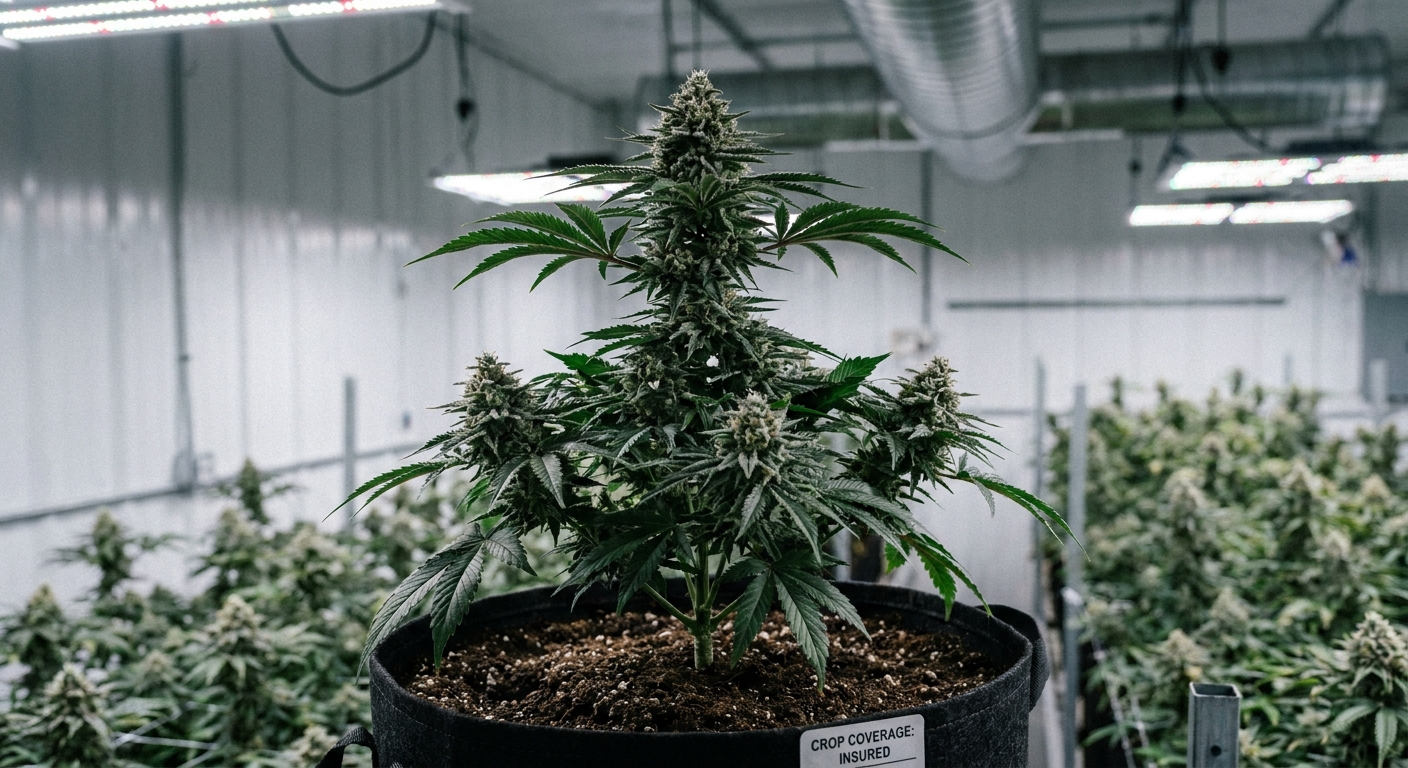
The short answer: A standard commercial property policy excludes living plants in soil and treats finished cannabis inventory as "stock" with sub-limits that don't reflect its true value. To insure a Connecticut cannabis cultivation or manufacturing operation properly, you need two specialty endorsements — Living Plant coverage for plants in vegetative and flowering stages, and Stock Throughput for inventory in any form, anywhere along the supply chain. Without both, the policy ladder collapses on a single bad night.
When we talk about cannabis property coverage on this blog, we usually focus on the building — the four walls, the roof, the HVAC, the perimeter security. That's the pillar piece every CT landlord and operator reads first. But a building shell isn't what an operator actually has at risk. The money in a cultivation room is in the plants. The money in a manufacturing kitchen is in the finished concentrate. The money in a dispensary back room is in the packaged inventory.
All three of those — the living plant, the work-in-process, the finished good — sit in a coverage gap that no standard commercial property form fills. Filling that gap is the entire job of two endorsements the cannabis specialty market built specifically for this class: Living Plant coverage and Stock Throughput. This post is the deep-dive on both — what they cover, what they exclude, what they cost in Connecticut in 2026, and how we structure them on the carriers we place most of our cannabis property business through.
Why standard property forms don't cover what cannabis operators actually own
Open any ISO commercial property policy (CP 00 10 or CP 00 17) and read the definition of "Covered Property." You'll find "Your Business Personal Property" — furniture, fixtures, machinery, stock. Then look at the exclusions. Three of them quietly delete most of what a cannabis operator owns:
- The "growing crops" exclusion — Standard property forms exclude "growing crops" and "land (including land on which the property is located)." Cannabis plants in flower are growing crops. They're excluded by default.
- The "controlled substances" exclusion — Most carriers added this in 2014 specifically to keep cannabis out of standard programs. It excludes any property "the production, sale, or use of which is prohibited or controlled" under federal law. Cannabis is federally Schedule I. Excluded.
- Stock sub-limits — Even when finished inventory isn't excluded, it's usually capped. A standard policy might write $250K of business personal property and quietly sub-limit "stock" to $50K. A 20,000-square-foot manufacturer can have $2M+ of inventory on a Friday night.
This is why a standard policy on a building with a cannabis tenant gets voided — or never covered the contents in the first place. The specialty endorsements below were built to put the missing pieces back.
Endorsement #1: Living Plant Coverage
"Living Plant" coverage (sometimes called "Crop in Process" or "Plants in Cultivation") insures the value of cannabis plants from clone to harvest, regardless of growth stage. It's the single most expensive piece of a cannabis cultivator's property tower and the one most operators dramatically under-schedule.
What it covers
- Mother plants — the genetic library a cultivator keeps in permanent vegetation
- Clones & seedlings — the youngest plants, valued at a per-cutting basis
- Vegetative plants — plants in pre-flower growth, typically 4–8 weeks old
- Flowering plants — plants in the bud-production stage, weeks 1–9 of flower, where 80% of the value sits
- Plants in drying or curing — post-harvest but pre-trim, still living tissue from a policy standpoint
How it's valued
This is where most operators get burned. Living Plant coverage is written on one of three valuation bases, and they produce wildly different claim payouts:
| Valuation Basis | What It Pays | Typical Carriers |
|---|---|---|
| Cost of Production | Direct cost of seed/clone, nutrients, labor, electricity allocated to that plant — no profit margin | Lancer, Continental Heritage (default) |
| Replacement Cost (Plant) | What it would cost to buy a comparable replacement clone or seedling — does NOT pay for lost flowering time | Atain, some Admiral forms |
| Selling Price (less expenses) | Estimated wholesale value at harvest, less expenses still to be incurred — best operator economics, hardest to get bound | CannGen (with appraisal), Golden Bear (limited) |
A 1,000-plant flowering crop valued at "cost of production" might pay $80,000 after a fire. The same crop valued at "selling price less expenses" might pay $450,000. The premium difference between those two bases is typically 30–60%, but the recovery difference is 5x.
What's excluded inside Living Plant coverage
Even when the endorsement is in place, carriers carve back specific causes of loss. Most cannabis Living Plant forms exclude:
- Power outage not caused by physical damage — A utility failure with no underlying covered cause (storm damage to lines, transformer fire) will void the plant claim. You need Service Interruption as a separate endorsement to bridge this.
- Mold, mildew, and microbial contamination — Carriers will not pay for a botrytis or powdery-mildew outbreak. This is treated as a maintenance failure, not a covered peril.
- Theft of plants from outdoor or unsecured areas — If your grow rooms aren't behind locked alarm-monitored doors with surveillance per the carrier's security warranty, theft is excluded.
- Regulatory destruction — If the Department of Consumer Protection orders a batch destroyed due to a compliance failure, that's not a covered loss.
What Living Plant coverage costs in Connecticut, 2026
Premium varies more by canopy size and security than by plant count. As of Q2 2026, the CT cannabis market is paying roughly:
- Micro-cultivator (under 7,500 sq ft canopy) — $8,000–$15,000 annual for $500K of Living Plant limit
- Standard cultivator (7,500–25,000 sq ft) — $18,000–$42,000 for $1M–$2.5M of limit
- Large cultivator (25,000+ sq ft) — $45,000–$110,000 for $3M–$8M of limit
Those numbers assume the operator passes the security and environmental-controls warranty. Operators with weak monitoring, no redundant HVAC, or prior loss history are paying 25–60% more — and a couple of carriers won't quote them at all.
Endorsement #2: Stock Throughput Coverage

If Living Plant covers what's still in the ground, Stock Throughput covers everything after harvest. It's a single coverage form that follows your inventory from the moment plants are cut down through trimming, drying, curing, processing, packaging, storage, and transit to a wholesale buyer or your own retail dispensary.
Why this matters more than a standard "stock" line item
Standard commercial property treats "stock" as a single bucket sitting at one location. Stock Throughput recognizes how cannabis actually moves:
- Plants get harvested in the grow room
- Wet flower moves to a drying room (different value, different fire risk)
- Dried flower moves to a curing room (now valued as raw biomass)
- Biomass moves to extraction (massive value compression — 50 lbs of biomass becomes 5 lbs of concentrate)
- Concentrate moves to manufacturing (now valued as finished product)
- Finished product moves to packaging
- Packaged product sits in vault inventory awaiting transport
- Product moves via licensed transport to a dispensary or wholesale buyer
A Stock Throughput policy covers the value of inventory at every stage and every location, with valuation adjusted at each step. A standard property policy covers stock at a fixed location with a single value — and almost never covers transit.
Specific perils Stock Throughput should cover
- Fire, lightning, smoke damage — the #1 covered peril; nearly every cannabis claim in CT involves these
- Theft from premises — subject to security warranties
- In-transit theft and hijacking — critical for operators self-transporting between cultivation, manufacturing, and retail sites
- Vehicle collision damage to product — your van rolls; the kilo of distillate in the back is also gone
- Refrigeration breakdown — relevant for fresh-frozen biomass and certain edibles
- Water damage from a covered cause — typically sprinkler discharge or pipe burst
The transit piece is what makes this endorsement valuable
Most cannabis losses we see in Connecticut don't happen in the building — they happen between buildings. An armored transport van getting rear-ended on I-91 with $80,000 of product in back. A delivery vehicle stolen from a vendor's parking lot during a wholesale pickup. A finished-goods shipment damaged during loading.
Standard commercial property doesn't cover product the moment it leaves the four walls of the insured premises. Stock Throughput does — typically up to a stated transit sub-limit (often $250K–$1M per shipment, with aggregate annual limits set higher).
What Stock Throughput costs in Connecticut, 2026
- Cultivation/manufacturing combined — $0.75–$1.85 per $100 of average annual inventory value
- Dispensary only (lower transit exposure) — $0.40–$0.95 per $100 of average inventory
- Add for in-transit limit above $250K — typically 10–18% surcharge to base premium
An average mid-size CT cultivator with $1.2M of average inventory across all stages is paying $9,000–$22,000 annually for Stock Throughput. That's on top of Living Plant. For full perspective on what cannabis property and contents coverage runs all-in, see our CT cannabis lessors risk and contents cost breakdown.
How the two endorsements work together on a real CT cultivator
Consider a 20,000 sq ft licensed cultivation/manufacturing site in Stamford with $4M of canopy investment and $1.5M of average finished inventory. The property tower we built for this kind of operator at iConn in 2026 looks like:
| Coverage Component | Limit | Annual Premium |
|---|---|---|
| Building (if owned) — Lessors Risk if leased | $3.5M replacement cost | $22,000–$28,000 |
| Business Personal Property (equipment, FF&E) | $1.2M | $8,500 |
| Living Plant endorsement | $2M (selling price basis) | $38,000 |
| Stock Throughput endorsement | $1.5M (with $500K transit) | $16,500 |
| Service Interruption (utility/HVAC) | $250K | $3,200 |
| Equipment Breakdown | $2M | $4,800 |
| Total property tower | ~$10.5M aggregate | $93,000–$99,000 |
Strip out the two specialty endorsements (Living Plant + Stock Throughput) and the same operator would pay maybe $40,000 — but a single fire in the flower room would generate a covered loss of about $80,000 instead of $3M+. The endorsements aren't optional; they're the entire reason cannabis property insurance exists as a specialty class.
Which carriers write these endorsements in Connecticut, 2026
Not every cannabis-friendly carrier writes both endorsements equally well. From our 2026 broker review of CT cannabis property carriers:
- Lancer Insurance — Strong Living Plant form (cost-of-production default, selling-price available with appraisal). Stock Throughput available as endorsement, in-transit sub-limit $500K standard. Best lender acceptance on the property side.
- Continental Heritage — Solid Living Plant; Stock Throughput written on a separate inland-marine form. Higher transit limits available ($1M+) with additional underwriting.
- Admiral Insurance — Living Plant only at replacement-cost basis (not selling price). Stock Throughput available but with tighter transit warranties (armored vehicle required above $100K).
- CannGen — The most flexible Living Plant valuation in the market — selling price is the default — but requires the most documentation (chain of custody, METRC tag log, prior 12 months of harvest yields).
- Atain Insurance — Living Plant at replacement cost; Stock Throughput limited to $250K transit unless armored. Good for smaller cultivators.
- Golden Bear / Sapphire — Selective on cannabis; Living Plant with sub-limits below $1M; Stock Throughput available but rare. Best as an option-of-last-resort market.
Six warranties that determine whether either endorsement actually pays
Both Living Plant and Stock Throughput coverage come with conditions precedent. If the operator violates any of these on the date of loss, the claim will be reduced or denied:
- Continuous video surveillance on all grow rooms, processing rooms, and inventory storage areas (90-day retention minimum)
- UL-rated commercial vault for finished inventory, locked outside business hours
- Alarm-monitored perimeter and interior with 24/7 central-station monitoring (not self-monitored)
- Two-person rule for inventory access in some forms — especially CannGen and Continental Heritage
- Documented chain of custody via METRC tag log, with daily reconciliation to physical inventory
- Redundant HVAC and environmental monitoring for Living Plant — most carriers require backup capacity within the cultivation room
Every claim denial we've seen in CT cannabis property in 2024–2026 traces back to a warranty failure on this list. Don't accept the policy unless you've read the warranties and you can document compliance with each one.
How to schedule values correctly the first time
The other place operators bleed money is in the initial schedule. Underschedule Living Plant and the carrier pays the underscheduled amount even if you have a partial loss — co-insurance penalties on plant coverage are brutal. Here's how we walk a CT cultivator through the initial value-setting at iConn:
- Pull the 12-month METRC harvest history — what did this operation actually produce? Average wholesale price per pound, multiplied by pounds harvested, gives you a true topline.
- Calculate the peak-inventory point — for most cultivators, this is the week after a major harvest before product moves to wholesale buyers. That number, not the average, sets the Stock Throughput limit.
- Add the in-flower plant value at any given moment — count the flowering plants × value per plant. Most cultivators run 2–4 staggered crops; the limit needs to cover the largest in-flower batch.
- Build in 20% headroom — yields can spike, prices can move, and underscheduling at policy inception means a co-insurance penalty at claim time.
Key Takeaways
- Standard commercial property excludes growing crops and controlled substances — neither living plants nor finished cannabis inventory are covered by default.
- Living Plant coverage insures plants from clone through harvest. Valuation basis (cost of production vs. replacement cost vs. selling price) drives a 3–5x difference in claim payout.
- Stock Throughput coverage follows inventory from harvest through processing, storage, and transit. The transit piece is what catches the losses standard property never sees.
- A mid-size CT cultivator's full property tower runs $93K–$99K annually; pull the two endorsements and the same operator pays $40K but recovers cents on the dollar after a fire.
- Six warranties — surveillance, vault, monitored alarms, two-person access, METRC chain of custody, redundant HVAC — gate whether either endorsement actually pays. Every CT denial we've reviewed traces back to one of them.
- Schedule values from peak inventory, not average, and add 20% headroom to avoid co-insurance penalties at claim time.
Frequently Asked Questions
Can I buy Living Plant coverage without a building policy?
Almost never in Connecticut. The carriers writing Living Plant want to see a complete property tower — building (or lessors risk), business personal property, plants, and stock — placed with them or a partner carrier. Stand-alone Living Plant is technically available through one specialty market but priced 60–80% above bundled.
What's the difference between Stock Throughput and "Stock" on a standard property policy?
A standard "stock" line item covers inventory at a single declared location, at a single declared value, with no transit coverage. Stock Throughput covers inventory at every stage of production, at multiple locations, and in transit between them — with valuation adjusted as the product transforms.
Do I need both endorsements if I only operate a dispensary (no cultivation)?
You need Stock Throughput but not Living Plant. A retail-only dispensary doesn't own plants in cultivation, but it does own substantial finished inventory and often does in-house repackaging or moves product between vault and floor — both situations Stock Throughput is built for.
How does a Living Plant claim actually get paid?
After a covered loss, the carrier sends an adjuster (and sometimes a third-party horticulture expert) to inventory the destroyed plants by stage. They verify against your METRC log, then apply the valuation basis on the policy. Cost-of-production claims close fast — usually 30–60 days. Selling-price claims take longer (90–150 days) because the adjuster has to forecast what those plants would have wholesaled for.
What's the most common reason a Stock Throughput transit claim gets denied?
Failure to follow the carrier's transport warranty. Most policies require a licensed transport vehicle with two staff, GPS tracking, locked compartments, and (above certain limits) an armored vehicle. If the operator self-transports in an unmarked van with one driver, the carrier will use that as the denial basis.
Related Content
AI Payment Fraud Incident Response: What to Do First
The first hour after a fraudulent wire can decide whether funds are frozen or lost. Follow this practical response guide for banks, insurers, evidence, law enforcement, and recovery.
Read post →
Hotel and Commercial Property Insurance: Where Should Renewal Savings Go?
A practical guide for hotel and commercial-property owners deciding whether to keep renewal savings, lower deductibles, increase limits or restore coverage.
Read post →AI Fraud Insurance Exclusions: Where Coverage Can Break
A large cyber limit can hide a small social engineering sublimit. Learn how voluntary-transfer language, verification conditions, and overlapping crime coverage can affect AI fraud claims.
Read post →
Connecticut Builders Risk Insurance: 2026 Buyer’s Guide
Connecticut builders risk buyers should update project values, timelines and controls. Learn what to prepare and compare for a 2026 placement.
Read post →