
A Sewer Backup That Touched 5 Policies: A Real Plumbing Claim Walkthrough
A Sewer Backup That Touched 5 Policies: A Real Plumbing Claim Walkthrough
Short answer: A single sewer backup at a finished residential basement triggered $312,400 in covered claims across five different insurance policies on the plumbing contractor's program: Business Auto (truck damage), Contractor's Pollution Liability (sewer backup + cleanup + bodily injury), General Liability (a separate non-pollution property damage claim), Inland Marine (a damaged jetter), and a Commercial Umbrella (excess limits over the CPL). The plumber's out-of-pocket cost was the deductibles plus one denied claim item — about $12,800 total. Without the CPL and umbrella, the same incident would have cost the plumber roughly $245,000 in self-funded losses.
The Setup
This case study is a composite — the names, addresses, and specific dollar figures have been changed, but the claim pattern, policy responses, and decision points are drawn from real plumbing contractor losses we've seen across the Northeast. If you're a fleet plumber, the scenario will feel familiar.
The plumbing contractor: "Apex Plumbing & Drain," a 14-truck residential and light-commercial plumbing fleet in Hartford County, Connecticut. Annual revenue: $4.2M. Eleven service trucks, two jetter rigs, one supervisor pickup. Class 5183. Twelve years in business, owner-operated.
The insurance program:
- BAP — $1M CSL, all 14 vehicles, written through Federated
- GL — $1M / $2M, written through Federated (pollution buyback endorsement on the GL with $250K sub-limit)
- CPL — $1M / $2M standalone Contractor's Pollution Liability, written through Travelers Construction Specialty (purchased after a smaller backup claim two years prior)
- Inland Marine — $185,000 blanket equipment floater (jetters, cameras, locators, tools)
- Workers' Comp — $1M / $1M / $1M, Federated
- Commercial Umbrella — $5M excess over BAP, GL, CPL, and Employer's Liability, Travelers
The customer: A residential homeowner in West Hartford. 2,800 sq ft colonial, fully finished walk-out basement built in 2019, professionally remodeled in 2022. Estimated basement remodel value: $145,000.
The Job
Tuesday morning. Routine call: customer reports slow drainage in the basement floor drain, intermittent gurgling in the main stack. Apex dispatches a senior tech, Mike, with a service van and one of the two jetter rigs.
Mike arrives at 10:42 AM. Initial inspection: floor drain in the basement is partially backed up; the main 4-inch cast iron sewer cleanout in the basement utility room shows evidence of prior overflow at the gasket. Mike runs a sewer camera down the lateral — visible root intrusion at roughly 47 feet, just past the property line where the lateral connects to a 6-inch clay city main.
Mike calls into the shop, gets authorization for a jetter clean-out, and starts setting up. He notifies the homeowner: "I'm going to jet this — there might be some splash-back. Stay out of the basement for the next 45 minutes."
At 11:18 AM, Mike begins jetting at 1,800 PSI, ramping toward 3,500 PSI to break up the root mass.
What Went Wrong
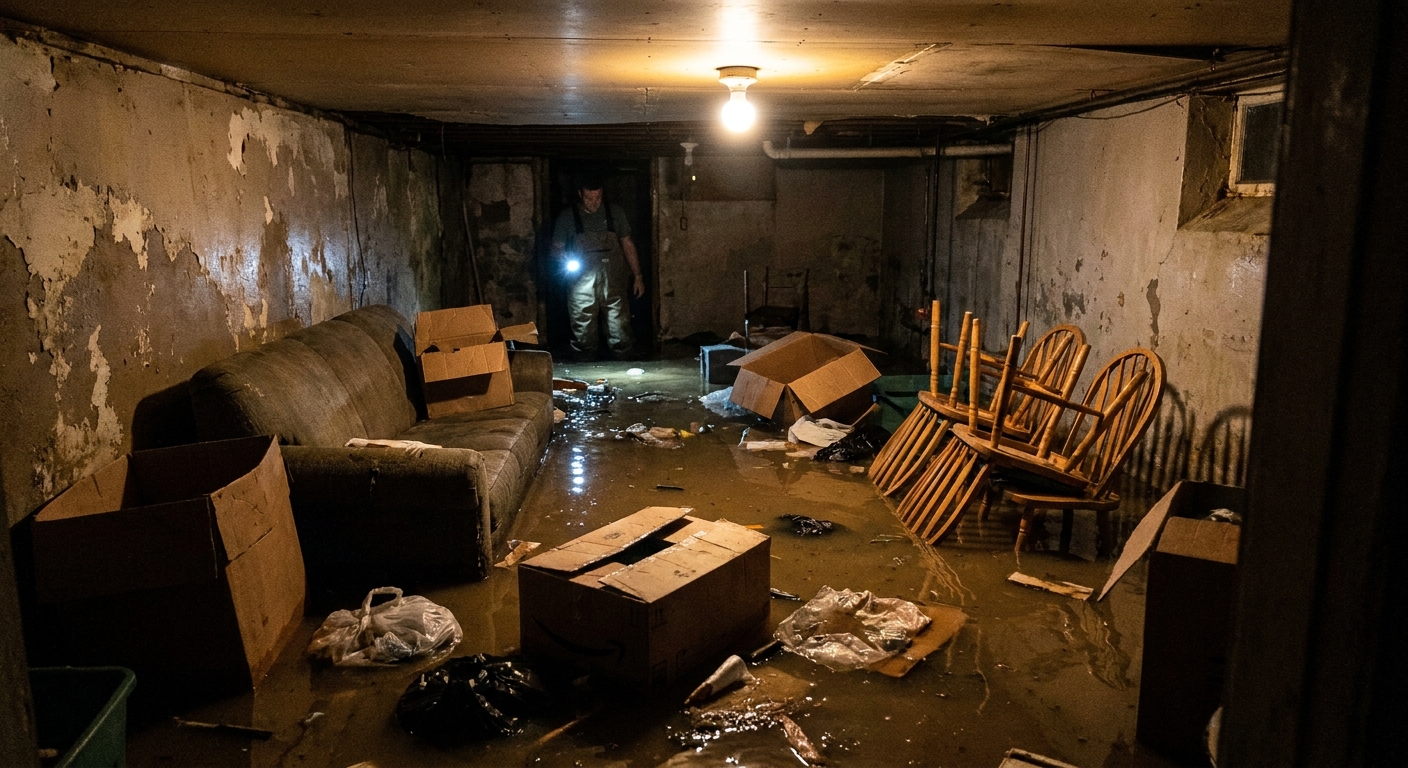
The lateral was in worse shape than the camera revealed. Behind the visible root mass, a 14-foot section of clay pipe had partially collapsed — the camera couldn't navigate past the roots, so Mike didn't see it. When the jetter broke through the roots at 3,200 PSI, the pressurized flow hit the collapsed section, pushed water laterally into the saturated soil around the pipe, and created enough back-pressure to force a column of sewage up the basement floor drain and out the cleanout gasket Mike had been working at.
Within 90 seconds, the basement utility room had 2 inches of sewage on the floor. Within 5 minutes, the sewage had migrated through a partially-open utility room door into the adjacent finished family room, soaking $32,000 worth of engineered hardwood, the bottom 14 inches of the drywall on three walls, the baseboards, two built-in cabinets, and the bottom of a leather sectional. Sewage water also reached two storage areas and ruined approximately $18,000 of customer-owned personal property — books, photographs, a piano, holiday decorations.
Mike shut down the jetter immediately, killed the water at the main, and started extraction with shop vacs. But the damage was done.
While running back to grab additional supplies from the truck at 11:31 AM, Mike — moving fast, distracted — clipped the side of the homeowner's parked Audi with the open driver door of the service van. Minor damage to the Audi, but real damage: a creased driver-side panel, $4,200 in estimated repair.
At 11:34 AM, while pulling the jetter hose back to the truck, the high-pressure swivel on the jetter pump failed catastrophically — likely overstressed by the back-pressure event. The pump head cracked. The jetter unit was now out of service. Repair estimate later returned: $7,800. Replacement jetter package: $42,000.
At 11:47 AM, the homeowner's wife — who had been upstairs the entire time — walked down into the basement to assess and slipped on sewage-coated tile in the family room. Sprained wrist, contusion to her hip. ER visit, X-rays, follow-up with orthopedics. Eventual medical claim: $14,200.
How the Claims Unfolded
Mike called Apex's owner from the driveway at 11:52 AM. The owner called the agent at iConn at 12:08 PM. By 1:00 PM, four separate claim numbers had been opened. Here's how each policy responded.
Claim 1: Business Auto Policy (BAP) — The Audi Side-Swipe
Policy responding: Apex's Federated BAP, third-party property damage liability.
What it paid: $4,200 to repair the customer's Audi.
Deductible: $0 on third-party liability claims.
Apex's cost: $0.
Straightforward. Routine commercial auto claim handled in 14 days. The Federated BAP adjuster cut a check directly to the body shop. The incident was recorded on Apex's loss runs, which contributed to a 3.2% BAP rate bump at the next renewal.
Claim 2: Contractor's Pollution Liability (CPL) — The Sewer Backup Damage
Policy responding: Apex's Travelers Construction Specialty CPL, $1M occurrence / $2M aggregate.
What it paid: $238,400 total across three sub-categories:
- Third-party property damage to the home (drywall, flooring, baseboards, cabinetry, sectional, personal property): $147,300
- Cleanup and remediation (initial extraction, hazmat-rated cleaning, dryout, ozone treatment): $42,600
- Mold remediation 4 months later (mold found in wall cavities behind the rebuilt drywall): $34,300
- Third-party bodily injury (the homeowner's wife — ER + orthopedics + 8 weeks PT + settlement): $14,200
Deductible: $5,000.
Apex's cost: $5,000.
This claim is the entire reason Apex bought the CPL policy two years prior. Without it, every dollar above would have hit either the GL pollution buyback (capped at $250K and woefully insufficient once mold remediation was added) or — more likely — would have been denied entirely under the GL pollution exclusion and become Apex's self-funded loss.
Travelers' CPL adjuster also coordinated the emergency-response cleanup crew, which arrived on-site within 4 hours and prevented the damage from doubling — a significant value-add that most plumbers don't appreciate until they need it.
Claim 3: General Liability (GL) — The Cleanout Gasket Failure
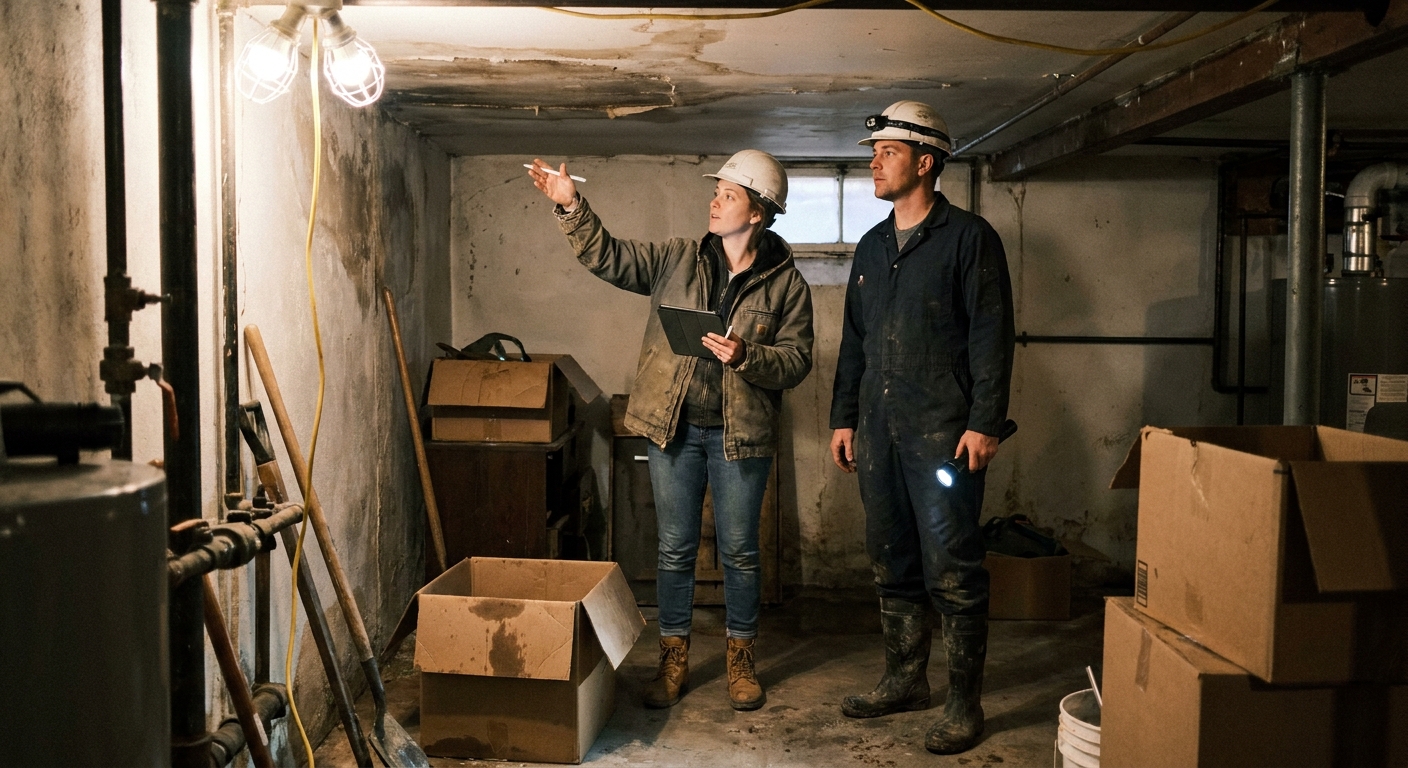
This one is subtle. The homeowner's attorney later argued that the original cleanout gasket — which Mike had been working at when the backup occurred — was damaged by Apex's installation of a replacement cleanout cap the previous year. The argument: the gasket failure (separate from the pollution event) caused additional property damage downstream, specifically water damage to a section of the basement that the pure pollution claim wouldn't have reached.
Policy responding: Apex's Federated GL, $1M / $2M.
What it paid: $11,800 for a small carve-out of non-pollution property damage attributed to defective work product, settled via products-completed-operations coverage.
Deductible: $1,000.
Apex's cost: $1,000.
The GL claim was carved out because the carrier's coverage attorney correctly identified that part of the loss was attributable to the prior work (not the current pollution event). Without the GL, this slice of the claim would have been Apex's responsibility. The two carriers — Federated GL and Travelers CPL — worked the allocation between themselves through standard contribution agreements.
Claim 4: Inland Marine — The Damaged Jetter Pump
Policy responding: Apex's blanket inland marine, $185,000 limit.
What it paid: $7,800 to repair the damaged jetter pump head (Apex elected repair over replacement since the rest of the unit was less than 3 years old).
Deductible: $1,000.
Apex's cost: $1,000.
The inland marine policy covered the pump as equipment breakdown — Apex had specifically endorsed equipment breakdown coverage on the inland marine the year prior, after a smaller pump failure on the other jetter unit. Without that endorsement, the pump damage may have been denied as wear-and-tear or mechanical breakdown excluded under standard inland marine forms.
Claim 5: Commercial Umbrella — Where the Limits Stretched
The CPL paid the first $1,000,000 of the pollution-related loss. The actual pollution claim — homeowner's third-party property damage + cleanup + mold + the wife's bodily injury — totaled $238,400 (well below the $1M occurrence limit), so the umbrella was never triggered on this claim.
But here's what almost happened: the homeowner's attorney initially filed a demand letter at $1.2M, citing the basement remodel value, mold contamination, the wife's injury, and a claim for emotional distress related to the contamination event. Travelers and Apex's defense team negotiated the demand down to the $238,400 figure across 9 months of back-and-forth.
Had the demand stuck at $1.2M or settled at $1.1M, the umbrella — Apex's $5M Travelers umbrella that sits excess over the CPL — would have responded for the $100K–$200K above the CPL limit. The umbrella didn't pay on this claim, but it was the reason the homeowner's attorney didn't push the demand harder. Visible excess limits change settlement behavior; this is one of the under-appreciated reasons fleet plumbers carry umbrella over CPL.
The Final Accounting
| Policy | Claim Paid | Apex's Deductible |
|---|---|---|
| BAP (Federated) | $4,200 | $0 |
| CPL (Travelers) | $238,400 | $5,000 |
| GL (Federated) | $11,800 | $1,000 |
| Inland Marine (Federated) | $7,800 | $1,000 |
| Umbrella (Travelers) | $0 (capacity sat behind CPL) | n/a |
| Totals (insured) | $262,200 | $7,000 |
Apex also self-funded one item the carriers didn't cover: $5,800 of additional billable time for senior staff coordinating the claim and answering the homeowner's questions over the 9-month settlement window — a soft cost no policy reimburses.
Total covered claim: $262,200
Total Apex out-of-pocket: $12,800 (deductibles + soft costs)
What This Would Have Cost Without Proper Coverage
This is the part that matters. Imagine the same incident with a typical "skinny" plumbing program — $1M GL with no CPL, no umbrella, no equipment breakdown endorsement:
| Loss Item | Covered? | Self-funded amount |
|---|---|---|
| Audi side-swipe | Yes — BAP | $0 |
| Basement property damage | NO — GL pollution exclusion | $147,300 |
| Cleanup & remediation | Partial — GL buyback (if endorsed, capped at $250K but with sub-limits) | $10,000–$42,600 |
| Mold remediation | NO — GL mold exclusion | $34,300 |
| Homeowner's wife bodily injury | NO — pollution origin | $14,200 |
| GL products-completed-ops slice | Yes — GL | $0 |
| Jetter pump damage | NO — no equipment breakdown endorsement | $7,800 |
| Self-funded total | $213,600–$246,200 |
That's the difference between a $13K incident and a $245K incident. A 14-truck plumbing shop with $4.2M in revenue can absorb $13K. The same shop absorbing $245K is forced to either liquidate retirement accounts, sell vehicles, take on debt, or — in the worst cases we've seen — close the business.
The Financial-Planning Layer Most Plumbers Don't Build
Here's the part that bridges into a conversation most plumbing fleet owners haven't had: your commercial insurance is the first line of defense for your personal financial plan.
If Apex's owner had been under-insured on this claim — say, no CPL and no umbrella — the $245K self-funded loss would have come from somewhere. Realistically, that means one or more of: business operating cash, owner's personal savings, owner's home equity, owner's retirement accounts, or new business debt. Every one of those decisions has implications that extend well beyond the immediate claim.
This is exactly the gap that drives plumbing contractor owners toward integrated business-and-personal financial planning. The agents at iConn Insurance Solutions place the commercial program, and for clients who want the next layer — protecting personal balance sheet, planning the eventual exit, structuring owner-comp and retirement plans that don't break under a claim shock — our affiliated team at Wealth America handles the personal-side conversation. The commercial policy buys you the present-day protection; the financial plan buys you the durability if the policy ever has to absorb a hit this size.
Most fleet plumbers we work with don't know these two conversations belong in the same room until they've lived through a claim like Apex's. We'd rather have the conversation before the claim, not after.
What Apex Did Differently After the Claim
Six months after the claim closed, Apex made three program changes:
- Increased CPL limit from $1M / $2M to $2M / $4M. The settlement demand at $1.2M was uncomfortably close to the $1M occurrence limit. Cost increase: $2,800/year. Cheap insurance for upper-end claim exposure.
- Added a written "jetter operations protocol" to the shop's safety program, including a mandatory secondary camera pass after root removal and before final jetting pressure, and required customer sign-off on a backup-risk acknowledgment for any clay or cast-iron lateral over 50 years old. Travelers gave a 4% CPL renewal credit for the documented protocol.
- Added equipment breakdown endorsement to both jetters explicitly, plus the second jetter as a backup-onsite-within-2-hours operational policy so the shop is never down on jetter capacity. Cost: $400/year on the inland marine.
Total cost increase: roughly $3,200/year. Net coverage improvement: substantial. Apex hasn't had another comparable claim since.
The Five Lessons
- One incident touches more policies than you think. Plan for multi-policy claims, not single-policy ones.
- CPL is non-negotiable for any plumber doing sewer/drain work. The GL won't cover the loss that puts you out of business.
- Umbrella over CPL changes settlement dynamics even when it never pays out.
- Inland marine equipment breakdown coverage is a small endorsement that protects your most expensive working asset.
- The commercial insurance program and the personal financial plan are connected. The plumber whose business survives a $300K claim still has to live with the financial consequences if the policy can't fully absorb it. Build both layers.
Want Your Plumbing Program Audited Before You Need It?
The team at iConn Insurance Solutions audits plumbing contractor programs for exactly this kind of multi-policy claim readiness. We'll review your current policies, identify the gaps that matter (CPL, umbrella, equipment breakdown, products-completed-operations), and quote a structure that holds up under a real claim — not just on the certificate of insurance.
Frequently Asked Questions
How common are sewer backup claims for plumbing contractors?
Industry data places sewer/drain backup claims as the most frequent severity claim for plumbing contractors — not the most frequent (auto claims are more frequent) but the most expensive per occurrence. Average severity in 2024–2026 plumbing data is $42,000 per backup claim, with the top 10% of claims exceeding $150,000.
Why didn't the GL pay the sewer backup damage in this case?
Standard Commercial General Liability policies on the ISO CG 00 01 form contain an absolute pollution exclusion that excludes bodily injury and property damage from pollutants — including sewage, contaminated water, and ejected waste. Without Contractor's Pollution Liability, those claims are denied at the GL level.
What's the difference between CPL and the pollution buyback on a GL?
A pollution buyback endorsement gives back limited pollution coverage (typically $250K–$1M sub-limit, often with mold and defense erosion concerns) inside the GL. A standalone CPL provides dedicated limits ($1M–$5M), broader operations coverage, mold coverage with meaningful sub-limits, and defense costs outside the limit. For fleet plumbers, standalone CPL is the better answer in most cases.
How fast do plumbing pollution claims close?
Typical sewer backup claims close in 6–12 months from incident to final settlement. The 9 months in this case study is typical. Faster resolution often correlates with whether the claimant retains counsel; complex multi-policy claims with bodily injury components routinely run 12–18 months.
What's the most important coverage gap in plumbing contractor programs?
In order: (1) Missing or under-limit Contractor's Pollution Liability, (2) missing umbrella over the CPL, (3) inland marine with no equipment breakdown endorsement, (4) BAP with low-CSL liability limits, (5) GL without a pollution buyback for shops that decline standalone CPL. Address them in that order.
Does this case study apply to plumbers outside Connecticut?
The dollar figures shift modestly by state — basement remediation runs higher in New York City and lower in upstate Pennsylvania — but the policy mechanics, exclusions, and claim sequence are essentially universal across the U.S. plumbing market. The lessons apply nationally.
Continue the Plumbing Fleet Insurance Series
- Pillar: Commercial Auto Insurance for Plumbing Contractor Fleets — The Complete 2026 Guide
- How Much Does Commercial Auto Insurance Cost for a Plumbing Fleet?
- 7 Insurance Mistakes Plumbing Fleets Make
- BAP vs Contractor's Pollution Liability vs Sewer Backup Endorsements
- Best Insurance Carriers for Plumbing Contractors With Fleets
- Federated Insurance Review: The Plumbing Contractor's View
- How to Insure a Truck-Mounted Jetter Without a Coverage Gap
- Contractor's Pollution Liability for Plumbers — The Coverage Most Plumbers Skip
Related Content
AI Payment Fraud Incident Response: What to Do First
The first hour after a fraudulent wire can decide whether funds are frozen or lost. Follow this practical response guide for banks, insurers, evidence, law enforcement, and recovery.
Read post →
Hotel and Commercial Property Insurance: Where Should Renewal Savings Go?
A practical guide for hotel and commercial-property owners deciding whether to keep renewal savings, lower deductibles, increase limits or restore coverage.
Read post →AI Fraud Insurance Exclusions: Where Coverage Can Break
A large cyber limit can hide a small social engineering sublimit. Learn how voluntary-transfer language, verification conditions, and overlapping crime coverage can affect AI fraud claims.
Read post →
Connecticut Builders Risk Insurance: 2026 Buyer’s Guide
Connecticut builders risk buyers should update project values, timelines and controls. Learn what to prepare and compare for a 2026 placement.
Read post →