
Garage Liability & Garagekeepers for CT Trucking: A Shop Operator's Guide
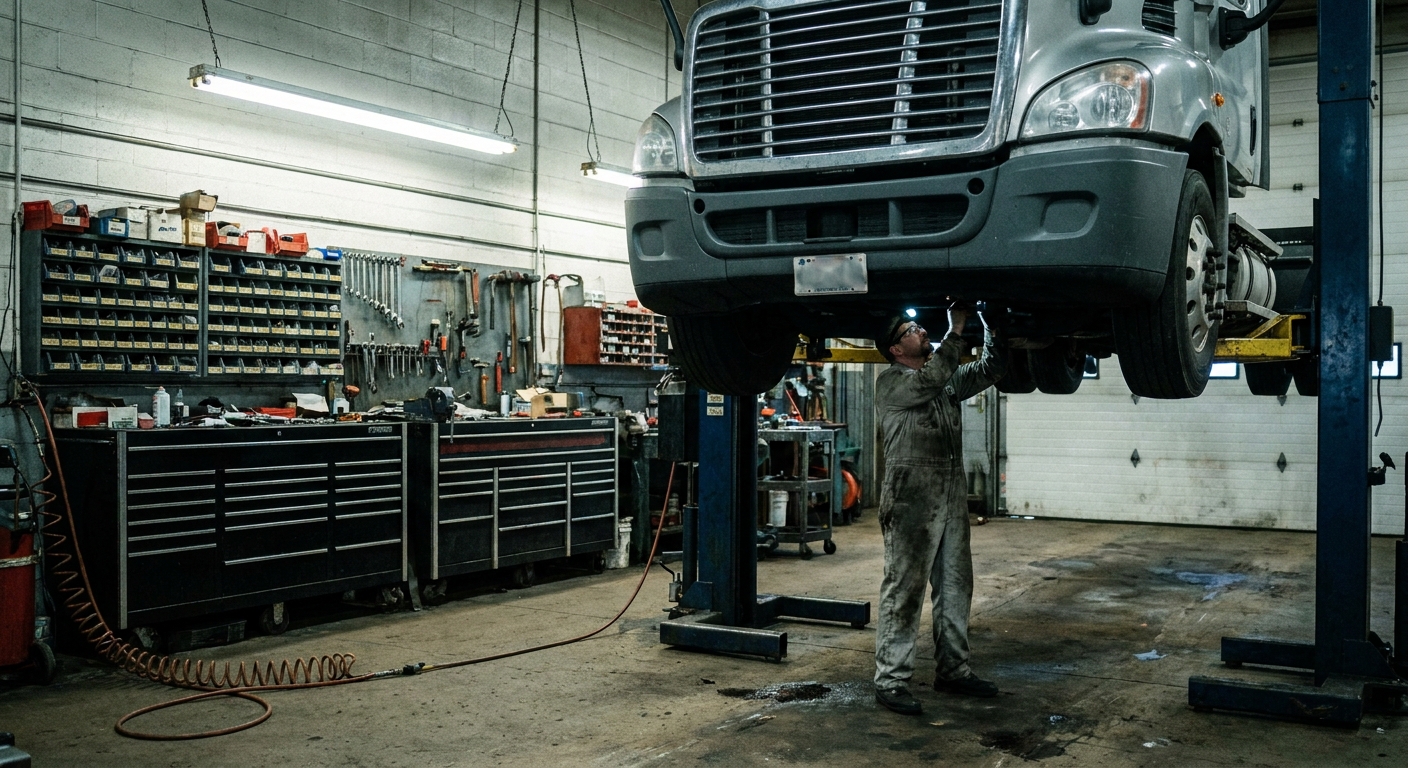
The coverage gap that surprises CT trucking owners with in-house shops: the moment you start servicing your own tractors in your yard — oil changes, brake jobs, alignments — you've stepped into garage operations. Your commercial auto policy doesn't cover damage to customer vehicles in your care. Your general liability policy excludes "auto" exposure. Your motor truck cargo policy excludes shop work. The exposure falls into a gap that requires Garagekeepers Coverage and Garage Liability — two specialty coverages most CT motor carriers never realize they need until a tractor catches fire on the shop floor.
Plenty of CT trucking operations grow into in-house maintenance. The fleet hits 6 power units, the owner buys a hydraulic lift, hires a part-time mechanic, and starts doing routine PMs in-house instead of paying $1,800 per service visit at the dealer. Others go further — leasing the shop space to outside customers when the bays are open, doing the occasional repair job for a friend's owner-operator, or selling parts on the side. Each step deeper into shop operations expands the insurance exposure into territory that standard motor carrier policies don't reach.
At iConn Insurance Solutions, we write Garage Liability and Garagekeepers Coverage for CT motor carriers running in-house shops, yards leased to third parties, and dual-purpose truck-and-shop operations. This guide explains where the coverage line falls — between commercial auto, general liability, and garage operations — and how to structure coverage so the in-house shop becomes a profit center, not an uninsured liability.
What Is Garage Liability vs. Garagekeepers Coverage?
Garage Liability is third-party bodily injury and property damage coverage for premises and operations of a garage business — customer slip-and-falls in the bay, garage employee causing damage during a test drive, fumes or fires from shop operations. Garagekeepers Coverage is first-party physical damage coverage for customer vehicles in your care, custody, or control while in the shop or yard for service or repair. The two are distinct coverages, both required for any CT trucking operation servicing third-party vehicles.
The simplest test: does a vehicle owned by someone else sit on your property while you work on it? If yes, you need Garagekeepers. Do customers or visitors come onto your shop property? If yes, you need Garage Liability. The two together cost $1,500 to $4,500 per year for a typical small-shop CT trucking operation — modest compared to the exposure each addresses.
The 4 Scenarios Where Coverage Lines Get Blurry
Scenario 1: In-House Shop, Own Trucks Only
You service only your own tractors and trailers. No third-party vehicles, no customer work. Your commercial auto policy's physical damage coverage protects your own units — but you still face Garage Liability exposure if a delivery driver or visitor slips and falls in the shop, or if a mechanic causes property damage during a test drive. Limited garage liability ($300K-$500K) is appropriate here. Garagekeepers is not required since no third-party vehicles are in your care.
Scenario 2: In-House Shop That Occasionally Services Owner-Operators or Friends
You begin servicing the occasional friend's tractor, an owner-operator running parallel routes, a neighbor's truck. Now you have third-party vehicles on your property — and Garagekeepers Coverage becomes essential. Even unpaid favor work creates legal liability if the vehicle is damaged in your care. Garagekeepers at $50K-$150K per vehicle / $150K-$500K per occurrence is the typical structure.
Scenario 3: Commercial Shop With Outside Customers
You actively solicit outside trucking customers — running a shop business in addition to the motor carrier operation. Garage Liability at $1M and Garagekeepers at $250K-$500K per occurrence are standard. Most CT lender financing on shop equipment also requires garage coverage on the lender loss-payee form.
Scenario 4: Yard Leased to Third-Party Trucking Operators
You own a yard that other motor carriers park in — overnight parking, drop trailers, repair queueing. Now you're a "yard operator" with bailment exposure: legal responsibility for damaged or stolen vehicles parked on your property. General liability covers premises issues (someone trips in the parking lot) but excludes the parked-vehicle exposure. Garagekeepers Coverage written as a yard storage form fills the gap.
Garagekeepers Coverage Forms: Three Versions, Three Different Triggers
| Coverage Form | When It Pays | Best For |
|---|---|---|
| Legal Liability | Only when the shop is legally liable for the damage. Customer must prove negligence. | Lowest premium; storage yards where vehicles park at customer risk. |
| Direct Primary | Pays for damage to customer vehicle in your care regardless of legal liability — even if customer was at fault. | Active repair shops; provides customer service experience without litigation. |
| Direct Excess | Pays after customer's own insurance pays first; bridges any gap up to your policy limit. | Mid-tier option balancing premium with customer experience. |
The Direct Primary distinction matters: if a customer drops off a tractor for service and a hailstorm damages it overnight in your yard, Legal Liability coverage often won't pay because the shop wasn't negligent (you didn't cause the hailstorm). Direct Primary pays regardless — which is the customer experience most CT trucking shops want to deliver. Premium difference is typically 25-40% between Legal Liability and Direct Primary.
What Garage Liability Excludes — and How CT Trucking Operations Close the Gaps
Garage Liability is broad but not all-encompassing. The most common exclusions:
1. Pollution Exposure
Diesel spills, hydraulic fluid releases, oil tank overflows. Garage Liability typically excludes pollution unless a specific Pollution Liability endorsement is added. CT Department of Energy and Environmental Protection (DEEP) cleanup orders can run $25,000 to $250,000 for even minor releases.
2. Faulty Workmanship
If your mechanic installs brake pads incorrectly and the tractor crashes 200 miles later, Garage Liability covers third-party bodily injury and property damage — but typically excludes the cost of redoing the work. A Products/Completed Operations endorsement closes the workmanship gap.
3. Employee Theft
Tools, parts, customer property. Garage Liability excludes employee dishonesty. A separate Crime/Employee Dishonesty policy ($25,000 to $100,000 limits typical) addresses this.
4. Customers' Personal Property in the Vehicle
Tools left in the cab, electronics, paperwork, cash. Most Garagekeepers forms exclude personal property of customers. A Customers' Personal Property endorsement provides $1,000 to $10,000 of coverage.
Why Independent Brokers Matter for CT Trucking Shop Operations
Garage Liability is a specialty line written by a smaller pool of carriers than standard commercial lines. Zurich, Travelers, The Hartford, Universal Underwriters, and several specialty markets write CT garage business — each with different appetites for trucking shops versus auto shops, and different sub-limits and exclusion patterns.
At iConn Insurance Solutions, we match the operation to the carrier — combined trucking and garage programs where available, monoline garage placed alongside commercial trucking otherwise. Together with our sister agency Insure Connecticut LLC, we cover CT motor carriers with shop operations from single-bay PM facilities to multi-bay commercial repair shops.
Key Takeaways
- Garage Liability = third-party bodily injury and property damage from shop premises and operations. Garagekeepers = first-party physical damage to customer vehicles in your care.
- The moment a third-party vehicle is on your property for service or storage, Garagekeepers exposure exists — even unpaid favor work.
- Three Garagekeepers forms: Legal Liability (cheapest, narrow trigger), Direct Excess (mid-tier), Direct Primary (broadest, best customer experience).
- Common gaps to close with endorsements: pollution, faulty workmanship, employee theft, customers' personal property.
- Typical CT trucking shop garage program (GL + Garagekeepers) runs $1,500-$4,500 annually for small-bay operations; $5,000-$15,000 for commercial multi-bay shops.
Frequently Asked Questions About Garage Coverage for CT Trucking
Do I need garage coverage if I only service my own tractors in-house?
You don't need Garagekeepers (no third-party vehicles), but you should carry Limited Garage Liability for premises exposure — slip-and-falls, fires, fumes, test-drive accidents. Your standard general liability policy often excludes shop operations, leaving a gap. A small Limited Garage Liability policy ($300K-$500K limits) costs $400-$900/year and closes the gap cleanly.
Will my commercial auto policy cover damage to my tractor while it's on the shop lift?
Generally yes — your commercial auto physical damage coverage continues to apply while the unit is being serviced. But the moment the tractor is loaned out for a test drive by your mechanic, some commercial auto policies exclude coverage. Garage Liability extends to test-drive exposures and covers third-party damage caused during shop test drives.
Does Garagekeepers cover theft of a customer's tractor from my yard?
Yes if the theft is a covered cause of loss under the form selected. Direct Primary Garagekeepers covers theft regardless of liability. Legal Liability Garagekeepers covers theft only if the shop's negligence contributed (no security, broken gate, etc.). For overnight storage operations, Direct Primary is strongly recommended.
How much Garagekeepers limit should a CT trucking shop carry?
Standard limit structures: $50,000-$150,000 per vehicle and $250,000-$500,000 per occurrence for small-bay shops. Higher for commercial shops or shops servicing high-value units (newer tractors run $150,000+, specialty rigs $250,000+). The per-occurrence limit matters most during catastrophic events (shop fire affecting multiple vehicles).
Do I need garage coverage if I lease space to outside customers but don't service their trucks?
If you allow third-party trucks to park on your property — overnight storage, yard rental, drop trailer staging — yes, Garagekeepers (yard storage form) is required. Bailment law makes you legally responsible for damage to vehicles in your care, custody, or control. General liability excludes this; specific Garagekeepers Yard Storage coverage addresses it.
What about pollution from a diesel spill in my CT trucking yard?
Pollution Liability is a separate coverage. Garage Liability typically excludes pollution. A standalone Pollution Liability policy (or a Pollution Liability endorsement on the garage policy) covers DEEP cleanup orders, third-party bodily injury, and property damage from spills. CT operations storing diesel or used oil in tanks should carry a minimum $1M Pollution Liability limit.
Running an in-house shop on your CT trucking operation and not sure where the coverage lines fall? A 20-minute shop operations review identifies whether your current commercial auto, general liability, and motor carrier program covers the shop exposure — or whether Garage Liability and Garagekeepers Coverage are the missing pieces. Request a free CT trucking shop coverage review from iConn Insurance Solutions, or visit our sister agency Insure Connecticut LLC for Northeast motor carrier coverage.