
Workers Comp for CT Restaurants 2026: Class Codes, Experience Mods & Premium Control
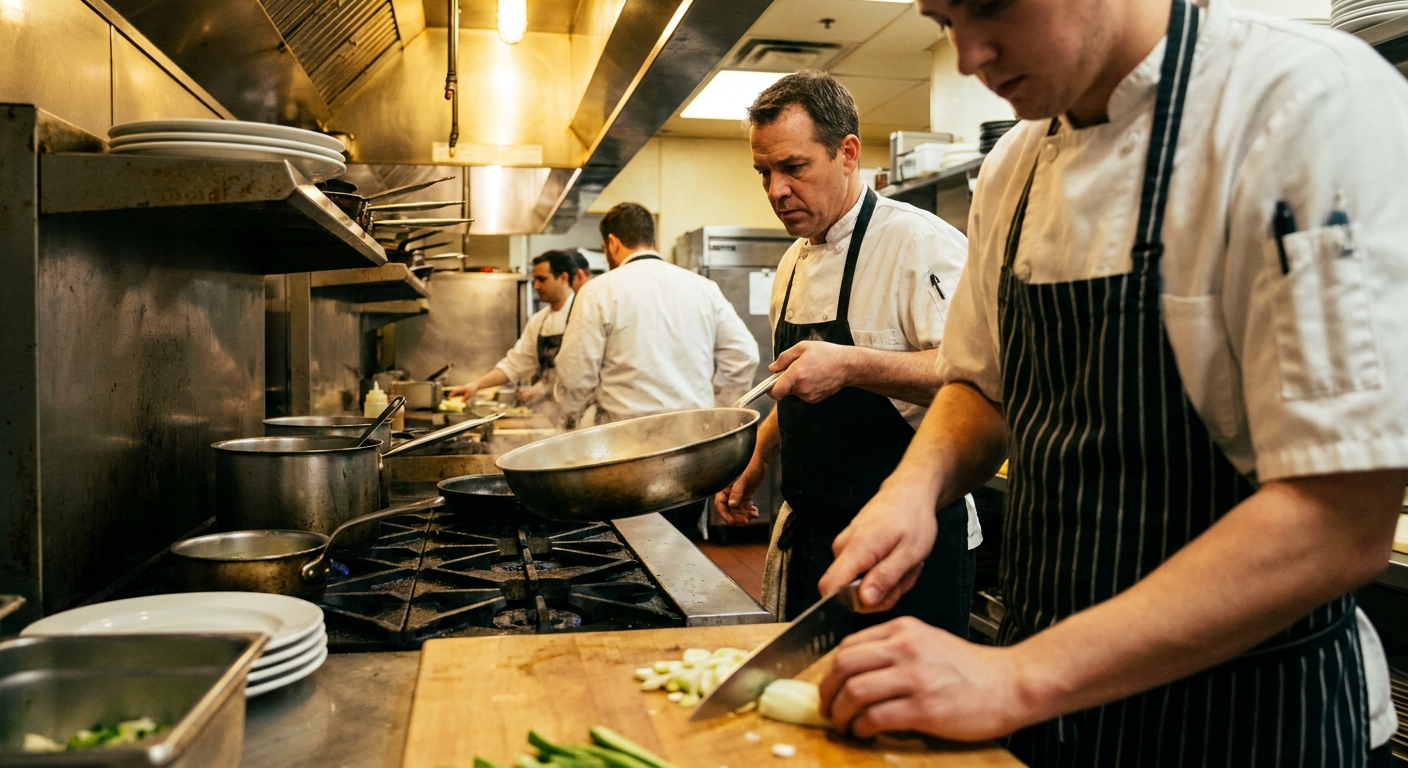
A line cook at a New Haven restaurant slipped on a wet kitchen floor during the Friday dinner rush, fractured a wrist, and was out for nine weeks. Total workers comp claim: $48,200 — medical, indemnity, and physical therapy combined. The restaurant's experience modifier jumped from 0.92 to 1.18 the following year, adding roughly $3,400 in additional comp premium annually for the next three years. Multiply that across a typical restaurant's 4–6 small claims per year and workers comp becomes the single largest variable line item in the operating budget.
This is the third spoke in our CT Restaurant Insurance cluster, building on the pillar guide to restaurant insurance and the GL & Product Liability deep-dive. Workers comp is statutorily mandated in Connecticut for any establishment with even one employee — but the way you structure the policy, classify your staff, and manage claims drives premium swings of 30–50% on the same payroll.
Is workers comp required for Connecticut restaurants?
Yes. Connecticut General Statutes Chapter 568 (Workers' Compensation Act) requires every employer with one or more employees to carry workers compensation insurance — no exceptions for small restaurants, family-owned operations, or part-time staff. Premiums for CT restaurants in 2026 range from $1,800/year (small cafe, no full-service kitchen) to $24,000+/year (full-service restaurant with bar, 30+ employees). Class codes and experience modifiers drive most of the variance.
The CT Workers' Compensation Commission enforces the mandate strictly. Operating without coverage exposes the owner to: (1) stop-work orders shutting the restaurant down, (2) civil penalties up to $300 per uninsured employee per day, (3) personal liability for all injury costs that would otherwise be covered, and (4) potential criminal charges for willful non-compliance. There is no exception for sole proprietors with even a single part-time employee.
At iConn Insurance Solutions, the most common restaurant workers comp mistake we see isn't non-coverage — it's wrong class code assignment. CT restaurants get classified under multiple potential codes (9082 Restaurant, 9083 Fast Food, 9084 Bar/Tavern), and the rate spread across codes can be 30% or more on identical payroll. A small classification error compounded across three policy years becomes a five-figure overpayment.
The CT restaurant workers comp class codes you need to know
| Class code | Description | 2026 CT base rate per $100 payroll |
|---|---|---|
| 9082 | Restaurant — full service (table service, no bar) | $1.78 – $2.40 |
| 9083 | Restaurant — fast food / counter service | $2.10 – $2.85 |
| 9084 | Bar / tavern (alcohol-focused, limited food) | $2.60 – $3.45 |
| 9058 | Hotel restaurant operations | $1.95 – $2.55 |
| 8810 | Clerical (back-office, bookkeeping, manager office work) | $0.18 – $0.32 |
For a typical full-service restaurant with $400K in annual payroll, the difference between code 9082 (full service) and 9083 (fast food) at the midpoints is about $1,400/year. Bar/tavern code 9084 vs. 9082 on the same payroll runs closer to $3,200/year. Getting the primary classification right matters — and most restaurants have a mix of classifications across staff that needs to be split correctly.
The five injury categories driving CT restaurant comp claims
Slip and fall — 38% of claims
Wet floors during prep, hot kitchen lines, walk-in cooler thresholds, and bus paths between dining room and kitchen. Most frequent claim type, average severity $4K–$15K.
Burns — 22% of claims
Hot oil splash, oven contact, steam burns, hot pan handling, dishwasher water. Range from minor first-degree burns ($1K–$3K) to severe second-degree requiring grafting ($35K+).
Cuts and lacerations — 18% of claims
Knife work, broken glass, mandoline slicer accidents, food processor contact. Average severity $2K–$8K; severe tendon damage cases run $20K+.
Strains and sprains — 16% of claims
Heavy lifting (stock receiving, lifting hot pots, moving tables), repetitive motion (continuous chopping, dishwashing). Often the slowest to heal and most expensive in indemnity. Average severity $6K–$22K.
Other (assault, vehicle, equipment) — 6% of claims
Bar fight injuries, delivery driver accidents, equipment failure injuries. Lower frequency but occasional severe outliers.
How to control your restaurant workers comp premium
Lever 1: Get the experience modifier right
Your experience mod (or "x-mod") compares your loss history to similar restaurants. A 1.00 is industry-average; a 0.85 saves you 15%, a 1.20 costs you 20% extra. Mods are calculated on the prior three years of loss data — meaning a bad claim year affects premium for the next three policy terms. Aggressive claims management (early return-to-work, light-duty programs, modified schedules) reduces total claim severity and drives the mod down.
Lever 2: Audit your class codes annually
If your restaurant has changed — added a bar, dropped table service, opened a counter — the class code mix may need to shift. Get the broker to audit annually rather than letting the auditor at the carrier reclassify you unexpectedly at renewal.
Lever 3: Documented safety program
OSHA-compliant safety training, slip-resistant footwear policies, kitchen burn protocols, and proper PPE for dishwashing all reduce frequency. Some CT carriers offer 5–10% premium credits for documented training programs across all employees.
Lever 4: Pay-as-you-go premium
Some carriers (notably AmTrust and The Hartford) offer pay-as-you-go workers comp where premium is calculated on each payroll cycle instead of estimated annually. Better cash flow, fewer audit surprises — particularly valuable for seasonal restaurants where payroll varies significantly.
This is exactly the kind of structural work an independent broker does — auditing class codes, managing the experience mod, structuring pay-as-you-go where it helps, and shopping across appointed carriers when the existing structure becomes uncompetitive. Get a workers comp program review from iConn Insurance Solutions.
What restaurant owners specifically need to know about CT workers comp
Owner / sole proprietor exemption
CT sole proprietors and partners CAN exclude themselves from coverage (saving the premium on their own wages) — but corporate officers in C-corps and S-corps default to inclusion unless they elect out via form WCB-26. LLC members default to inclusion. Getting this election right at policy inception saves $500–$2,000/year for many owner-operators.
Tip income
Tipped employee payroll for workers comp purposes includes both wages AND reported tips. Underreporting tip income on the comp audit creates retroactive premium billings that often exceed the original premium. Use POS-integrated payroll reporting to make sure tip income is captured accurately.
Family member employees
CT doesn't exempt family members from the coverage requirement — your spouse, adult children, or in-laws working in the restaurant count as employees and must be covered. The premium applies to their wages just like any other employee.
Carriers writing CT restaurant workers comp in 2026
The CT restaurant workers comp market is competitive across multiple carriers. Travelers, The Hartford, Liberty Mutual, AmTrust, CNA, and Zurich all write restaurant comp in Connecticut. Smaller restaurants often find AmTrust and EMPLOYERS competitive; larger multi-location operators often find better economics with Travelers or Liberty Mutual due to their loss-control programs.
Why an independent broker matters for restaurant workers comp
Single-carrier captive agents will price you on their own loss-control program and rate structure. Independent brokers shop the same payroll and loss history across 6+ carriers — and the spread between best and worst quotes on identical restaurant operations regularly runs $4,000–$8,000/year for mid-sized operations. We also handle class-code audits, experience mod challenges, and pay-as-you-go transitions that captive agents typically don't.
Our sister agency Insure Connecticut LLC covers restaurant workers comp across 12 states for multi-location operators with locations in CT, NY, MA, NJ, and beyond.
Key takeaways
- CT workers comp is statutorily mandated for every employer with 1+ employees — no small-restaurant exception. Penalties for non-coverage include stop-work orders and $300/day per uninsured employee.
- Class codes 9082 (full-service), 9083 (fast food), and 9084 (bar/tavern) have rate spreads of 30%+ on identical payroll — get the classification right.
- 2026 CT restaurant premium range: $1,800 (small cafe) to $24,000+ (full-service w/ bar, 30+ staff).
- Slip-and-fall (38%), burns (22%), and cuts (18%) drive 78% of restaurant comp claims.
- Experience modifiers affect three years of premium — aggressive claims management is the highest-ROI risk control.
Frequently Asked Questions About CT Restaurant Workers Comp
Do small restaurants in Connecticut need workers compensation insurance?
Yes. Connecticut requires every employer with one or more employees to carry workers comp — there is no small-restaurant exception. Penalties include stop-work orders, $300/day per uninsured employee in civil penalties, personal liability for injury costs, and potential criminal charges for willful non-compliance.
How much does workers comp cost for a Connecticut restaurant in 2026?
CT 2026 premiums range from $1,800/year (small cafe, $80K payroll, no full-service kitchen) to $24,000+/year (full-service with bar, $700K+ payroll, 30+ employees). Most mid-sized restaurants pay $4,500–$11,000/year depending on payroll, claims history, and class code mix.
Can a restaurant owner exclude themselves from workers comp coverage?
Sole proprietors and partners in CT can exclude themselves from coverage — saving premium on their own wages. C-corp and S-corp officers default to inclusion but can elect out via form WCB-26. LLC members default to inclusion. The election should happen at policy inception.
What's a workers comp experience modifier and how does it affect my restaurant?
The experience mod (x-mod) compares your three-year loss history to similar restaurants. A 1.00 is industry-average; 0.85 saves 15% on premium; 1.20 adds 20%. One bad claim year affects three policy terms — aggressive claims management is the highest-ROI risk control investment.
Are family member employees required to be covered under workers comp in CT?
Yes. Connecticut doesn't exempt family members from coverage. Spouses, adult children, in-laws working in the restaurant count as employees and must be covered. Their wages apply to the premium calculation like any other employee.
What's pay-as-you-go workers comp and is it worth it for restaurants?
Pay-as-you-go calculates premium on each payroll cycle instead of estimating annually. Better cash flow, fewer audit surprises, and particularly valuable for seasonal restaurants where payroll varies. Carriers like AmTrust and The Hartford offer this for most CT restaurant classifications.
Get your CT restaurant workers comp program audited before the next renewal
Request a workers comp program review from iConn Insurance Solutions — we'll audit your class codes, review the experience mod, shop the payroll across 6+ appointed carriers, and identify whether pay-as-you-go would improve your cash flow. Multi-location operators can also tap our sister agency Insure Connecticut LLC for 12-state coverage.
Insure Connecticut LLC, iConn Insurance Solutions, and Wealth America, Inc. are independently operated companies under common ownership.