
Commercial Auto Insurance for Plumbing Contractor Fleets: The Complete 2026 Guide
Commercial Auto Insurance for Plumbing Contractor Fleets: The Complete 2026 Guide
The short answer: A plumbing contractor with 3–25 service vehicles in 2026 needs a layered insurance program, not just commercial auto. The minimum stack is: a Business Auto Policy (BAP) with $1M combined single limit and physical damage on every truck; a Business Owners Policy (BOP) covering general liability and shop property; a Workers' Compensation policy on NCCI class 5183 (plumbing) and 8810 (clerical); a Contractors' Equipment Inland Marine policy at $50K–$100K per truck to cover jetters, sewer cameras, drain machines, and hand tools; a Contractor's Pollution Liability (CPL) policy — the line most plumbers skip and shouldn't — to cover sewer backups, contaminated water releases, and fuel-oil work; and a Commercial Umbrella at $1M–$10M over the package. For a 10-truck plumbing contractor in CT/NY/PA, that complete program runs roughly $58,000–$78,000 annually, with the right carrier mix (Travelers, Federated, Progressive, Hartford, Liberty Mutual, or Nationwide E&S depending on size and history).
Why plumbing fleet insurance is structurally different
Most insurance content lumps "contractors" together — and most of the time that's roughly fine. But plumbers have three exposures that distinguish them from electricians, framers, drywallers, or HVAC techs:
- Pollution risk is real and frequent. Every job involves moving water, sewage, fuel oil, or refrigerant. When a sewer line backs up into a customer's finished basement, when a hot-water line ruptures and floods a tenant's unit below, when fuel oil leaks from a basement tank during a service call — those are pollution events under general liability terminology, and standard GL policies exclude them.
- Tools are bigger and more expensive. A fully-loaded plumbing service truck in 2026 carries $40,000–$80,000 of equipment: a sewer camera ($8K–$22K), a jetter (truck-mounted: $18K–$45K), drain machines ($1.5K–$6K), pipe locators ($1.5K–$4K), press tools, threaders, torches, plus everyday Ridgid and Klein hand tools.
- Liability theory expands faster. A plumber who installs a faulty water heater that fails in year three triggers GL claims, products-completed-operations claims, possibly mold, possibly business income for the building owner. Plumbing claims layer.
None of this means plumbers are uninsurable. It means the program has to be built right. Below is the actual structure.
1. Business Auto Policy (BAP) — the foundation
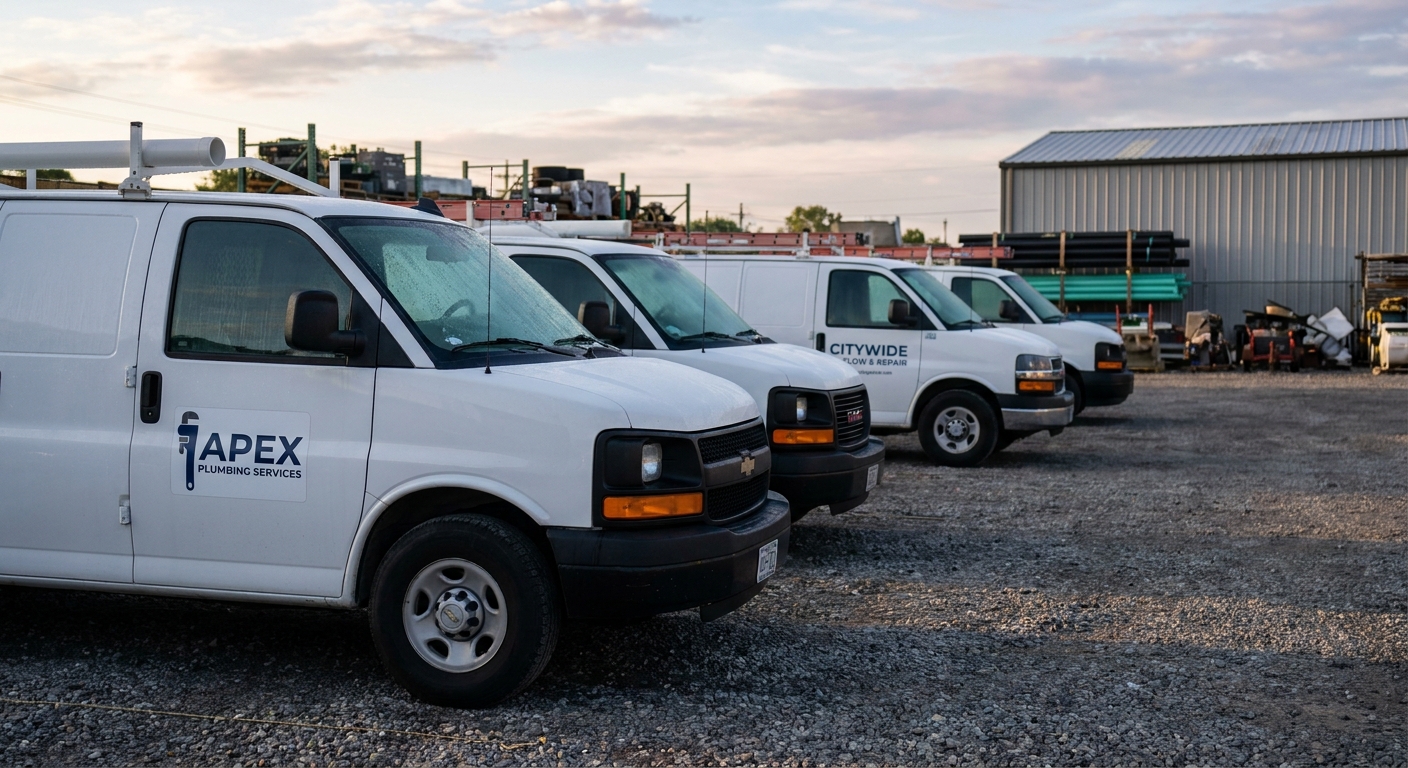
Every service truck in your fleet — vans, pickups, jetter trucks, even the owner's personal truck if it's used for company work — gets scheduled on a BAP. The right structure for a plumbing contractor with 3+ vehicles in 2026:
- Liability: $1M combined single limit. Don't go lower — your umbrella requires it.
- Symbol stack: Symbols 1, 7, 8, 9 (any auto, owned, hired, non-owned). Don't accept Symbol 7 alone unless you'll never use a personal vehicle for work.
- Physical damage: Collision + comprehensive on every truck under 10 years old. Drop to liability-only on truly disposable older trucks.
- Agreed value endorsement: On any truck under 4 years old or with significant truck-mounted equipment (jetters, compressors), use agreed value, not ACV. The settlement difference on a total loss is usually $5K–$15K per truck.
- Hired/non-owned auto: Included, even if you don't think you "rent." You rent more often than you think — equipment trailers, U-Hauls for jobs out of town, even a temp pickup when one truck's in the shop.
- Drive-other-car endorsement for the owner if the company is the entity owning the trucks.
Carriers that write plumbing fleets well in 2026 on BAP: Travelers, Progressive Commercial, The Hartford, Liberty Mutual, Federated Insurance, and (for larger or claim-affected accounts) Nationwide E&S/Scottsdale.
2. Business Owners Policy (BOP) — GL and property
The BOP packages your General Liability, your shop building/contents property, and (depending on carrier) business-income coverage, employment practices, and cyber. For a typical plumbing contractor:
- GL: $2M/$4M occurrence/aggregate. Don't go below $1M occurrence; most general contractors and municipalities require $2M occurrence as a vendor.
- Products & Completed Operations: included, full limits — your past work follows you.
- Property: shop building, parts inventory, office contents, signage. Replacement cost valuation.
- Business income: 12 months of continuing operations expenses if the shop is unavailable.
- Employment practices liability: sub-limit of $100K–$500K. Plumbers run real risk on harassment/discrimination claims as they grow.
Critical exclusion to understand: Standard commercial GL excludes "pollution." Sewer backups, contaminated-water releases, fuel-oil leaks, and refrigerant releases are all considered pollution events. The GL policy will not respond. That's where Contractor's Pollution Liability comes in (see section 5).
3. Workers' Compensation — class 5183
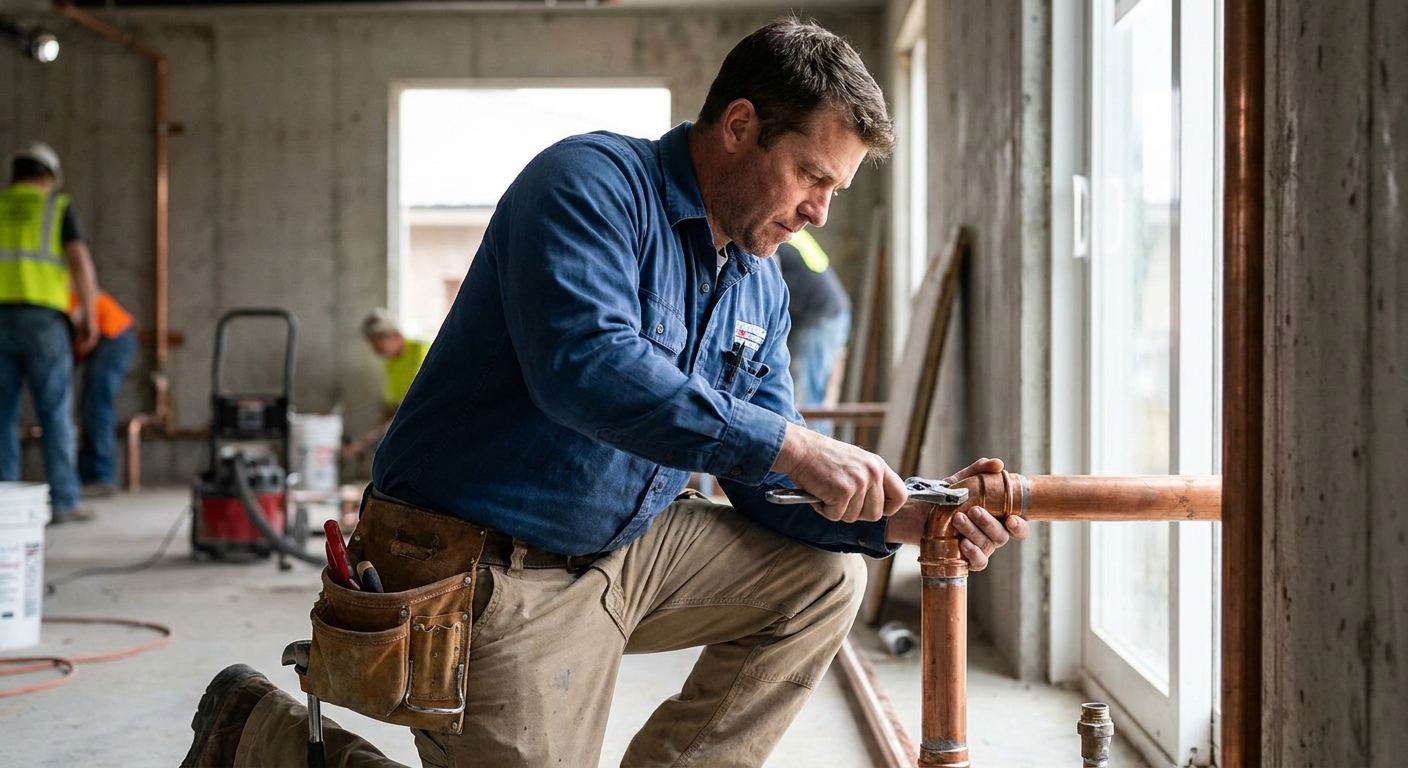
Plumbing falls under NCCI class 5183 (Plumbing — Including Shop & Drivers). Apprentices and journeymen at the jobsite get coded 5183. Office staff, dispatchers, and bookkeepers code 8810 (clerical). Owners can elect coverage or exclusion depending on entity structure and state.
Critical things about WC for plumbing contractors:
- Class 5183 rates in CT/NY/PA range from $4.50 to $7.20 per $100 of payroll in 2026 depending on state and territory. Manual rates before any experience modifier.
- Experience modifier (e-mod) matters enormously. A 0.85 mod vs. a 1.20 mod on $700K of payroll is roughly a $24,000 swing in annual premium.
- Scheduling credit for documented safety programs: OSHA 10/30 training, written safety manual, confined-space procedures (sewer/manhole work), lockout-tagout, return-to-work program. Real safety = 10–25% scheduling credit at Travelers, Liberty, or Federated.
- Drive-cam programs — Federated and Liberty in particular reward fleet contractors who run drive-cams with WC + BAP discounts.
4. Contractors' Equipment Inland Marine — the $60K-per-truck problem
Your BAP does not cover the tools and equipment inside your truck. Period. That's a separate inland marine policy (or BOP endorsement). For a plumbing service truck specifically, the typical loadout in 2026:
- Truck-mounted hydro-jetter: $18,000–$45,000 (per truck — only on dedicated jetter rigs)
- Sewer camera with monitor (RIDGID SeeSnake or equivalent): $8,000–$22,000
- Cable drain machine (K-7500 or similar): $4,500
- Drum machines, hand-snakes, smaller cleaners: $1,500–$4,000
- Pipe locator (RIDGID NaviTrack): $1,500–$4,000
- Press tools (RIDGID RP 350/351 or Milwaukee ForceLogic): $4,000–$7,000
- Pipe threader (portable, RIDGID 300 or 600): $2,500–$5,000
- Torches, propane/MAPP, leak detection: $800–$1,500
- Hand tools, wrenches, channel-locks, basin wrenches: $3,000–$5,000
- Ladders, work lights, gloves, PPE: $1,500–$2,500
- Truck shelving and interior buildout: $4,000–$8,000
- Pipe and fitting inventory carried on-truck: $2,000–$6,000
Total per fully-built plumbing service truck: $42,000–$92,000. For a 10-truck shop, that's $420K–$920K of mobile equipment. Your inland marine limit better match.
What to insist on in the inland marine policy:
- Per-truck blanket limit: minimum $50K, ideally $75K–$100K on jetter rigs
- Per-item limit of at least $25,000 (covers the sewer camera and the jetter pump)
- Replacement cost (not actual cash value) valuation
- Theft from unattended vehicles covered without a special sub-limit
- Employees' tools extension ($5K per employee)
- Rented and borrowed equipment extension ($25K–$50K sub-limit)
5. Contractor's Pollution Liability (CPL) — the line you can't skip
This is the single biggest gap in most plumbing programs. Standard commercial general liability excludes:
- Sewer backups and overflows from your work
- Contaminated water releases (anything carrying bacteria, sewage, chemicals)
- Fuel oil leaks from tanks you service
- Refrigerant releases from equipment you install
- Mold caused by water releases from your work
- Lead, asbestos, and chemical exposures from older pipe demolition
Every one of those is a real, documented plumbing-contractor claim type. A sewer backup that floods a tenant's finished basement isn't "general liability" — it's pollution. The GL adjuster will deny the claim and point you to the pollution exclusion. If you don't have CPL, you eat the loss personally.
What CPL covers, properly structured:
- Sudden & accidental pollution events arising from your plumbing operations
- Gradual pollution events (in some forms — read carefully)
- Property damage and bodily injury caused by released pollutants
- Cleanup costs at the customer's site
- Cleanup costs at your own owned/operated locations
- Mold resulting from a covered pollution event
- Transportation pollution (your truck rolling over and releasing fuel)
Right limit for a 10-truck plumbing contractor: $1M occurrence / $2M aggregate CPL, with a $5K–$10K deductible. Annual cost: $3,500–$7,500. Compared to the exposure (a single severe sewer-backup claim into a luxury condo finished basement can hit $80K–$300K), it's the best dollar-for-dollar coverage a plumber can buy.
Carriers writing CPL for plumbers in 2026: AIG, Chubb, Zurich, Berkley, Travelers' CPL line, Liberty/Ironshore, and Markel. Federated bundles a modest CPL within their construction package.
We go deeper on CPL in our spoke Contractor's Pollution Liability for Plumbers later in this cluster — it deserves its own piece.
6. Commercial Umbrella — the catastrophic layer
Above your $1M BAP, $2M GL, and CPL primary limits, you stack a commercial umbrella to handle catastrophic claims. For a plumbing contractor:
- 1–3 trucks: $1M–$2M umbrella is enough.
- 5–15 trucks: $3M–$5M umbrella.
- 15+ trucks or commercial-focused operations: $5M–$10M umbrella.
The umbrella needs to follow form over CPL — meaning if the primary policy covers pollution, the umbrella does too. Cheap umbrellas drop CPL coverage above the primary. Read the form.
Annual umbrella cost: $1,800–$2,500 per $1M layer for a clean plumbing account.
What it costs — real numbers
For a 10-truck plumbing contractor in Connecticut, $4M in annual revenue, clean five-year claims history, six journeymen and three apprentices on the road, NCCI class 5183 with a 0.95 e-mod, here's roughly where a properly-built 2026 program lands:
| Policy | Limit | Annual Premium |
|---|---|---|
| Business Auto Policy | 10 vehicles, $1M CSL, physical damage | $16,000–$22,000 |
| Workers' Compensation | ~$700K payroll, mod 0.95 | $32,000–$48,000 |
| BOP (GL $2M/$4M, building, BI) | $2M/$4M GL + property | $5,500–$8,000 |
| Contractors' Equipment Inland Marine | $600K blanket, $25K per-item | $2,500–$4,000 |
| Contractor's Pollution Liability | $1M/$2M | $3,500–$7,500 |
| Commercial Umbrella | $5M | $3,800–$5,500 |
| Package total (with multiline credit) | $58,000–$78,000 | |
For full cost methodology, see our spoke How Much Does Fleet Insurance Cost for Plumbing Contractors?
Which carriers actually want plumbing fleets in 2026
Carrier appetite for NCCI 5183 plumbing is broad — it's not roofing or excavation. But the strongest in 2026:
- Federated Insurance — best overall for plumbing contractors. Risk-management depth is unmatched and their construction package handles 5183 cleanly. Get the full review at Federated Insurance Review: The Plumbing Contractor's View.
- Travelers Construction — strong on bundled package, especially when CPL and umbrella are added in.
- Progressive Commercial — best BAP-only rate for 2–12 truck plumbing fleets, 10–18% under market.
- The Hartford — best for 2–8 truck small operations who want fast, smooth small-commercial service.
- Liberty Mutual — best for 15+ truck operations with real safety programs.
- Nationwide E&S/Scottsdale — best second-chance carrier for accounts coming off non-renewal.
- Berkshire Hathaway GUARD — best monoline WC for class 5183.
Full ranking: Best Insurance Carriers for Plumbing Contractors With Fleets (2026).
Frequently Asked Questions
Does general liability cover sewer backups?
No. Standard commercial GL excludes pollution events, and sewer backups are pollution under most policy forms. You need a separate Contractor's Pollution Liability (CPL) policy. This is the most common coverage gap in plumbing contractor programs.
What NCCI class code is plumbing on Workers' Comp?
Class 5183 — Plumbing — Including Shop & Drivers. Manual rates in CT/NY/PA range from $4.50 to $7.20 per $100 of payroll in 2026 before experience modifier. Office staff code separately to 8810 (clerical).
How much does insurance cost for a 10-truck plumbing contractor?
For a clean account in CT/NY/PA with $4M revenue, a properly-built full program (BAP + WC + BOP + IM + CPL + Umbrella) runs roughly $58,000–$78,000 annually in 2026.
What's the biggest insurance mistake plumbers make?
Skipping Contractor's Pollution Liability. The premium is $3,500–$7,500/year. A single uncovered sewer backup claim into a finished basement can be $80,000–$300,000. The math is obvious in hindsight.
Does my BAP cover the jetter and sewer camera in my truck?
No. Truck-mounted equipment and tools inside the truck are covered under a separate Contractors' Equipment Inland Marine policy, not BAP. Jetters and cameras specifically need per-item limits of at least $25,000.
Which carrier is best for a plumbing contractor?
Depends on size. For 5–15 truck shops with risk-management priorities: Federated. For bundled program with strong claims service: Travelers. For BAP-only at the lowest rate: Progressive Commercial. For 15+ truck operations: Liberty Mutual. See our full ranking.
The bottom line
Insuring a plumbing contractor fleet in 2026 is not a one-policy purchase. It's a six- or seven-policy program where each piece does a specific job, and where the biggest costly gap most plumbers run is the missing Contractor's Pollution Liability line. Get the BAP right, package the BOP and WC with a strong carrier, fully cover the tools and equipment, add CPL, and stack a real umbrella on top. The total cost is meaningful but it's tiny compared to a single uncovered sewer backup claim.
If your plumbing fleet program hasn't been pressure-tested in the last 18 months, contact iConn Insurance Solutions. We'll walk through every policy, identify the gaps, and quote the right structure against the seven carriers worth quoting in 2026.