
Connecticut Workers' Comp Class Codes: The Hidden Mistake Overcharging Your Business

What Are Connecticut Workers' Comp Class Codes — and Why Do They Matter?
Quick answer: Workers' compensation class codes are 4-digit NCCI codes that classify each of your Connecticut employees by the actual work they perform. Each code carries a published per-$100-of-payroll rate that determines your premium. A single misclassified employee can inflate your annual premium by 10–40% — money most CT business owners never realize they are spending.
If you own a Connecticut business with even one W-2 employee, you are legally required to carry workers' compensation insurance. There is no opt-out, no waiver, no minimum-employee exemption. The CT Workers' Compensation Commission enforces this for every employer in the state, and the penalties for non-compliance are steep — up to $300 per day per employee, plus personal liability for any uninsured injury claim.
Here is what nobody tells you, though: the difference between an accurately classified workers' comp policy and a misclassified one can be the gap between a $4,800 annual premium and a $9,200 annual premium — for the exact same coverage. Workers' comp rates are set by class code, and most business owners have no idea what their codes actually mean, where they came from, or whether they are correct.
In nearly two decades of writing workers' comp policies across Connecticut, we have audited hundreds of in-force policies brought to us by business owners shopping their renewal. Roughly 6 in 10 had at least one classification error. Most of those errors had been silently overcharging the business for years. This guide is how to find yours — and what to do about it.

Why Class Codes Quietly Inflate Your Connecticut Workers' Comp Premium
Connecticut uses the National Council on Compensation Insurance (NCCI) classification system to set workers' comp rates. Every employee in your business is assigned a 4-digit code based on what they actually do — not their job title, not what they were hired to do, not what is on their LinkedIn profile. What they actually do, week in and week out.
Each code has a published "loss cost" approved by the CT Insurance Department. The rate is expressed as a dollar amount per $100 of annual payroll. Here are real Connecticut rates from the most recent NCCI filing for some common classifications:
| Class Code | Description | CT Rate per $100 Payroll |
|---|---|---|
| 8810 | Clerical office employees | $0.13 |
| 8742 | Outside salespersons / collectors | $0.27 |
| 9082 | Restaurant NOC | $2.06 |
| 8868 | College / school: professional employees | $0.37 |
| 5645 | Carpentry — detached 1 or 2 family dwellings | $7.42 |
| 7228 | Trucking — local | $7.42 |
| 5403 | Carpentry NOC (commercial) | $9.65 |
| 5551 | Roofing — all kinds | $14.83 |
Now do the math. A $50,000-per-year office bookkeeper coded correctly as 8810 generates $65 in workers' comp premium for the year. The same $50,000 employee mistakenly coded as 5403 generates $4,825 — a 74× difference. That is not a typo, and it is not a rounding error. It is what happens every day on Connecticut workers' comp policies that nobody re-audits.
This is the quiet part of workers' comp that nobody explains to small business owners. The codes are invisible. They sit in a Schedule A nobody reads, baked into the renewal each year, never re-examined. The only way they ever surface is when someone — usually an independent broker shopping the policy — opens the page and reads what is actually there.
The 4 Most Common Class Code Mistakes We See on Connecticut Policies
After auditing hundreds of CT workers' comp policies, the same handful of errors keep showing up. Here are the big four — in rough order of how much they typically cost.
1. The "I Hired Them as a Carpenter" Default
A small contractor hires their first office worker — often a spouse, an admin, or a part-time bookkeeper. The renewing agent never asks. The new employee gets dropped into the existing dominant class code (5403, 5551, 5645, or similar trades code) by default. Result: $9.65 per $100 of payroll on someone who never picks up a hammer.
The fix: employees who spend their entire workweek inside an office, doing genuinely clerical work, physically separated from the operational floor or job site, qualify for code 8810 at $0.13 per $100. On a $45,000 salary, that is the difference between $4,343 and $59 in annual premium. Same employee. Same work. Different code.
2. The Outside Salesperson Hidden in an Operational Code
Connecticut has a specific NCCI code for outside salespersons (8742, $0.27 per $100) that is dramatically underused on CT policies. If an employee spends more than 50% of their time visiting customers, prospects, or job sites off-premises — and is not also performing operational work like installation or repair — they belong in 8742, not your dominant trade code.
We see estimators, project managers, and account reps misclassified into trade codes constantly. On a $70,000 estimator at a CT general contractor, the correct classification saves around $6,500 per year.
3. The Restaurant That Forgot About Delivery
Hartford, New Haven, and Stamford restaurants frequently keep all employees under code 9082 (restaurant NOC). The second a restaurant adds delivery — even a single in-house driver — that person needs class 7380 (drivers, chauffeurs). Mixing them up undercharges in one direction and overcharges in another, and CT carrier audits almost always catch it at year-end. By then, the back-premium is owed in a single lump sum.
4. The Subcontractor Trap
If you hire a 1099 subcontractor in CT and they cannot produce a current certificate of insurance showing their own workers' comp policy, their payroll rolls onto yours at your dominant class code at audit time. This single rule destroys more small contractors than any other audit finding. We see business owners who think they paid $4,000 in workers' comp for the year, only to receive a $19,000 audit bill in February because three subs could not produce certificates.
Pro tip: Build a one-page subcontractor onboarding form that requires a current workers' comp certificate of insurance before the first invoice is paid. Keep certificates in a shared folder. This single discipline saves Connecticut contractors thousands per year at audit time.
How a Single Wrong Code Cost a Hartford Contractor $14,000 a Year
Names changed, story real. A Hartford-area general contractor — we will call him Mike — came to iConn in early 2025 after his workers' comp renewal premium jumped 22%. He had been with the same captive agent for nine years and assumed the increase was just "the hard market." His total premium had climbed past $36,000 a year.
We pulled his Schedule A and found this:
- 4 field carpenters, coded 5403 (correct)
- 1 full-time office bookkeeper coded 5403 ($52,000 payroll → $5,018 in annual premium)
- 1 estimator who worked from his home office and visited job sites, coded 5403 ($68,000 payroll → $6,562 in annual premium)
The bookkeeper should have been coded 8810 (annual premium: $68). The estimator should have been coded 8742 (annual premium: $184). His captive agent had simply rolled new hires into the dominant code for nine straight years.
Annual overcharge: roughly $14,300. Across nine years: roughly $128,000. None of it recoverable retroactively. The codes can be corrected going forward, but the carrier is not obligated to refund prior-year premium based on a reclassification request submitted years later.
That conversation — explaining to a business owner what nine years of inattention has actually cost — is one we have more often than any other at iConn. It is also the conversation that converts more captive-agency clients to independent brokers than any single marketing message we could write.
How to Audit Your Class Codes — A 5-Step Checklist
You can do a preliminary class-code audit yourself in about 30 minutes. Pull your current workers' comp policy and walk through these five steps:
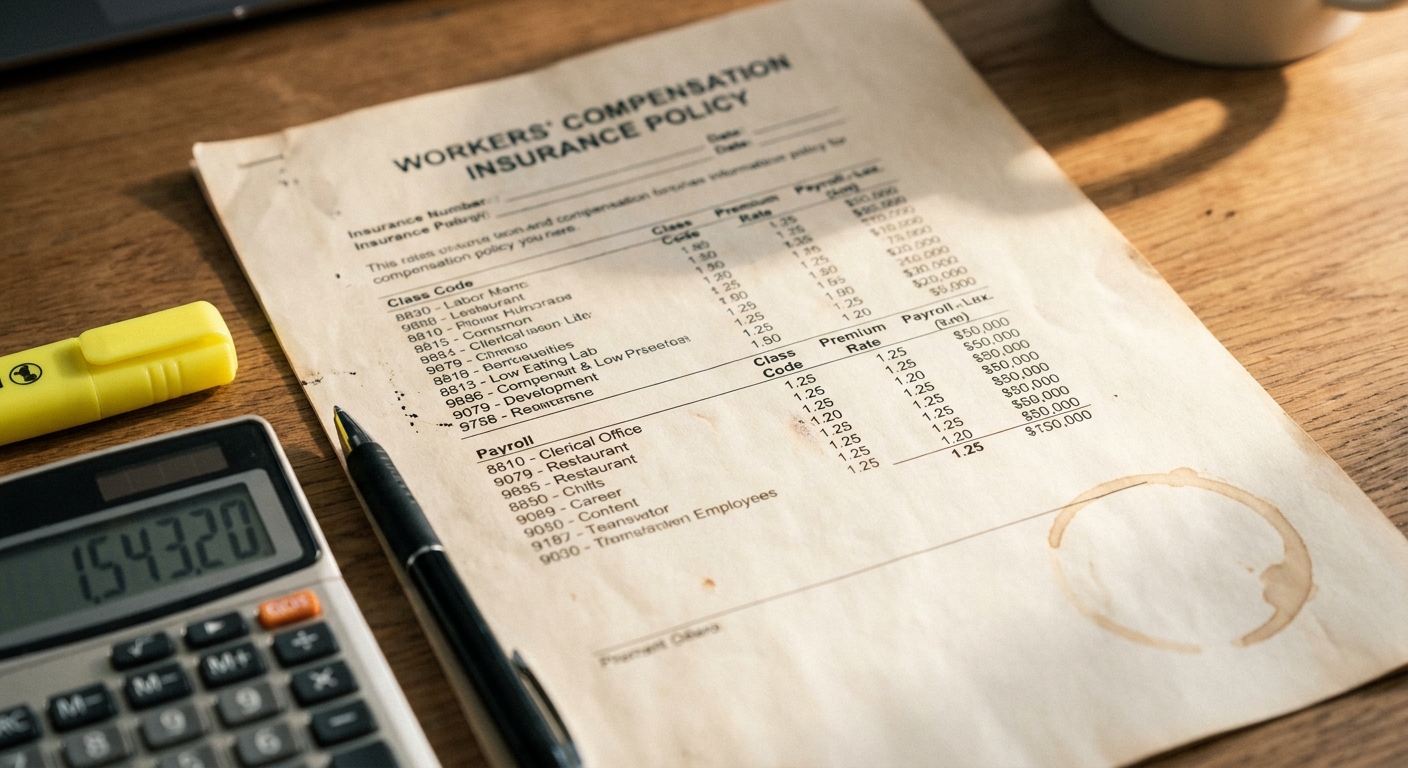
- Find your Schedule A (Classification of Operations). Every CT workers' comp policy has one. It lists every class code on your policy, the description, the per-$100 rate, and the estimated annual payroll assigned to that code.
- List every employee and what they actually do. Name, title, and the most honest one-sentence description of how they spend a typical workweek. Flag anyone who splits time between roles — that is where most errors hide.
- Compare actual work to each code's description. Look each code up in the NCCI Scopes Manual or ask your broker for the entry. If any employee's actual work does not match the code's "applies to" language, flag it for review.
- Check for missing splits. A clerical worker who also helps unload trucks one day a week cannot be coded as pure 8810. Splits are allowed under NCCI rules but they require contemporaneous payroll records broken out by activity.
- Verify every 1099 contractor carries their own workers' comp policy — and get the certificates of insurance into a file before your annual audit. Without certificates, those payrolls become yours.
If any step turns up something that does not look right, get a second opinion from an independent broker — not the same agency that built the policy in the first place.
What to flag during your DIY audit
- Any office worker coded into a trade class (5403, 5551, 5645, etc.)
- Any salesperson or estimator coded into an operational class
- Restaurants with delivery activity coded as 9082 only
- 1099 subs without current certificates of insurance on file
- Any employee whose role has changed in the last 18 months without a code update
How Do I Find the Right Workers' Comp Class Code for My Connecticut Business?
Finding the right code starts with NCCI's published Scopes Manual, which describes every code, its inclusions, exclusions, and common cross-references. NCCI sells the manual at ncci.com, but most CT business owners do not need to buy it. The faster path is:
- Ask your broker for the NCCI scope entry for every code on your current policy. Read the actual description, not the one-line summary printed on your declarations page.
- Compare it against what your employees actually do using the 5-step audit above.
- If you suspect a mismatch, request a re-classification in writing before your next audit. The CT Workers' Compensation Commission and your carrier both honor good-faith mid-policy reclassifications when the supporting payroll records are accurate and contemporaneous.
- For new businesses or new employee types, ask before you assume. A 10-minute call to a knowledgeable broker before you write the first paycheck is the cheapest classification audit you will ever do.
Independent brokers like iConn carry NCCI scope subscriptions and can cross-reference your situation against the manual in real time. Captive agents — who only sell one carrier's policies — are often constrained to that carrier's interpretation of the codes, which is not always the most favorable reading.
Why Independent Brokers Matter for Workers' Comp
Workers' compensation is one of the few insurance lines where the structure of your broker's relationship to the carriers directly affects your cost — not just your service.
Captive agents work for a single carrier. They quote that carrier's class code mapping, that carrier's e-mod methodology, and that carrier's interpretation of CT statute. When something does not fit, the answer is usually "that is just how the rate works."
Independent brokers — like iConn Insurance Solutions and our sister agency Insure Connecticut LLC — write workers' comp through multiple carriers (The Hartford, Travelers, AmTrust, Liberty Mutual, EMC, Berkshire Hathaway GUARD, ICW Group, and others). When we audit a policy, we are looking for the right answer first and the policy form second.
For workers' comp specifically, that independence translates to:
- Class code re-mapping at quote time — not at renewal a year later
- Experience modifier (e-mod) review to catch carrier calculation errors before they compound
- Multi-carrier shopping so a single carrier's rate increase does not lock you in
- Audit defense — we sit with you during the annual audit and challenge classifications that do not match the work
That is the entire reason we built iConn Insurance Solutions. Most CT business owners only learn the cost of a captive-agency relationship in year five, when their e-mod has drifted upward and the renewal arrives 30% higher than the market. By then the back-premium is already gone — but the next nine years do not have to look the same.
Frequently Asked Questions About Connecticut Workers' Comp Class Codes
How much does workers' comp insurance cost in Connecticut?
Cost depends on your class code(s), total annual payroll, and your experience modifier. Office-only businesses can pay as little as $300–$600 a year. Trades businesses can pay $5,000–$50,000+. The single biggest driver is correct classification — a misclassified employee can change the bill by 10–40%.
Who sets workers' comp class codes in Connecticut?
The National Council on Compensation Insurance (NCCI) writes and publishes the class code system. The Connecticut Insurance Department approves the rates carriers can charge per code. Your specific carrier assigns codes when the policy is written, but those assignments can be corrected.
Can I change a class code mid-policy if it is wrong?
Yes. You can request a reclassification in writing any time. If your records support the new classification, the carrier will issue an endorsement and adjust your premium going forward. Retroactive refunds for prior policy years are rare but occasionally available with strong documentation.
What happens if I get caught misclassifying employees on purpose?
Intentional misclassification to lower premium is workers' comp fraud in Connecticut. Penalties include back-premium with interest, fines, loss of coverage, and in serious cases criminal prosecution. Honest classification errors caught at audit are handled differently — usually with a back-premium adjustment, no fraud finding.
Does Connecticut require workers' comp for every business?
Connecticut requires workers' comp for every business with one or more employees, full or part time. Sole proprietors and LLC members without employees can opt out for themselves but generally cannot waive coverage for any W-2 worker. Penalties for non-compliance run up to $300 per day per employee.
How often should I review my workers' comp class codes?
At minimum, every renewal (annually). Also any time you add a new role, change what an existing employee does, add delivery or off-site work, or bring on a 1099 subcontractor. New entity types and new operations should trigger a same-day classification review before the work starts.
Get a Free Class Code Audit from iConn Insurance Solutions
If you own a Connecticut business and have not had your workers' comp class codes independently reviewed in the last 12 months, the odds are roughly 6 in 10 that you are overpaying. We will audit your Schedule A, line by line, and tell you what we find — no obligation, no sales pitch.
Request your free class code audit →If you want the full picture beyond class codes — who needs workers' comp in CT, what it covers, how the formula works, and every other lever for lowering premium — start with our Complete 2026 Guide to Connecticut Workers' Compensation Insurance. It is the parent resource for every workers' comp topic we cover.
For a deeper dive into commercial insurance for Connecticut businesses — including general liability, business owner's policies, and commercial auto — our sister agency at Insure Connecticut LLC covers the full P&C landscape across CT and 11 additional states. Together we operate as a single Connecticut insurance network, so the broker who answers your call has access to whichever carrier writes the best policy for your business.
Related Content
AI Payment Fraud Incident Response: What to Do First
The first hour after a fraudulent wire can decide whether funds are frozen or lost. Follow this practical response guide for banks, insurers, evidence, law enforcement, and recovery.
Read post →
Hotel and Commercial Property Insurance: Where Should Renewal Savings Go?
A practical guide for hotel and commercial-property owners deciding whether to keep renewal savings, lower deductibles, increase limits or restore coverage.
Read post →AI Fraud Insurance Exclusions: Where Coverage Can Break
A large cyber limit can hide a small social engineering sublimit. Learn how voluntary-transfer language, verification conditions, and overlapping crime coverage can affect AI fraud claims.
Read post →
Connecticut Builders Risk Insurance: 2026 Buyer’s Guide
Connecticut builders risk buyers should update project values, timelines and controls. Learn what to prepare and compare for a 2026 placement.
Read post →