
7 Costly Mistakes Used Car Dealers Make With Their Plate Insurance (And How to Avoid Them)
7 Costly Mistakes Used Car Dealers Make With Their Plate Insurance (And How to Avoid Them)
Why dealer plate insurance keeps surprising owners
A used car dealer policy is not a personal auto policy with a different name. It is a hybrid commercial program — garage liability + dealer's open lot (physical damage) + garagekeepers + on-hook (if you tow) + workers' comp + cyber + EPLI — bundled and rated against your inventory turn, your test-drive volume, and your loss history. When dealers come to us after a six-figure claim that didn't pay, the problem is almost never the carrier. It is the way the policy was put together at bind.
We pulled the last three years of dealer claims across the tri-state footprint at iConn Insurance Solutions and ranked the seven mistakes that cost dealers the most actual dollars. They are below, in order.
1Under-reporting inventory value on the dealer's open lot endorsement
Dealer's open lot is the physical-damage piece — it pays when a hailstorm dents 40 units overnight, when a kid jumps the fence and keys 12 cars, when the wholesale auction lot floods. It is rated on a reported average inventory value that you (or your prior broker) attested to at bind.
What we see: a dealer reports $400,000 of average inventory because that's what they were carrying three years ago. Today they're carrying $1.1M. A hailstorm hits. The carrier pays out 36% of the claim and invokes co-insurance for the rest. The dealer eats the gap.
2Buying liability-only and skipping physical damage on the lot
This is the most common rookie mistake, and the most expensive. New dealers see the DMV requires a certificate of garage liability and a $20K surety bond, and they assume that's "the dealer insurance." It is not. Garage liability covers what happens to other people (the test drive that rear-ends a family in a Camry). It does NOT cover damage to your inventory.
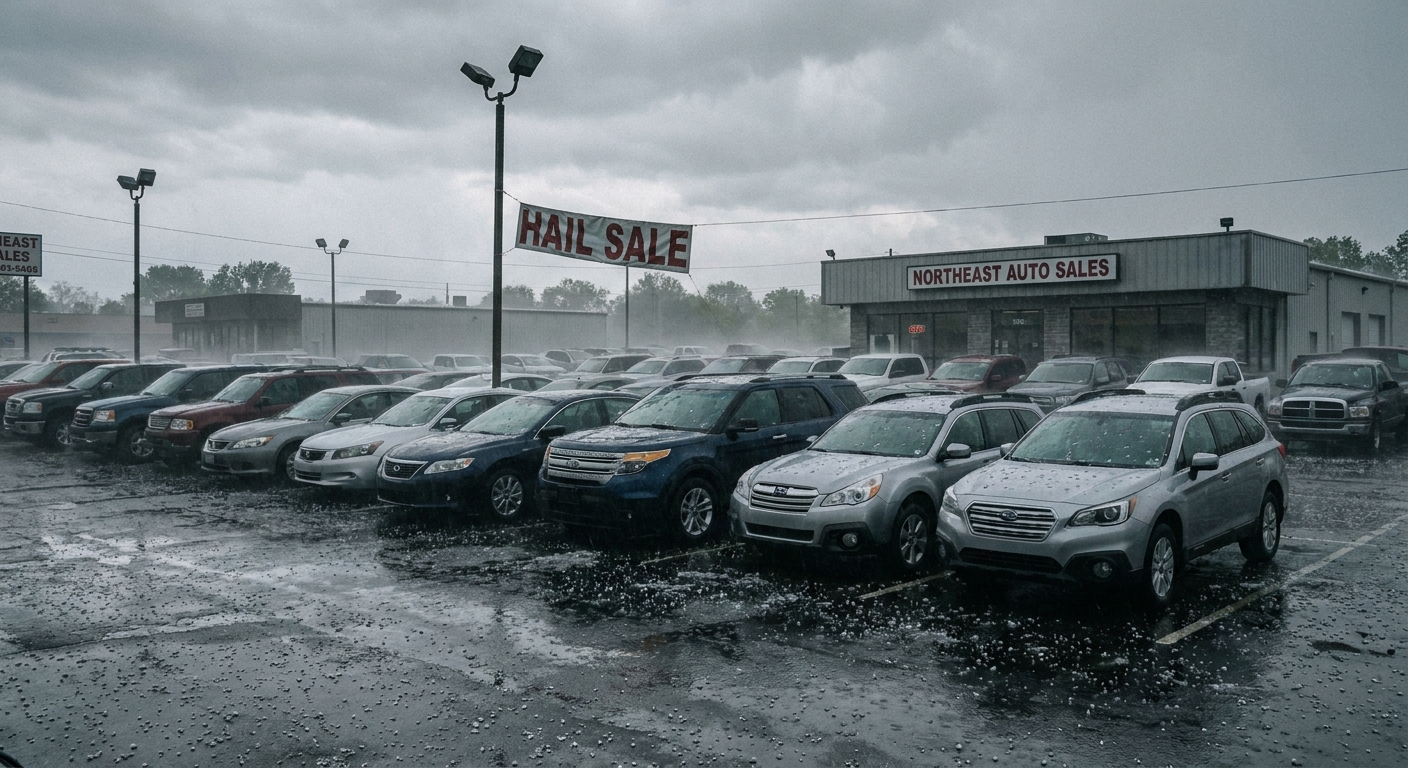
Skip physical damage, and a single tornado, fire, vandalism event, or flood wipes out your lot with zero recovery. We have personally watched a Connecticut wholesaler lose $830,000 of inventory to a freak May hailstorm in 2024 — and the policy paid only the $1M of garage liability that was triggered separately, because the lot itself had no comp/collision endorsement.
3Buying garage liability but forgetting garagekeepers
Garagekeepers legal liability is a separate endorsement. It covers damage you cause to a customer's vehicle while it's in your care, custody, or control — a trade-in parked overnight, a car you're detailing pre-sale, a unit on consignment from an estate. Garage liability does not cover this. It is a coverage gap dealers learn about exactly once.
The most common scenario: dealer is holding a customer's trade for valuation. A storm rolls through and a branch totals the trade. Without garagekeepers, the dealer is paying out of pocket — usually $15K to $40K.
4Classifying a transporter as a dealer (or vice versa)
The two operations look similar on paper — both touch a lot of vehicles, both need plates, both need liability. But the underwriting is completely different.
| Operation | What carrier wants | What you'd pay if misclassified |
|---|---|---|
| Dealer (retail/wholesale) | Garage liability + open lot + garagekeepers. Rated on inventory value + test drives. | Transporter rating: 25–60% overpriced and missing on-hook coverage. |
| Auto transporter | Motor truck cargo + on-hook + auto liability + general liability. Rated on miles + units hauled. | Dealer rating: 30–50% underpriced — but the cargo loss won't pay because the policy doesn't have motor truck cargo at all. |
| Wholesaler | Garage liability + open lot + transit coverage between auctions. Rated on auction volume. | Standard dealer rating: missing the auction-transit gap, which is when most wholesale losses happen. |
If your broker has never asked you "are you running retail, wholesale, or transport, and what percentage of each?" — your policy is probably miscoded. Carriers that specialize in this distinction — Lancer, Universal Underwriters, and Wesco — will class your operation correctly the first time. Generic commercial carriers often will not.
5Ignoring the named-driver schedule
Every dealer policy has a driver schedule — the list of people authorized to operate dealer-plated vehicles. If a driver is not on the schedule and they crash, coverage gets argued, not denied outright, but the carrier has every right to push back hard. MVR-pulls below acceptable thresholds (one DUI in five years, three speeding tickets in three years, certain at-fault accidents) also create coverage problems.
The two situations we see most often: a teenage child of the owner taking a unit home "to show his friends," and a new salesperson who hasn't been added to the schedule yet running a test drive. Both have produced six-figure denials in the last 18 months.
6Under-buying loss-of-use / business income
If a fire shuts down your lot for 90 days, who pays the rent, the floor-plan interest, the payroll? Business income / extra expense coverage does — but only if you bought enough of it. The default $50K limit most brokers slip into the policy is almost never enough for a real dealer with 30+ units of inventory and a leased lot.
The right limit is calculated, not guessed: gross profit ÷ 12 × 6 months (or 12 if you're in a slow-rebuild market). For most CT/NY/PA dealers, that lands between $150K and $400K. Anything less is leaving the carrier's checkbook closed when you need it most.
7Treating the DMV certificate of insurance as the finish line
The DMV needs a COI showing $1M combined single limit (or split limits meeting the same total) of garage liability before they will issue your dealer plates. Most dealers get the COI, hand it in, get the plates, and never re-open the conversation with their broker until renewal.
That is when the gaps form. A year passes. Inventory grew. You added a transporter trailer. You hired two salespeople. You started taking consignments. The policy you bought at startup does not match the business you are running today — but nobody's looking, because the DMV is satisfied and renewal is still 11 months away.
Key Takeaways
- The most expensive mistakes are policy-design mistakes, not premium-shopping mistakes.
- Garage liability ≠ physical damage. Both are needed on every dealer lot.
- Garagekeepers is cheap and protects you against trade-in and consignment losses.
- Dealer vs transporter vs wholesaler classification is the #1 underwriting error we see.
- The DMV COI is the START of your insurance program, not the end.
Frequently Asked Questions
How often should a dealer review their plate insurance?
Every 6 months at minimum. Inventory values, driver rosters, and operations change fast in the dealer space — annual-only reviews leave 6–11 months of drift between policy and reality.
Can I just buy garage liability and add the rest later?
You can, but you shouldn't. Bundling garage liability + open lot + garagekeepers at bind almost always costs less than buying them piecemeal, and it eliminates the gap exposure that exists between the COI date and the day you add the missing endorsements.
What's the average cost of fixing all 7 mistakes in one renewal?
For a 25–40 unit CT dealer, properly designing the program usually adds $1,500–$4,000 to annual premium vs the bargain-basement liability-only quote. The protection delta is typically $500K–$2M of additional covered exposure. The ROI is not close.
What if I've already had a small claim — should I switch carriers?
Not necessarily. One claim under $25K usually does not move a dealer into the surplus market. Two or more, or a single large claim, is when it's worth shopping. We compare standard carriers (Travelers, Hartford, Federated) against dealer specialists (Lancer, Universal Underwriters, Sentry) when designing a new program.
Does Lancer Insurance cover all 7 of these gaps?
Lancer's dealer & transporter program does cover open lot, garagekeepers, on-hook (for transporters), and driver scheduling — so yes, when properly written, a Lancer dealer policy can close all 7 gaps. The key word is "properly written" — that is the broker's job, not the carrier's.
I'm a new dealer — what should I do first?
Read our DMV walkthrough for the licensing steps, then call a dealer-specialty broker (us or otherwise) BEFORE you submit your DMV application. The COI you bring in shapes the policy. Get it right at bind.
Read the rest of the cluster
- Pillar: The Tri-State Operator's Guide to Dealer & Transporter Plates Insurance (2026)
- How Much Does Dealer Plate Insurance Cost? (2026 Tri-State Pricing)
- Dealer Plates vs Transporter Plates vs Garage Liability: The Real Differences
- How to Get Dealer Plates in Connecticut (2026 DMV & Insurance Walkthrough)
Want a 20-minute policy review?
We'll pull your current dec page, run it against the 7 mistakes, and tell you exactly which ones apply. No obligation, no spam.
Request a free dealer review →