Delivery Driver Coverage for CT Restaurants 2026: Hired & Non-Owned Auto Explained
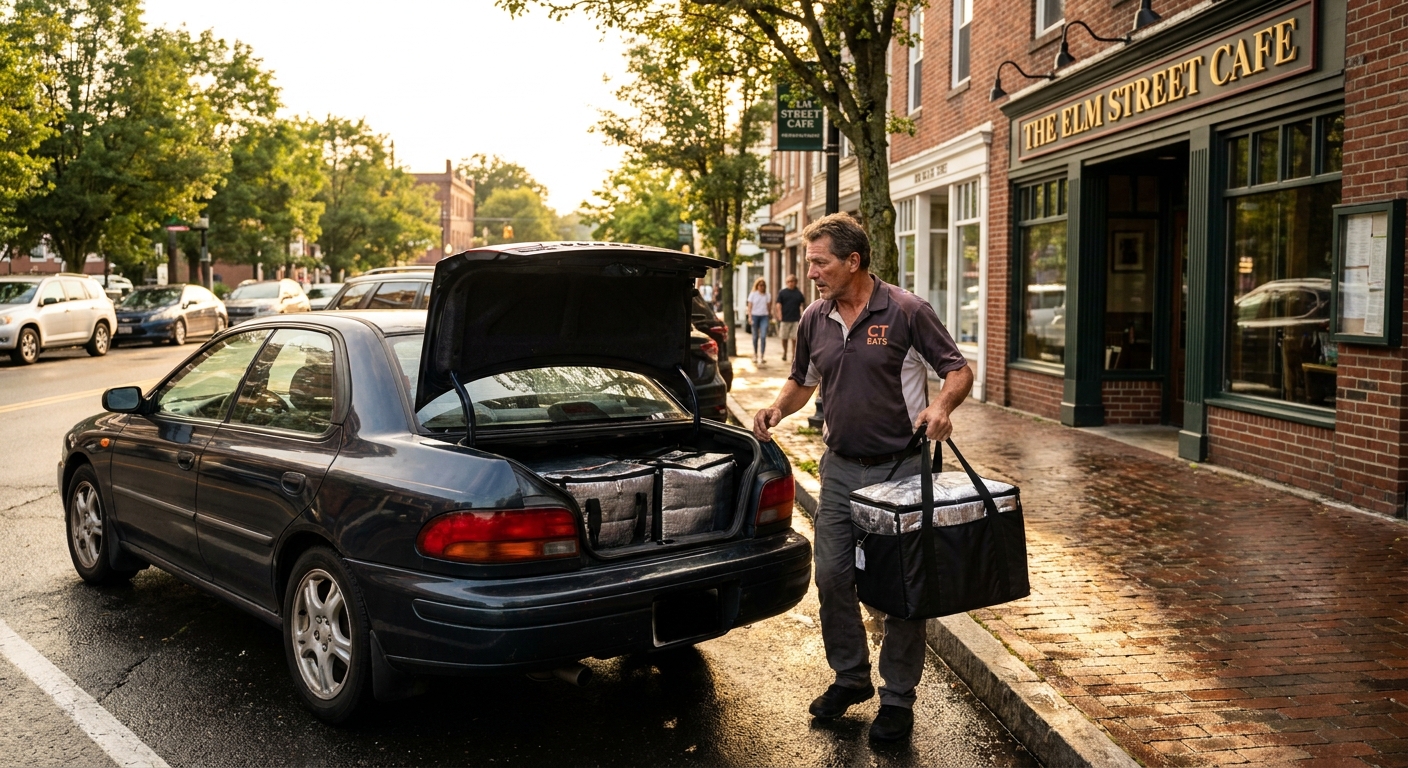
A West Hartford pizzeria's delivery driver, two months on the job, runs a yellow light, T-bones a Honda Pilot in the intersection, and seriously injures the other driver. The driver's personal auto policy denies the claim — "business use exclusion." The pizzeria's commercial general liability policy denies — "auto exclusion." The pizzeria's BOP doesn't include auto coverage at all. Total claim: $284,000 in medical bills + $42,000 in vehicle damage. The pizzeria is sued individually and ends up settling for $310,000. None of it was covered by insurance.
This is the single most under-insured exposure in CT restaurants in 2026: hired and non-owned auto liability (H&NO). Every restaurant doing in-house delivery — pizza, Asian food, sandwich shops, ghost kitchens — needs it. Most don't have it, or they have a $1,000 sublimit they don't know about. Here's what it covers, what it costs, and the exact endorsement language that closes the gap.
Why your restaurant policy doesn't cover delivery drivers (and what does)
The mechanics that create the gap:
- Personal auto policy exclusion. Every personal auto policy (Progressive, GEICO, Allstate, etc.) excludes "use of the vehicle in the business of the named insured." Delivering food for the restaurant counts. The driver's policy might pay their medical costs (depending on PIP/MedPay), but the third-party liability — the injured Honda Pilot driver — is excluded.
- Commercial GL exclusion. Every commercial general liability policy excludes "ownership, maintenance, use, or entrustment to others of any auto." This is the standard ISO exclusion. The restaurant's GL doesn't extend to auto liability.
- Commercial auto applies only to owned vehicles. If the restaurant owns the delivery vehicle, commercial auto covers it. If the driver uses their own car, owned-auto coverage doesn't apply — that's where H&NO fills in.
At iConn Insurance Solutions, we've reviewed CT restaurant policies in 2026 where the BOP includes a $500 H&NO "courtesy" sublimit. That's a marketing number, not coverage — $500 covers nothing in a real delivery accident. Real H&NO needs $1M minimum, $2M preferred, and an umbrella over that for any restaurant doing real delivery volume.
What H&NO actually covers — and what it doesn't
| Scenario | Covered by H&NO? | Notes |
|---|---|---|
| Employee using their personal car for delivery causes accident, injures third party | YES (liability) | The core H&NO claim. Pays third-party BI and PD. |
| Employee's personal car is damaged in delivery accident | NO (default) | Personal auto's collision/comprehensive covers their car. H&NO doesn't pay for the employee's vehicle. |
| Employee using a rental car for restaurant errand causes accident | YES (hired auto) | "Hired" auto = rented, leased, or borrowed. H&NO covers liability + sometimes physical damage on hired vehicles. |
| Manager driving to bank for daily deposit causes accident in personal car | YES if endorsed | Errands by salaried managers are within H&NO scope — check the "while in the course of employment" language. |
| Delivery driver injures themselves in solo crash | Workers comp, not H&NO | Driver injury falls under CT workers comp; H&NO is third-party liability only. |
| Driver delivers food in a vehicle they don't own (friend's car) | YES if course of employment | "Non-owned" in H&NO means non-owned by the employer; doesn't matter who else owns it. |
| 1099 delivery driver (DoorDash-style independent contractor) | Possibly NO | True 1099 contractors carry their own commercial auto. If misclassified, you're back to the W-2 question and full H&NO exposure. |
Limits sizing — what CT restaurants actually need
Minimum: $1M primary H&NO
The floor for any CT restaurant doing in-house delivery. Below $1M, a single severe-injury accident exhausts the policy and starts hitting the restaurant's assets. CT's medical inflation alone makes $500K limits functionally obsolete in 2026 — emergency department + ICU + surgery + rehab for one severely injured pedestrian easily clears $500K within 60 days.
Preferred: $2M primary + $5M umbrella with H&NO follow-form
The structure that holds up against modern CT verdicts. Mid-size restaurants doing 200+ deliveries/week need this. Combined annual cost in 2026: roughly $1,800-$3,400 for the primary $2M H&NO plus $2,200-$4,800 for the $5M umbrella with follow-form auto coverage. Total $4,000-$8,200 — money that pays back in a single moderate claim.
For larger operations: $10M+ via stacked umbrellas
Multi-location restaurant groups doing 500+ deliveries/week need limits closer to $10M. Achievable via primary auto/H&NO + first umbrella ($5M) + second umbrella ($5M) layered, OR a single $10M umbrella from a specialty market. Annual cost typically $9,000-$18,000 for the stacked umbrella structure.
Watch for the "drive-other-car" gap
Some H&NO endorsements exclude vehicles used "primarily" for restaurant business — language designed to push real delivery-fleet exposure to commercial auto instead. If a driver uses their personal car 80%+ of the time for deliveries, the carrier may argue it's "primary" business use and decline H&NO. The cure is either honest commercial auto on the delivery fleet OR negotiating cleaner H&NO language.
Key takeaways
- Standard restaurant policies (BOP, GL) exclude auto liability. Personal auto excludes business use. H&NO closes the gap.
- $1M H&NO is the floor for CT delivery; $2M primary + $5M umbrella is the preferred structure for mid-size restaurants.
- 2026 CT cost: $450-$2,400/yr for H&NO endorsement; $4,000-$8,200/yr for the full $7M+ structure including umbrella.
- H&NO covers third-party liability — not damage to the driver's own car (their personal auto covers that).
- 1099 drivers complicate the analysis; CT's ABC test re-classifies most "1099 delivery drivers" as employees.
The 1099 / W-2 question — same trap as workers comp
Many CT restaurants run delivery drivers as 1099 to "save on workers comp and H&NO." Two problems (same as we covered in our workers comp piece earlier this week):
(1) CT's ABC test. The CT Department of Labor's ABC test re-classifies almost all 1099 delivery drivers as employees. Driver fails (B): performing work outside the usual course of the restaurant's business — delivery is the restaurant's business if you advertise delivery. The reclassification triggers back-premium for workers comp AND opens H&NO exposure for the entire period.
(2) The third-party-platform difference. When customers order through DoorDash, Uber Eats, or Grubhub, the platform's drivers are the platform's contractors — they carry their own commercial auto (sometimes; gap depends on the state and platform). When customers order through your website, app, or phone line and your drivers deliver, the drivers are yours regardless of how you've W-2'd or 1099'd them. CT case law in 2024-2025 has been consistent on this point.
The clean structure for 2026 CT restaurants:
- If you do any in-house delivery — W-2 your drivers and carry H&NO. Don't try to gig-economy your way out of the exposure.
- If you route everything through DoorDash/Uber Eats/Grubhub — you don't need H&NO for delivery, but you still need it for managerial errands. $1M is enough.
- If you do hybrid (some in-house, some platform) — full H&NO at preferred limits. The hybrid carries the in-house exposure.
2026 CT carrier landscape for restaurant H&NO
| Carrier | Sweet spot | Notes |
|---|---|---|
| The Hartford | Restaurant package + H&NO | Restaurant-focused program; clean H&NO with $1M-$2M readily available |
| Travelers | Mid-market restaurants, delivery-heavy | Competitive on H&NO sublimits; strong umbrella follow-form |
| Liberty Mutual | Multi-location restaurant groups | Solid program; aggregates well across multiple locations |
| Progressive Commercial | Restaurants with owned delivery vehicles | If you own delivery cars, Progressive's commercial auto pairs well with H&NO on the BOP |
| Nationwide | Independent CT restaurants under $5M revenue | Competitive on the small / mid range; H&NO standard $1M |
| Philadelphia Insurance | Specialty restaurants, higher-frequency delivery | Niche program for delivery-heavy restaurants; broader H&NO forms |
| Excess / umbrella markets | $5M-$10M umbrellas over H&NO | Markel, RLI, Crum & Forster all write follow-form umbrellas; broker shop the umbrella separately |
How to verify your current H&NO coverage in 5 minutes
Pull your restaurant policy declaration page and check:
- BOP or GL declarations — look for "Hired Auto Liability" and "Non-Owned Auto Liability" line items. No line items = no coverage.
- The limit — anything under $1M needs to be raised.
- The endorsement form number — common forms include CA 99 33 (Auto Coverage Form), CG 04 24 (Coverage for Injury to Leased Workers — Excluded), or carrier-specific equivalents. If you don't see an auto-specific endorsement, you don't have H&NO.
- Umbrella declarations — confirm the umbrella schedule of underlying coverage includes H&NO as a scheduled underlying policy. If H&NO isn't listed, the umbrella doesn't follow it.
- Driver list / MVR requirements — some H&NO endorsements require you to maintain MVRs on all delivery drivers. Failing to comply can void the coverage at claim time.
Why independent brokers matter for H&NO
This is one of the most form-language-sensitive coverages in restaurant insurance. The default $500-$1,000 sublimits some carriers throw onto BOPs are a polite fiction. Real H&NO is a separately underwritten coverage with driver lists, MVR requirements, and umbrella coordination. At iConn Insurance Solutions, we structure CT restaurant H&NO with proper $1M-$2M primary limits, follow-form umbrella schedules, and the endorsement language that holds up at claim time. Our sister agency Insure Connecticut LLC at myinsurect.com handles the rest of the restaurant insurance program — property, GL, liquor, workers comp.
Frequently Asked Questions About Restaurant Delivery Driver Coverage
Does my restaurant's BOP automatically include hired and non-owned auto coverage?
Sometimes — at a useless sublimit. Many BOPs include a $500-$1,000 "courtesy" H&NO sublimit. That's not real coverage; it's a marketing line. Real H&NO is $1M-$2M primary with separate underwriting and an umbrella over the top.
What does H&NO cost for a typical CT pizzeria in 2026?
For a CT pizzeria doing $1.5M-$3M revenue with 4-8 in-house delivery drivers, $1M H&NO runs $850-$1,800/yr. $2M primary plus $5M umbrella runs $4,000-$7,500 total. The umbrella is the cost-effective layer — much cheaper per million of coverage than raising the primary alone.
If my driver is at fault, will their personal auto policy pay anything?
Sometimes — their PIP / MedPay may cover their own medical bills, and CT requires liability coverage on personal autos. But the personal policy almost always excludes business use, leaving the third-party liability uncovered. H&NO is what closes that gap on the restaurant's side.
Do I need H&NO if I only use DoorDash / Uber Eats / Grubhub?
Less critical for the delivery itself — platform drivers carry their own commercial auto (mostly). But you still need H&NO for managerial errands, supply runs, and any in-house delivery you do alongside platform delivery. $1M H&NO is the minimum even for platform-only operations.
What's the difference between H&NO and commercial auto?
Commercial auto covers vehicles you own (the restaurant owns the delivery cars). H&NO covers vehicles you don't own — employee personal vehicles, rentals, borrowed cars used in business. Most restaurants need both: commercial auto for owned vehicles, H&NO for personal vehicles used in delivery.
Does H&NO cover my driver's own injuries if they crash while delivering?
No — that's workers comp. H&NO is third-party liability coverage (pays the people the driver hits and damages they cause). Driver injury is a workers comp claim under CT statute. Make sure both are in place — H&NO without workers comp leaves your driver uncovered for medical bills.
Take the next step
If your restaurant does any in-house delivery and you haven't done a 5-minute H&NO check in the last 12 months, you're almost certainly under-insured for your highest-severity loss exposure. Request a no-cost restaurant policy review with iConn Insurance Solutions — we'll pull your declarations page, identify the auto coverage gap (or confirm it's covered), and quote the structure that protects against a real CT delivery accident. Our sister agency Insure Connecticut LLC handles the broader restaurant program.