
Drone Coverage for CT Productions 2026: UAS Liability, Hull & Part 107 Compliance
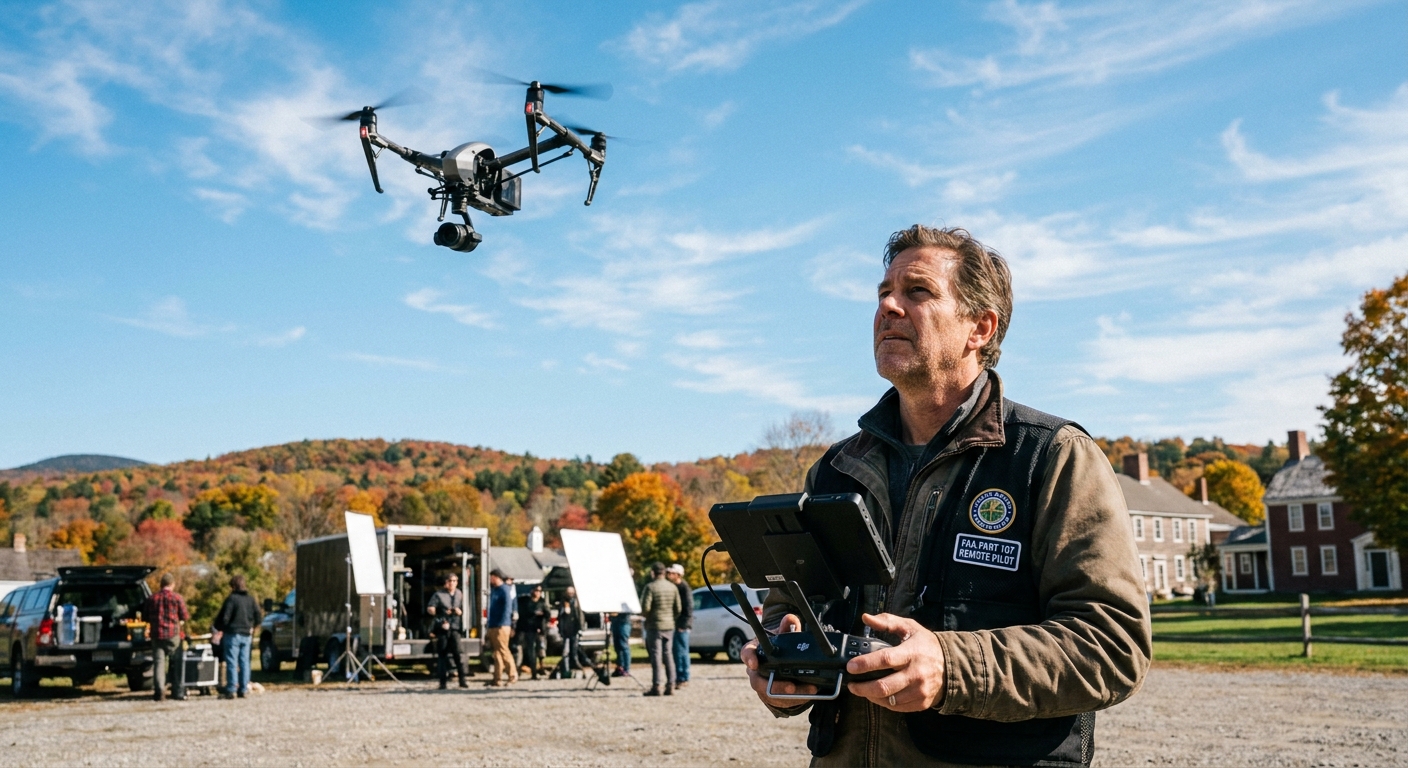
A documentary crew shooting in the Litchfield Hills launches a DJI Inspire 3 for an aerial establishing shot. The drone clips a tree branch, falls 60 feet, lands on a parked Tesla Model Y. The Tesla's owner files a claim for $8,400 in body damage. The drone — a $14,200 piece of cinema equipment — is destroyed. The production's general liability policy denies both claims, citing the "aircraft exclusion." The production's equipment policy denies the drone loss, citing the same exclusion. Net out-of-pocket: $22,600.
This is the standard outcome on a CT production without dedicated drone coverage in 2026. Standard production GL and equipment policies exclude aircraft by default — and the FAA classifies any unmanned aerial vehicle over 0.55 pounds as aircraft. A separate UAS (Unmanned Aircraft System) endorsement, FAA Part 107 compliance, and pilot certification are the only path to actual coverage. Here's what 2026 CT producers need to know about insuring drone operations.
Why standard production policies don't cover drones
The exclusion language is consistent across major production carriers in 2026. Every general liability policy excludes "ownership, maintenance, use, or entrustment to others of any aircraft." Every equipment policy excludes "aircraft, including unmanned aerial vehicles." This isn't loose language carriers can argue around — it's a deliberate carve-out because aircraft liability is treated as a specialty market under federal aviation regulation.
At iConn Insurance Solutions, the most common scenario we see on CT productions is the producer who assumes their existing $1M general liability extends to the drone. It doesn't. The denial letter cites the aircraft exclusion, the claim is paid out-of-pocket, and the production company learns the rule the expensive way. The cure is structural — drone coverage attaches by endorsement specifically for UAS, not as a sub-class of general aviation.
The three coverage parts a drone production needs
1. UAS Liability ($1M-$5M)
Covers bodily injury and property damage to third parties caused by the drone. The Tesla in the example above. The pedestrian struck by a falling drone. The historic stone wall the drone hits during an autonomous flight. Limits typically run $1M / occurrence with $2M aggregate, scaled up to $5M for productions filming in populated areas or with stunt-flight requirements.
2. UAS Hull / Physical Damage
Covers physical loss or damage to the drone itself. A cinema-grade Inspire 3 with a Zenmuse X9-8K Air camera runs $14,000-$22,000 just for the airframe + camera; full ground package including controllers, batteries, ND filters, and ground station can hit $35,000. Hull coverage is written on an agreed-value basis (you and the carrier agree the value at binding; that's what they pay on total loss) at roughly 7-12% of insured value annually, or pro-rated for short-term policies.
3. Non-Owned UAS Liability
The often-overlooked third piece. When the production hires a Part 107 contractor to fly their own drone for one shoot day, the production company can still be named in any third-party claim. Non-owned UAS liability covers that exposure even when the production doesn't own the equipment. Usually $250-$500 to add on annual policies; baked into project policies.
FAA Part 107 — the regulatory floor
FAA Part 107 is the regulatory framework for commercial drone operations in the U.S. Any drone flight that supports a paid production — commercial, branded content, documentary, scripted film — must comply with Part 107 or operate under a waiver. The core requirements:
- Pilot certification. The Remote Pilot in Command (RPIC) holds a current Part 107 certificate (a written knowledge test, renewed every 24 months).
- Aircraft registration. Drones over 0.55 lbs registered with the FAA (free for hobbyists; required for commercial).
- Visual Line of Sight (VLOS). Pilot or designated Visual Observer maintains continuous visual contact with the drone.
- Maximum altitude 400 feet AGL. Higher needs a Part 107 waiver.
- Daylight or civil twilight — unless the drone has anti-collision lighting visible 3+ miles, in which case night ops are permitted.
- No flight over people — unless flying a Category 1-4 compliant aircraft or holding a waiver.
- Authorized airspace — controlled airspace requires LAANC authorization or a Part 107 waiver.
Productions that skip Part 107 compliance face two layered consequences: (a) FAA enforcement (civil penalties up to $32,666 per violation as of 2026), and (b) insurance denial — every UAS policy excludes losses where the operator wasn't operating in compliance with Part 107 or applicable waiver. The aircraft exclusion that already declined the claim doesn't even need to be cited; the compliance exclusion alone is enough.
2026 CT cost framework
| Policy structure | Coverage | Annual cost / Per-day cost | Best for |
|---|---|---|---|
| Annual UAS policy | $1M liability, $15K hull, named pilot | $850-$1,400/yr | Production company with 6+ shoot days/year |
| Annual UAS policy | $2M liability, $25K hull, multi-pilot | $1,650-$2,800/yr | Established production company, multiple drones |
| Project / short-period | $1M liability, $15K hull, 7-30 days | $300-$650/day or $1,800-$3,800 per project | Single feature or commercial campaign |
| Add-on to production package | $1M aircraft liability endorsement only (no hull) | $450-$900/yr | Hiring outside Part 107 operators who carry their own hull |
| Specialty / waiver flights | Night ops, over-people, BVLOS, populated areas | +50-150% surcharge | Music videos, sports, urban shoots |
Key takeaways
- Standard production GL and equipment policies exclude all aircraft, including drones. Coverage requires a separate UAS endorsement.
- Three coverage parts: UAS liability ($1M-$5M), UAS hull (agreed-value for the equipment), and non-owned UAS liability (for hired Part 107 contractors).
- FAA Part 107 compliance is the regulatory floor; non-compliance triggers FAA penalties AND voids insurance.
- 2026 CT annual cost: $850-$2,800 depending on liability limits and hull value. Project policies: $300-$650/day.
- Waivers (night, over-people, BVLOS) carry 50-150% surcharges and need specialty markets.
The four claim categories that hit drone productions
1. Property damage to third-party property
Vehicle, building, structure, crops. The Tesla scenario. Routine claim with clear UAS liability coverage. Typical claim severity $1,500-$25,000.
2. Bodily injury to bystanders
Less frequent but high severity. A 4-pound cinema drone falling 200 feet has serious kinetic energy. Severity range $25,000-$2M+ when injuries occur. Why $1M minimum aircraft liability is the right floor; $2M-$5M for any urban or populated-area shoot.
3. Damage to the production's own property
Drone crashes into a $250,000 RED V-Raptor on a Technocrane. Drone hits a $40,000 picture car. These are your equipment / picture vehicles — covered under your equipment policy only if the equipment policy doesn't exclude drone-caused loss (most do — read carefully).
4. Hull loss
The drone is destroyed in a crash or fly-away. Battery failure causing forced landing in water is the most common cause in 2026 CT productions. Hull coverage at agreed value pays the schedule; without it, the drone is a total writeoff.
2026 CT carrier landscape for UAS
| Carrier / Program | Sweet spot | Notes |
|---|---|---|
| Global Aerospace | Established production companies, high-value cinema drones | Aviation-domiciled carrier; broadest hull forms, generous Part 107 expertise |
| Starr Aviation | Mid-tier production, multi-drone operations | Strong on commercial production; integrates with Starr's broader production program |
| USAIG (United States Aviation Underwriters) | Larger productions, waiver flights | Specialty aviation; deep waiver support for night ops, over-people |
| SkyWatch.AI | Independent Part 107 operators, project / hourly policies | Tech-forward; mobile app binding for per-flight coverage; integrates with annual |
| Thimble / on-demand | One-day project policies, freelance operators | Lowest-friction binding for single shoots; thinner forms |
| Tokio Marine HCC | Hybrid: drone endorsement on full production package | Pairs UAS with their entertainment program; simplest single-policy solution for mid-tier productions |
For most CT productions, the cleanest 2026 structure is either a standalone annual UAS policy with one of the aviation carriers (Global Aerospace, Starr, USAIG) for productions flying 20+ days/year, OR the integrated drone endorsement on a Tokio Marine HCC production package for productions flying 5-20 days/year. Below 5 days/year, project-based policies through SkyWatch or Thimble are cheaper per shoot.
Common 2026 underwriting questions you'll be asked
- RPIC name + Part 107 certificate number + date of last currency check
- Drone make, model, serial number, value (for each aircraft)
- Flight environments: rural/suburban/urban; over crew only or over public?
- Any waiver flights planned (night, over-people, BVLOS)?
- Annual flight hours estimate + shoot day estimate
- Prior losses (UAS specifically — your full company loss runs don't usually cover this)
- Maintenance / pre-flight checklist documentation
- Loss control program: pre-flight inspection log, post-incident reporting
Why independent brokers matter for UAS
The aviation market is structurally different from the standard P&C market — different underwriting cycles, different form language, different claims handling. Captive agents at major P&C carriers don't have appointments with Global Aerospace or USAIG; they default to whatever their carrier's aircraft endorsement looks like (usually narrow and expensive). At iConn Insurance Solutions, we maintain wholesale relationships with the aviation specialty markets and can pull side-by-side quotes from 4-5 UAS carriers for any CT production. Together with our sister agency Insure Connecticut LLC at myinsurect.com, we package UAS coverage with the production's broader GL, workers comp, and equipment policies into a coordinated program.
Frequently Asked Questions About Drone Coverage for CT Productions
Does my standard production general liability cover drone operations?
No. Every standard production GL policy in 2026 excludes aircraft, including unmanned aerial systems. You need a separate UAS liability endorsement or a standalone UAS policy. The aircraft exclusion is consistent across all major carriers — there's no workaround in standard language.
How much does drone coverage cost for a one-day CT commercial shoot?
Project-based UAS policies for a single CT shoot day run $300-$650 with $1M liability and $15,000 hull coverage. Lower-end binding through Skywatch or Thimble; higher-end through traditional aviation carriers for cinema-grade equipment. Annual policies are dramatically cheaper if you fly more than 6 days/year.
What's the difference between Part 107 and FAA Part 61?
Part 107 is the commercial small UAS framework — for drones under 55 pounds with the standard rules (VLOS, 400 ft AGL, daylight). Part 61 is the manned-pilot certification (private/commercial pilot license). Some larger or specialty drone operations operate under Part 61 instead of Part 107 — but for the vast majority of CT productions, Part 107 is the right framework.
If I hire a Part 107 contractor to fly their drone, do I need my own UAS coverage?
Yes — non-owned UAS liability. The contractor's hull and liability policies cover them, but you can still be named in claims. Non-owned UAS extends your production's GL coverage to drone operations performed by hired contractors. Costs $250-$500 added to an annual production package.
Will my UAS policy cover night-time drone shots?
Only if you've added a night-ops endorsement and the drone is equipped with FAA-compliant anti-collision lighting. Night flight is permitted under Part 107 as of 2021 if the drone has anti-collision lighting visible 3 miles, but insurance pricing surcharges 50-100% for night-ops endorsement and underwriters want documented pilot night-experience.
What happens if my drone crashes into a $200,000 RED camera package on my own production?
Tricky. Your equipment policy probably excludes drone-caused loss (read the exclusions). Your UAS liability policy covers third-party property but not your own. Some carriers offer a "cross-coverage" endorsement that allows the UAS hull to respond to damage to the production's own equipment caused by drone operations — worth asking for if you're running heavy cinema packages near drone flight paths.
Take the next step
If you're running drone operations on CT productions in 2026 and want a real UAS coverage review — including non-owned exposures, waiver-flight pricing, and Part 107 documentation — request a production insurance audit with iConn Insurance Solutions. We'll pull quotes from 4-5 aviation specialty markets, line up the hull and liability forms side-by-side, and identify the structure that fits your shoot calendar. Our sister agency Insure Connecticut LLC handles the rest of the production insurance program.