
Tools, Equipment & Inland Marine: How Electrical Contractors Should Cover the $40K Inside Every Van
Tools, Equipment & Inland Marine: How Electrical Contractors Should Cover the $40K Inside Every Van
The short answer: A fully outfitted electrical service van in 2026 carries roughly $25,000–$55,000 of tools, meters, cordless platforms, conduit benders, scopes, and test equipment — and your Business Auto Policy physical damage coverage does not cover any of it. Tools and equipment are covered under a separate Contractors' Equipment Inland Marine policy (or Inland Marine endorsement on a BOP). The right coverage for an electrical contractor includes: a per-item limit of at least $10,000, a blanket limit of $50,000–$100,000 per van, replacement-cost (not actual cash value) valuation, coverage extended to employees' personal tools, theft from unattended vehicles, and rented/borrowed equipment. Annual cost: roughly $1,200–$2,400 for a 10-van shop — pennies relative to the exposure.
The exposure most contractors underestimate
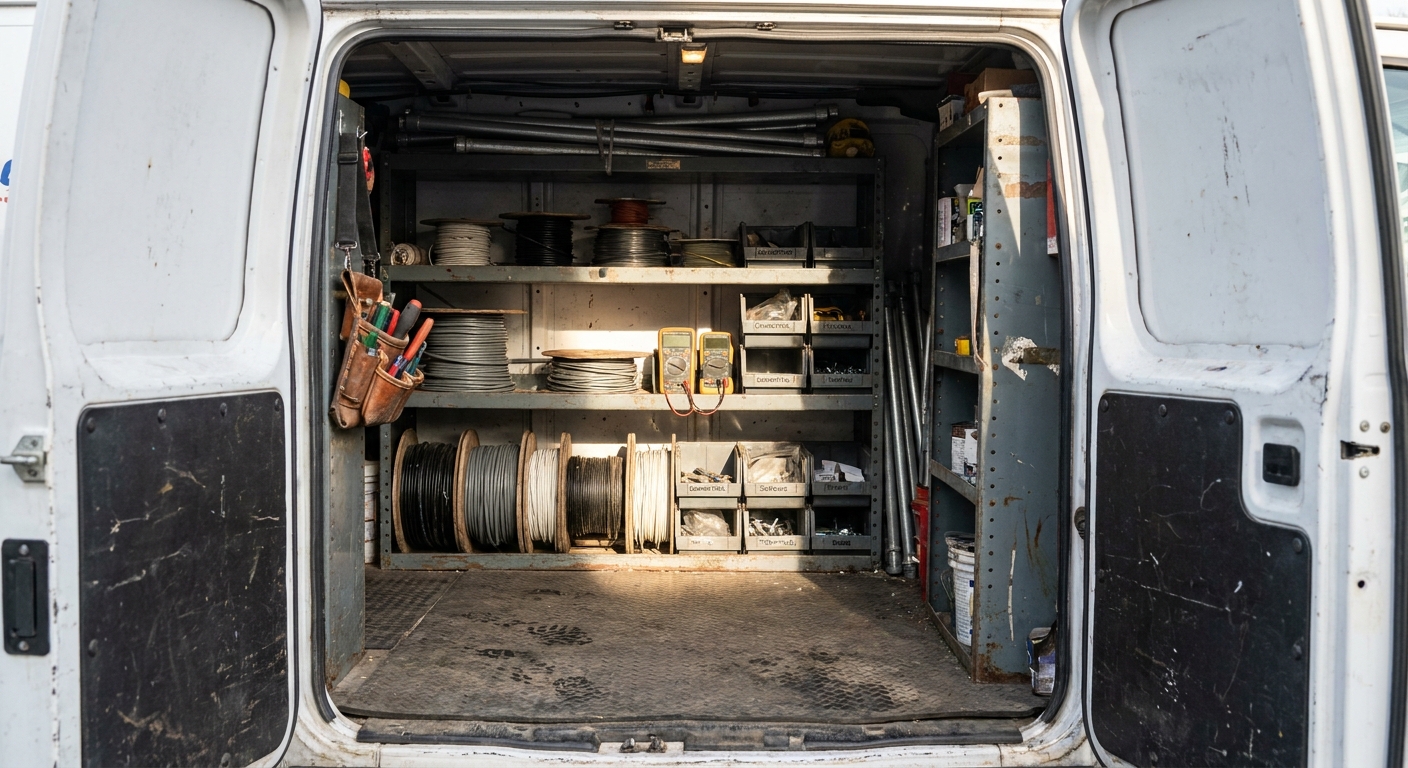
Ask an electrical contractor what's in the back of his service van and he'll say "a bunch of tools." Then he'll guess $8,000. Then we open the back, write down what's actually there, and the inventory always ends up north of $30,000. Sometimes north of $50,000.
Here's what a typical fully-outfitted electrical service van for a small commercial / residential service contractor actually contains in 2026:
- Cordless platform (Milwaukee M18 / DeWalt FlexVolt / Makita LXT): $4,500–$8,000 in batteries, chargers, and tools.
- Specialty Klein, Greenlee, and Ideal hand tools (insulated, pliers, strippers, crimpers, lugs): $2,500–$4,000.
- Conduit bender set (1/2" through 1.25" hydraulic and mechanical): $1,200–$3,500.
- Cable puller (Greenlee Ultra Tugger or similar): $2,000–$4,500.
- Test equipment — Fluke multimeters, clamp meters, megohmmeter, AC/DC clamps, thermal camera: $3,000–$8,000.
- Wire/cable inventory carried on-truck (THHN, MC, romex, low-voltage): $1,500–$5,000.
- Devices, breakers, fittings, anchors (rolling stock): $2,000–$6,000.
- Ladders (extension, A-frame, podium): $800–$2,500.
- Generator, work lights, fans: $1,000–$3,000.
- Drain snake / fish tape / fiberglass rods: $800–$2,000.
- Van shelving and interior buildout (Adrian Steel / Ranger Design): $4,000–$8,000.
Total: $22,300 to $54,500 per fully-built service van. For a 10-van shop, that's $223,000 to $545,000 of tools and equipment rolling around the tri-state every day. If your inland marine limit is $25,000 — and many electrical contractors' is — you're underinsured by a factor of 10x to 20x at the fleet level.
If you haven't read the foundational piece, start with Commercial Auto Insurance for Electrical Contractor Fleets: The Complete 2026 Guide. This spoke goes deep on the tools side.
Why your BAP doesn't cover tools
This is the single most important sentence in this article: your Business Auto Policy covers the vehicle, not what's inside it.
BAP physical damage coverage (collision and comprehensive) pays for damage to the van itself — the body, frame, engine, glass. It does not pay for the $40,000 of tools the thief took out of the back when he popped the rear door at 3 AM at a job site. It does not pay for the meters destroyed when the van caught fire from a battery thermal runaway. It does not pay for the conduit bender that fell off the rack during the rollover.
Tools and equipment are covered under a separate line of insurance called Inland Marine — a category that exists for property that moves (which originally meant goods on barges, hence "marine," and now means anything from contractors' tools to musical instruments to fine art in transit).
For electrical contractors specifically, the relevant inland marine form is Contractors' Equipment Coverage (sometimes called "Tools & Equipment Floater"). It can be written as a standalone policy or as an endorsement on your Business Owners Policy (BOP).
What good inland marine coverage looks like
1. Limits that match the actual exposure
- Per-item limit: at least $10,000 — covers any single tool/meter/piece of equipment. Without a high enough per-item limit, your $6,500 thermal camera is excluded even if your overall limit is $100,000.
- Blanket limit per van: $50,000 for a moderately-loaded service van; $75,000–$100,000 for a fully built-out shop with high-end test gear.
- Fleet aggregate: sum of per-van limits, plus a small cushion for shop-stored tools and tools in transit between vehicles.
2. Replacement cost, not actual cash value
This matters enormously. Actual cash value (ACV) pays the depreciated value of the tool — a five-year-old Milwaukee M18 drill might pay $80. Replacement cost (RC) pays what it costs to replace the tool today — $260. On a $40,000 van of tools, the difference between ACV and RC settlement on a total theft is often $12,000–$18,000.
Some carriers default to ACV. Always ask: "Is this written replacement cost or actual cash value?" If it's ACV, ask for the RC endorsement. The extra premium is usually 8–15% and it's worth every dollar.
3. Theft from unattended vehicles
This is the silent exclusion. Many standard contractors' equipment policies exclude — or sub-limit to a tiny amount — theft from an unattended vehicle. If your service van is parked overnight at a job site (or in front of a house, or at the shop) and the back is popped open, the exclusion can wipe out the claim entirely.
The fix: confirm in writing that the policy covers theft from unattended vehicles with no special sub-limit, or that the sub-limit is at least equal to the per-van blanket limit. Some carriers require the vehicle to be locked; some require visible signs of forced entry; some require an alarm. Read the conditions.
4. Employees' personal tools
Most journeymen and apprentices own their own tools — sometimes $5,000–$15,000 of personally-owned gear that lives in the company van. Standard contractors' equipment coverage covers company-owned tools, not employee-owned. Without an "employees' tools" extension (typically $5,000 per employee, scheduled or blanket), the journeyman's personal tools are uncovered when the van is stolen.
Add the employees' tools extension. It's a small extra premium and it prevents the messy "the company paid for new company tools but the journeyman is out his $9,000 of personal Klein and Klein Tools" conversation.
5. Rented and borrowed equipment
When you rent a 100-foot scissor lift, a trencher, or a thermal camera you don't own, the rental agreement holds you responsible for damage and theft. Inland marine policies can extend coverage to "rented or borrowed equipment" — usually with a $25,000–$50,000 sub-limit — at modest extra premium. Without it, a $35,000 trencher you rent and then accidentally drop into a ditch is on you, personally.
What you'll pay
For a 10-van electrical contractor in CT/NY/PA with roughly $400,000 of total tools and equipment exposure (mix of company tools, employee tools, and occasional rented equipment), expect:
- Contractors' Equipment Inland Marine policy with $500K blanket, $25K per-item, RC, theft from unattended vehicles, employees' tools $5K each, rented equipment $50K sub-limit: $1,200–$2,400 annually.
- If bundled inside a BOP at Travelers or The Hartford, the inland marine endorsement is often $900–$1,800 because of package credit.
- Standalone Inland Marine markets like Burlington, RLI, and Markel sometimes price below the bundled option when the tools exposure is large or unusual.
Compared to the $400K exposure, $1,500/year is a rounding error. The reason electrical contractors end up underinsured isn't the cost — it's that nobody actually asked them what was in the van.
How to actually inventory your fleet's tools
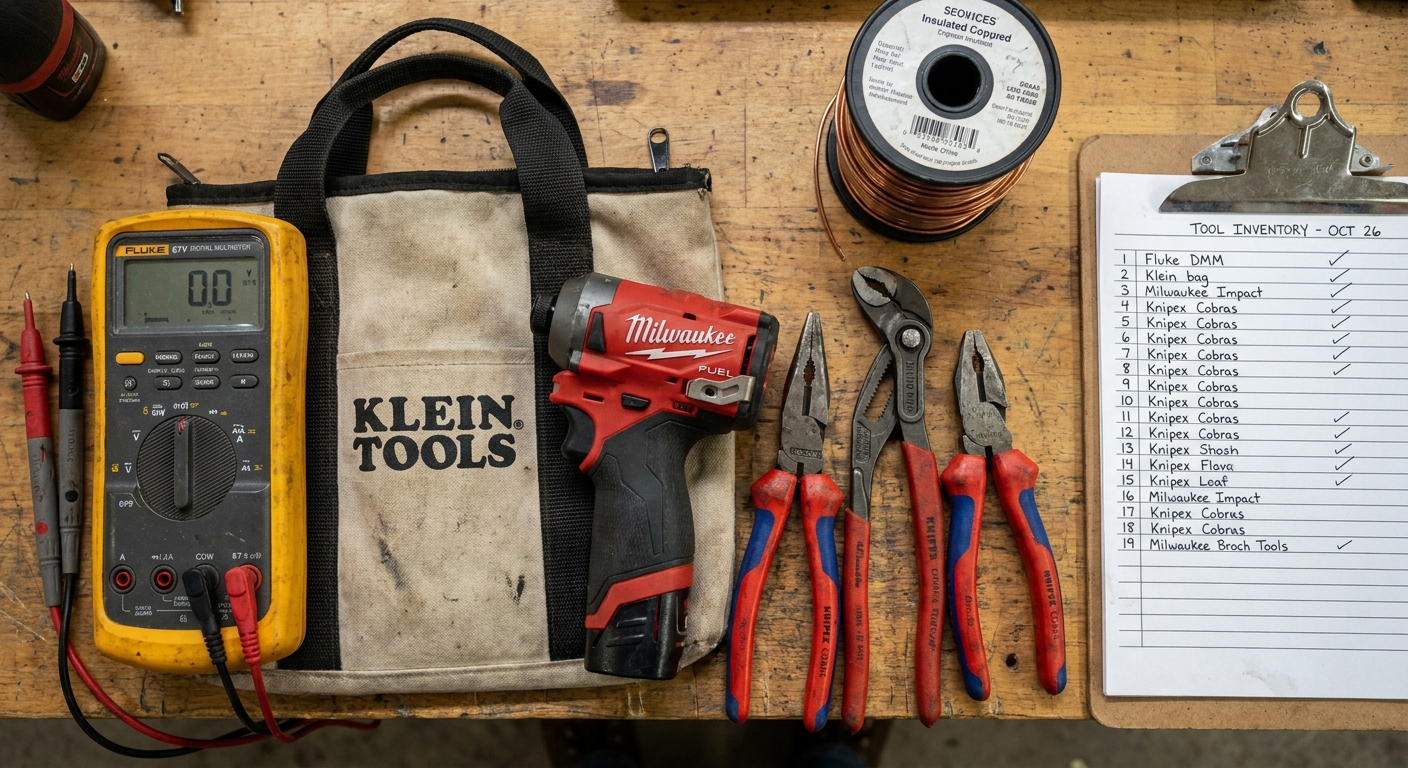
Most insurance applications ask "tools and equipment value: $______". The contractor guesses. The guess is wrong. Here's how to do it properly:
- Open each van. Don't do this from memory.
- Take photos of the interior, shelving, and major equipment.
- List the high-value items individually with serial numbers: thermal camera, Fluke meter, megohmmeter, Greenlee bender, cable puller. These should be scheduled on the policy by serial.
- Lump-sum the consumable/rolling stock: hand tools, breakers, wire, fittings. Estimate by category.
- Add the shelving and buildout — Ranger Design or Adrian Steel installs are $4,000–$8,000 per van and often forgotten.
- Multiply by van count, add 10% for shop-stored gear, and that's your target blanket limit.
Update the inventory annually — at renewal time is the natural moment. Tools wear out, get replaced, get upgraded. A 2022 inventory is wrong by 2026.
The claims that actually happen
Real claims we've worked on electrical contractor inland marine policies in the last 24 months:
- Overnight job-site theft. Van parked at a commercial project, rear door pried open, $18,000 of tools gone. Replacement cost coverage paid the full $18,000. Without RC, the ACV settlement would have been $11,200.
- Battery fire. Lithium-ion battery in a cordless platform thermally ran away inside a parked van. Total loss of $22,000 in tools plus the van. Inland marine paid the tools; BAP paid the van.
- Rollover at job site. Driver lost control on a wet on-ramp, van rolled. Tools were thrown free, conduit bender bent, meters destroyed. $14,500 claim paid under inland marine.
- Rented trencher damage. Apprentice ran a rented Ditch Witch into a buried gas line. Pipe was fine, trencher was not. $11,000 in damage to the rental — paid under the rented/borrowed equipment extension.
- Employee personal tools theft. Three vans hit overnight at the shop yard. Journeymen's personal Klein and DeWalt tools — $14,000 across three employees — paid under the employees' tools extension.
Every single one of these claims would have been a fight (or a complete denial) under a thin inland marine policy or a BAP-only program with no tools coverage.
The three things to ask your broker today
- "What's the per-item limit and the per-van blanket limit on my current inland marine?"
- "Is it written replacement cost or actual cash value, and is theft from unattended vehicles covered without a sub-limit?"
- "Do I have employees' personal tools coverage and rented/borrowed equipment coverage attached?"
If your broker can't answer those three questions in 60 seconds, you have homework to do — and possibly a different broker to consider.
Frequently Asked Questions
Does my commercial auto policy cover the tools inside the van?
No. BAP covers the vehicle itself (collision and comprehensive). Tools and equipment inside the vehicle are covered under a separate Contractors' Equipment Inland Marine policy or endorsement.
How much inland marine coverage does a typical electrical service van need?
A fully-outfitted electrical service van carries $25,000–$55,000 of tools and equipment in 2026. Your per-van blanket limit should be at least $50,000, with a per-item limit of at least $10,000 to cover high-value test equipment.
What does inland marine coverage cost for an electrical contractor?
For a 10-van shop with $400K of total tools exposure, expect $1,200–$2,400 annually for a standalone policy, or $900–$1,800 if bundled inside a BOP at Travelers, The Hartford, or similar.
Does inland marine cover theft from unattended vehicles?
It depends on the policy. Many standard forms either exclude theft from unattended vehicles or sub-limit it severely. Confirm in writing that your policy covers it with no special sub-limit, or get the exclusion removed.
What's the difference between replacement cost and actual cash value?
Replacement cost pays what it costs to replace the tool today. Actual cash value pays the depreciated value (today's market value of the used tool). On a $40,000 tool loss, the difference is often $12,000–$18,000. Always write inland marine on RC.
Does inland marine cover my employees' personal tools?
Only if the policy has an employees' tools extension. Standard contractors' equipment coverage covers company-owned tools. Add an employees' tools endorsement ($5,000 per employee is typical) to cover journeymen's and apprentices' personal gear.
The bottom line
The $40,000 of gear inside every electrical service van isn't covered by your BAP — period. It needs a separate Contractors' Equipment Inland Marine policy with the right limits, replacement cost valuation, theft-from-unattended-vehicles coverage, employees' tools extension, and rented/borrowed equipment coverage. The total annual cost is small relative to the exposure. The single most common reason electrical contractors are underinsured here is that nobody actually inventoried the vans.
If you want an inland marine review done properly — vans inventoried, exposures matched to limits, replacement cost confirmed, and the right carrier on the policy — contact iConn Insurance Solutions. We'll spend an hour with you, write the right policy, and your $40K of tools per van will actually be covered when something goes wrong.