
Contractor's Pollution Liability for Plumbers: The Coverage Most Plumbers Skip (And Shouldn't)
Contractor's Pollution Liability for Plumbers: The Coverage Most Plumbers Skip (And Shouldn't)
Short answer: Contractor's Pollution Liability (CPL) is a standalone or endorsed insurance policy that covers third-party bodily injury, property damage, and cleanup costs arising from pollution incidents during contracting work. For plumbers, this means sewer backups, ejected sewage, fuel spills, refrigerant releases, contaminated water, mold from improperly installed fixtures, and most other "polluted" claim scenarios. The standard ISO General Liability form contains an absolute pollution exclusion — without CPL, none of these claims is covered. A $1M / $2M CPL policy for a plumbing fleet costs $2,500–$7,500 per year and is one of the most important coverages a fleet plumber can carry.
Why Plumbers Are a Pollution-Risk Class
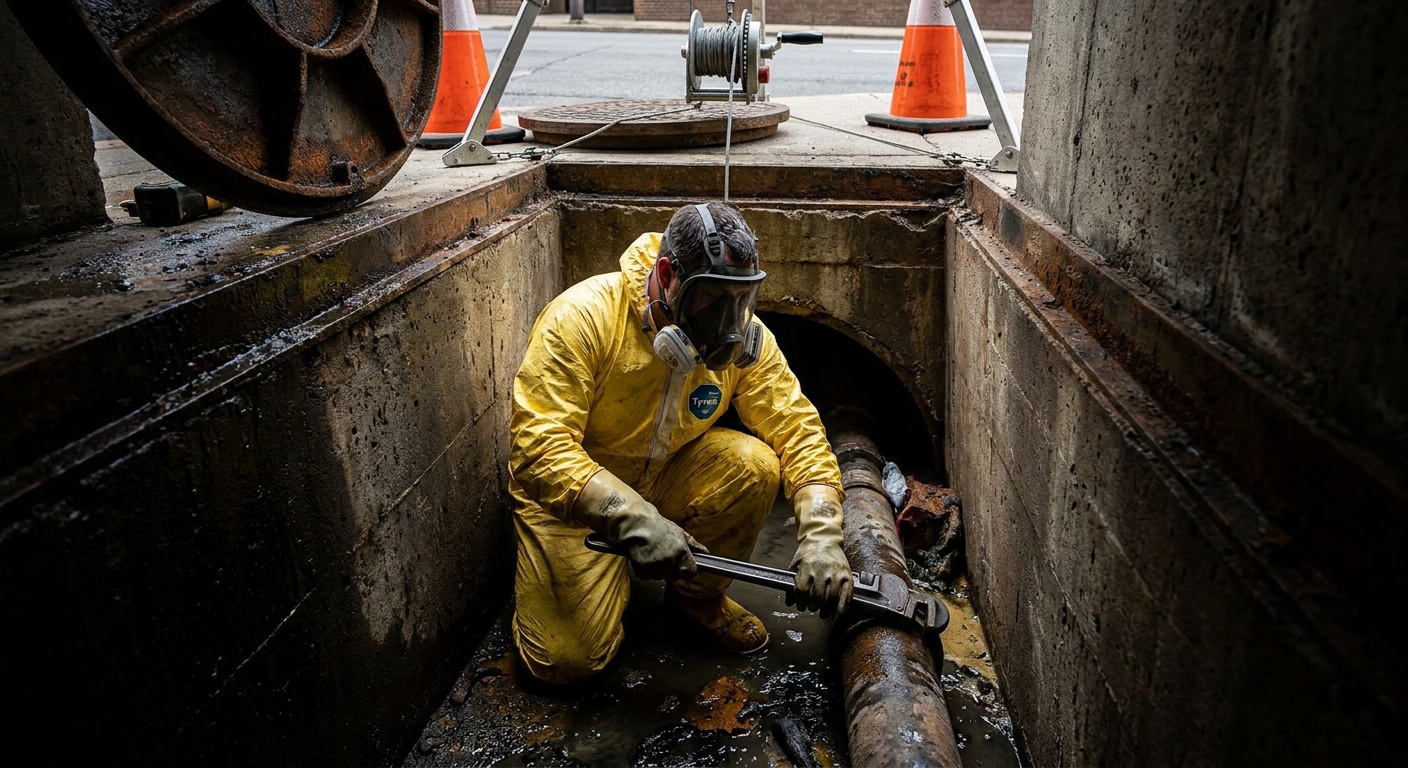
Most people don't think of plumbing as a "pollution" trade. Pollution sounds like chemical plants and refinery fires, not a guy with a snake and a service van. The insurance industry sees it differently.
The legal and policy definition of "pollutant" is broad: "any solid, liquid, gaseous, or thermal irritant or contaminant, including smoke, vapor, soot, fumes, acids, alkalis, chemicals, and waste." Sewage, sewer water, contaminated tap water, refrigerant, natural gas, fuel oil, and even debris from a backed-up drain all fit inside that definition.
Plumbers encounter pollutants on essentially every job:
- Sewer and drain work — sewage backflow, ejected waste, contaminated water
- Water heater service — natural gas, propane, water damage from tank failure
- Boiler and hydronic systems — glycol leaks, fuel oil spills, refrigerant releases on chilled-water systems
- Backflow prevention work — cross-connection contamination of potable water
- Sump pump and ejector pump installs — discharge contamination, basement flooding
- Gas line work — leaks, evacuations, indoor air contamination
- Mold exposure — secondary to any of the above, often the largest single claim driver
Every one of these is a pollution event under standard policy language. The frequency is high, the severity is high, and the GL policy doesn't cover any of it.
The Pollution Exclusion: Read It Once and You'll Buy CPL
Every Commercial General Liability policy on the ISO CG 00 01 form (the dominant GL form in the U.S. market) contains Exclusion f — Pollution. The relevant text reads:
This insurance does not apply to: (1) "Bodily injury" or "property damage" arising out of the actual, alleged or threatened discharge, dispersal, seepage, migration, release or escape of "pollutants": (a) At or from any premises, site or location which is or was at any time owned or occupied by, or rented or loaned to, any insured… (d) At or from any premises, site or location on which any insured or any contractors or subcontractors working directly or indirectly on any insured's behalf are performing operations…
Read in plain English: if anything that looks like a pollutant escapes during the work a contractor is doing, the GL doesn't cover it. There are narrow exceptions (heat/smoke/fumes from a hostile fire, equipment fuel spills in some cases), but for a working plumber, the practical answer is: pollution claims aren't covered by GL.
Plumbers who don't carry CPL often discover this exclusion the first time they file a claim for a sewer backup. The denial letter arrives 60–90 days later, the claim becomes self-funded, and a $40,000 basement remediation becomes the plumber's own cash problem.
What Contractor's Pollution Liability Actually Covers
A CPL policy is purpose-built to cover the pollution exclusion gap on the GL. A well-written plumbing CPL will respond to:
Third-party bodily injury
Customer or bystander illness, exposure, or injury from contact with sewage, contaminated water, refrigerant, gas, or other pollutants released during the work. Includes medical expenses, lost wages, pain and suffering, and any awarded damages.
Third-party property damage
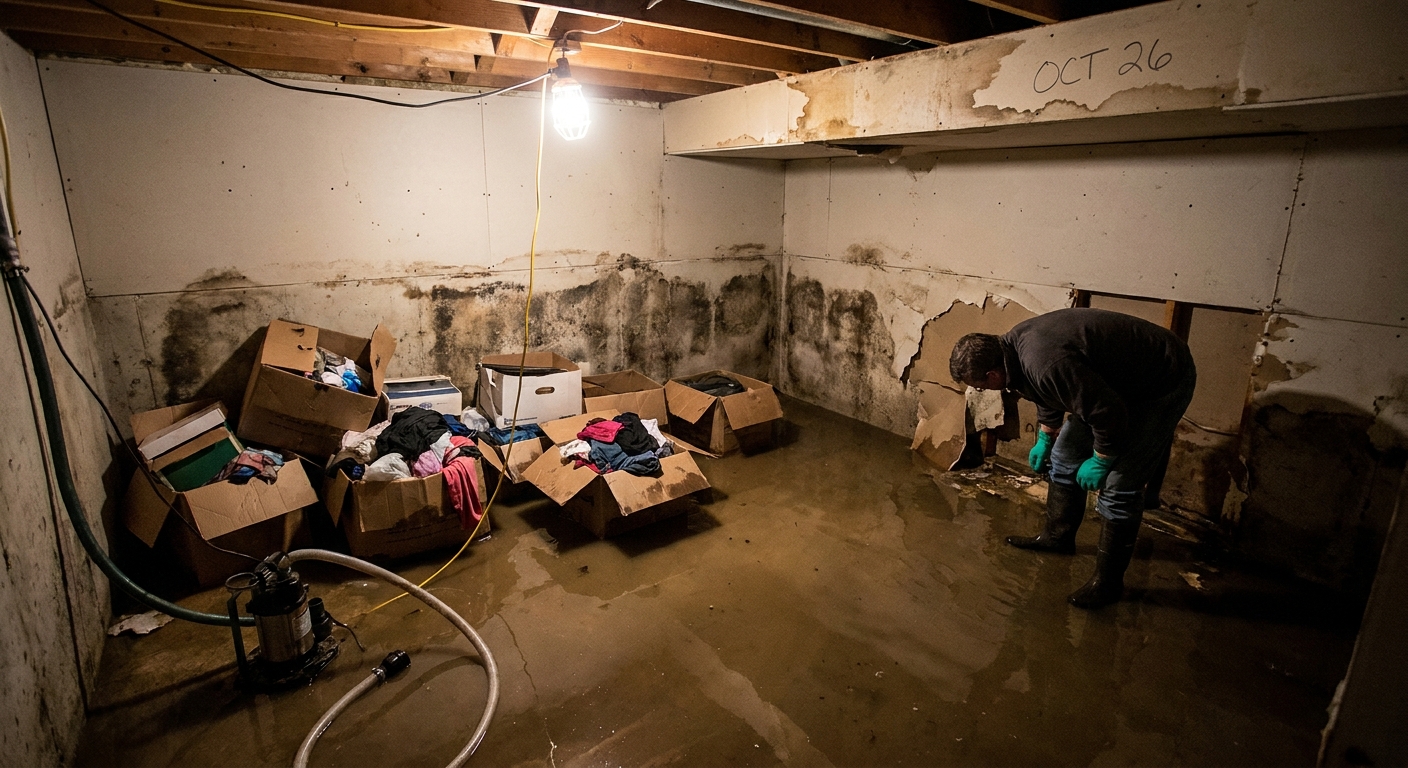
Damage to customer or third-party property from a pollution release. This is the most common plumbing CPL claim category — a sewer backup soaks a finished basement, ejected waste damages landscaping, contaminated water destroys flooring or drywall.
First-party and third-party cleanup costs
The cost of actually cleaning up the pollution. Cleanup is often the biggest single line on a pollution claim — a 1,200 sq ft basement remediation with category-3 water (sewage) runs $30,000–$80,000 before structural repairs. CPL covers this; GL doesn't.
Defense costs
Legal defense for any covered pollution claim. Well-written CPL policies pay defense outside the limit, meaning a $200,000 defense doesn't erode your $1M occurrence limit. Cheaper CPL policies pay defense inside the limit; this is one of the more important policy-form details to negotiate.
Emergency response costs
Immediate response and containment costs after a pollution event — calling in a hazmat cleanup crew, deploying water-extraction equipment, or coordinating with local authorities. Most CPL policies include $25,000–$100,000 of emergency-response coverage with no deductible.
Mold and microbial coverage
Plumbers see a huge volume of mold claims downstream of water damage. Standard GL excludes mold. A well-endorsed CPL will include mold coverage — both first-party (mold growth in customer property after plumbing failure) and resulting bodily injury (occupant illness from mold exposure). This is the second-most-important endorsement to verify on a plumbing CPL.
What CPL Does NOT Cover
It's worth being explicit about what CPL is not:
- The plumber's own work product — if you install a fixture wrong and have to come back to fix the fixture itself, CPL doesn't pay for the rework. That's products-completed-operations coverage on the GL.
- Damage to the plumber's own truck or equipment — that's BAP and inland marine.
- Pre-existing pollution conditions — if you arrive at a job site and the customer's existing sewer was already leaking, CPL covers your work but not the pre-existing condition.
- Intentional pollution events — illegal dumping, willful misconduct, or fraud is excluded everywhere.
- Asbestos and lead — unless specifically endorsed. Most modern CPL policies exclude these by default; ask if you do work in older buildings.
Standalone CPL vs Pollution Buyback on the GL — Which Should a Plumber Carry?
You have two structural options for adding pollution coverage to your plumbing program:
Option 1: Pollution buyback endorsement on the GL
Carriers like Federated, Travelers, The Hartford, and Liberty Mutual can endorse a "pollution buyback" onto your GL that gives back some of the pollution coverage the exclusion strips out. Typical limits: $250K–$1M sub-limit per occurrence, shared with the GL aggregate.
Pros: cheap (often $500–$1,500/year added to the GL), simple, single policy.
Cons: limits are usually low, mold is often capped severely or excluded, defense costs erode the limit, and the coverage is typically tied to specific operations rather than blanket.
Best for: small plumbing shops with minimal sewer work, no heavy jetting, no hazmat exposure, and limits below $1M.
Option 2: Standalone Contractor's Pollution Liability policy
A separate CPL policy from a specialty carrier — Travelers Construction, Hartford Pollution, Berkley One, ACE/Chubb, or a surplus-lines market like Scottsdale.
Pros: dedicated limits ($1M–$5M occurrence common), broader operations covered, mold typically included with meaningful sub-limits, defense usually outside the limit, blanket coverage anywhere the plumber operates.
Cons: more expensive ($2,500–$7,500 for a fleet), separate renewal date, separate policy to manage.
Best for: any plumbing fleet doing sewer/drain work, jetting, large commercial jobs, or operating in a state with active class-action plaintiff bar (CT, NY, NJ, PA all qualify).
The right answer for most plumbing fleets
For a plumbing contractor with 5+ trucks doing any sewer/drain work, the right answer is almost always a standalone CPL policy. The cost differential is $1,500–$5,000/year. The coverage differential is the difference between "your sewer backup claim is fully defended and paid" and "your sewer backup claim is denied and you self-fund a $60,000 cleanup."
Limits — What Should a Plumber Buy?
For most plumbing fleets, the minimum defensible CPL structure is:
- $1M per occurrence / $2M aggregate — the floor for any plumbing fleet doing residential and light commercial work
- $2M per occurrence / $4M aggregate — recommended for fleets above 10 trucks, or shops doing meaningful sewer/drain volume
- $5M occurrence (via excess CPL or umbrella over CPL) — for plumbing fleets doing large commercial, multi-family, healthcare, or municipal work
The cost-per-million curve flattens quickly. Moving from $1M to $2M CPL typically adds 40–60% to the base premium; moving from $2M to $5M adds another 50–80%. For a $5M plumbing CPL on a 15-truck fleet, expect roughly $8,000–$14,000/year.
Real Claim Examples Where CPL Was the Difference
Three composite-but-realistic plumbing pollution scenarios:
Case 1 — Residential sewer backup, finished basement
A plumbing tech jetting a residential 4-inch clay sewer line punches through a root mass that was bridging a partially collapsed section. Sewage backflows up the house's main stack and into a finished basement with $80K of remodeling — wood floors, drywall, built-ins, an entertainment system. Total third-party damage: $94,500. Cleanup: $38,000. Mold remediation 90 days later: $22,000. CPL paid $154,500. GL would have denied.
Case 2 — Commercial restaurant, fuel oil release
A plumbing crew replacing a fuel-oil-fired water heater at a downtown restaurant accidentally over-tightens a fitting on the supply line during decommissioning, and oil drips into a floor drain that connects to the storm sewer. Restaurant is closed for 6 days while environmental remediation pulls 220 gallons of contaminated wash water from the storm system. Third-party damage + business interruption + remediation: $187,000. CPL paid the full claim.
Case 3 — Backflow contamination at a school
A plumbing contractor installing a new irrigation system fails to install the required backflow preventer at the connection point. Three months later, a pressure drop causes contaminated irrigation water to backflow into the school's potable water supply. 14 children show GI symptoms; the school is closed for 3 days; the public health department investigates. Aggregate claim from the school district and affected families: $640,000. CPL paid up to the $1M limit. The plumber's $5M umbrella picked up the rest.
In all three cases, the plumber was covered because CPL was in force. In all three, the GL would have denied. The total avoided self-funded loss across the three claims: roughly $980,000.
How Much Does Plumbing CPL Cost in 2026?
Pricing varies by fleet size, operations mix, prior loss history, and state. Typical 2026 rates for a clean plumbing fleet in the Northeast:
| Fleet Profile | Limit | Annual Premium |
|---|---|---|
| 3-truck residential plumbing, no jetters | $1M / $2M | $1,800–$2,800 |
| 10-truck residential + light commercial, 1 jetter | $1M / $2M | $3,500–$5,200 |
| 10-truck residential + light commercial, 1 jetter | $2M / $4M | $5,500–$7,800 |
| 25-truck mixed commercial, 3 jetters, drain specialty | $2M / $4M | $8,500–$13,000 |
| 25-truck mixed commercial, 3 jetters, drain specialty | $5M / $10M | $14,000–$22,000 |
For perspective: the $5,500 mid-fleet CPL premium is roughly the cost of one $40,000 sewer backup claim's deductible plus 10% of the claim. The math doesn't work to skip the coverage.
Carriers Writing Plumbing CPL in 2026
The primary admitted markets for plumbing CPL:
- Travelers — broad appetite, can bundle with GL/BAP/WC
- Federated Insurance — pollution buyback on GL or standalone CPL
- The Hartford — pollution buyback on GL for smaller fleets, standalone CPL through specialty unit
- Liberty Mutual — strong on mid-market and large plumbing fleets
- Chubb / ACE — premium specialty CPL, best policy form on the market
- Berkley One / Berkley Environmental — specialty CPL writer
- Nationwide E&S / Scottsdale — surplus-lines option when admitted declines
Want CPL Quoted on Your Plumbing Fleet?
The team at iConn Insurance Solutions places Contractor's Pollution Liability for plumbing contractors across the Northeast, with appointments at every carrier above. We'll quote three structures side by side — pollution buyback on the GL, standalone $1M / $2M CPL, and standalone $2M / $4M CPL — so you can see the cost-vs-coverage curve on your specific account before deciding.
Frequently Asked Questions
Do plumbers really need Contractor's Pollution Liability?
For any plumbing contractor doing sewer/drain work, fuel oil systems, hydronic systems, backflow installation, or even residential service plumbing — yes. The standard GL policy excludes pollution, and most meaningful plumbing claims have a pollution component (sewage, contaminated water, mold, fuel, refrigerant). Without CPL, those claims become self-funded losses.
What does CPL cover that GL doesn't?
CPL covers third-party bodily injury, property damage, cleanup costs, and defense costs from pollution incidents during contracting work — including sewer backups, ejected sewage, contaminated water, fuel spills, refrigerant releases, and (when endorsed) mold. GL's absolute pollution exclusion bars all of these from the GL.
How much does CPL cost for a plumbing fleet?
Roughly $1,800–$2,800/year for a 3-truck shop at $1M/$2M, $3,500–$5,200 for a 10-truck fleet at $1M/$2M, and $8,500–$13,000 for a 25-truck fleet at $2M/$4M. Pricing varies by fleet size, operations mix, jetter count, and prior loss history.
Is pollution buyback on the GL enough, or do I need a standalone CPL?
For a small plumbing shop with no sewer/drain work and limits below $1M, the GL buyback can be enough. For any plumbing fleet doing sewer work, jetting, or commercial jobs, a standalone CPL is the right answer — broader operations coverage, dedicated limits, defense outside the limit, and meaningful mold sub-limits.
Does CPL cover mold from a plumbing leak?
If the CPL policy is properly endorsed, yes. Most modern plumbing CPL policies include a mold sub-limit ($250K–$1M typical) covering both first-party mold remediation and third-party bodily injury from mold exposure. Standard GL excludes mold entirely.
Will CPL cover a sewer backup that wasn't caused by my plumber?
CPL responds to pollution events caused by the insured's operations. If a customer's sewer backed up before your plumber arrived, CPL doesn't cover the pre-existing condition. If your plumber was on-site doing work that contributed to or caused the backup, CPL covers the resulting damage.
Continue the Plumbing Fleet Insurance Series
- Pillar: Commercial Auto Insurance for Plumbing Contractor Fleets — The Complete 2026 Guide
- How Much Does Commercial Auto Insurance Cost for a Plumbing Fleet?
- 7 Insurance Mistakes Plumbing Fleets Make
- BAP vs Contractor's Pollution Liability vs Sewer Backup Endorsements
- Best Insurance Carriers for Plumbing Contractors With Fleets
- Federated Insurance Review: The Plumbing Contractor's View
- How to Insure a Truck-Mounted Jetter Without a Coverage Gap
- Sewer Backup Claim Walkthrough: 5 Policies, One Plumber
Contenido relacionado
AI Payment Fraud Incident Response: What to Do First
The first hour after a fraudulent wire can decide whether funds are frozen or lost. Follow this practical response guide for banks, insurers, evidence, law enforcement, and recovery.
Leer artículo →
Hotel and Commercial Property Insurance: Where Should Renewal Savings Go?
A practical guide for hotel and commercial-property owners deciding whether to keep renewal savings, lower deductibles, increase limits or restore coverage.
Leer artículo →AI Fraud Insurance Exclusions: Where Coverage Can Break
A large cyber limit can hide a small social engineering sublimit. Learn how voluntary-transfer language, verification conditions, and overlapping crime coverage can affect AI fraud claims.
Leer artículo →
Connecticut Builders Risk Insurance: 2026 Buyer’s Guide
Connecticut builders risk buyers should update project values, timelines and controls. Learn what to prepare and compare for a 2026 placement.
Leer artículo →