
What Insurance Does a Ship Detailing Business Need?
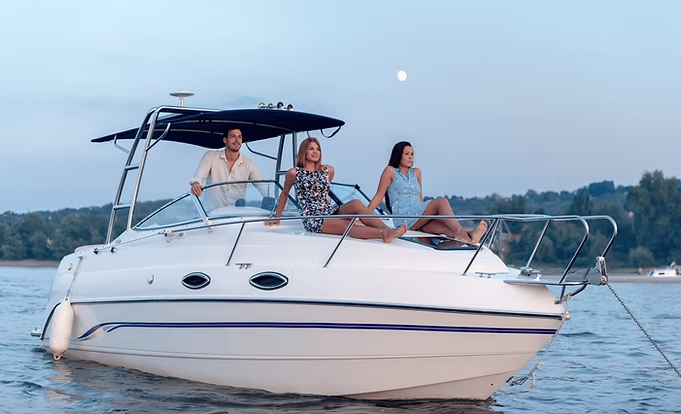
A ship detailing business can look simple from the outside: polish, wash, wax, protect, repeat. But anyone who has worked around marinas, yacht clubs, boatyards, and waterfront slips along the Connecticut coast and Rhode Island coast knows the job carries a very different risk profile than ordinary cleaning work. You are not just cleaning a surface. You are working around high-value customer property, wet walking surfaces, electrical systems, fuel, solvents, environmental rules, and contracts that may decide whether you are allowed on the dock at all.
That is why this first article launches our ship detailing business insurance series. We will cover the practical questions owners ask before bidding on marina work, hiring helpers, buying a van, signing a vendor agreement, or finding out after a claim that a policy did not match the job. The goal is straight answers first, sales second.
What insurance does a ship detailing business need?
A ship detailing business usually needs general liability, coverage for customer vessel damage, commercial auto, workers' compensation, mobile equipment coverage, and pollution or chemical-related protection. The exact mix depends on whether the business works dockside, in boatyards, from a mobile van, under marina contracts, or with subcontractors.
Why is ship detailing riskier than regular cleaning?
Regular cleaning usually happens in a building where the property values, access points, and hazards are familiar. Ship detailing often happens on floating docks, ladders, lifts, tight walkways, wet decks, and customer vessels with expensive finishes. A buffer burn on gelcoat, a chemical stain on upholstery, an overspray incident, or a slip on a dock can turn one job into a five-figure problem.
The Insurance Information Institute explains that commercial general liability is meant to protect a business from financial loss when it is liable for bodily injury, property damage, or personal and advertising injury tied to operations, services, or employees. That is the foundation, but marine detailing adds a question that many ordinary service businesses do not face: what happens when the thing you are working on is the customer's vessel?
That question matters across coastal Connecticut and Rhode Island because many detailers work around New Haven Harbor, the Gold Coast of Fairfield County, the lower Connecticut River, Mystic, Stonington, Newport, Warwick, Narragansett, and Point Judith. In these marina communities, one contract can require specific coverage wording before a crew steps on site.
What changes for ship detailers on the Connecticut coast and Rhode Island coast?
Coastal work adds two layers that inland mobile service businesses may not face as often: marina access and water-quality sensitivity. Connecticut DEEP notes that marinas sit at the water's edge, where pollutants from parking lots and hull maintenance areas can be transported by runoff into marina basins. Rhode Island's Coastal Resources Management Council is responsible for preservation, protection, development, and restoration of the state's coastal areas through coastal management plans and permitting.
For insurance purposes, that means a ship detailing business serving the Connecticut coast or Rhode Island coast should be ready to discuss not only customer vessel damage, but also marina certificates, environmental procedures, chemical use, wastewater handling, subcontractor controls, and whether the business crosses state lines. A policy written for a generic cleaning operation may miss the details that matter most in a marina setting.
What coverage areas should marine detailers review first?
Think of insurance like a detailing kit. One bottle does not solve every surface problem. You need the right product for fiberglass, stainless, canvas, vinyl, teak, glass, and non-skid. Coverage works the same way. One policy may handle some losses well and leave others outside the bucket.
| Coverage area | What it may address | Question to ask before you buy |
|---|---|---|
| General liability | Third-party bodily injury or property damage claims | Does it clearly allow marine detailing and work at marinas? |
| Customer property coverage | Damage to vessels or vessel components in your care | Is care, custody, or control damage limited or excluded? |
| Inland marine or equipment coverage | Polishers, generators, vacuums, ladders, extractors, and supplies away from your shop | Are tools covered in the van, at the dock, and overnight? |
| Workers' compensation | Employee injuries from slips, lifting, repetitive motion, heat, chemicals, or falls | Are all employees, seasonal workers, and helpers classified correctly? |
| Commercial auto | Business vehicle use, equipment transport, and jobsite travel | Does your personal auto policy exclude business use? |
| Pollution or environmental coverage | Chemical runoff, wastewater, spills, and related cleanup claims | Are solvents, soaps, wastewater, or overspray incidents excluded? |
Does general liability cover damage to a customer's boat?
Sometimes. But this is the wrong place to rely on a casual answer. The phrase to know is care, custody, or control. Many liability policies restrict damage to property you are actively working on or property under your control. If a worker scratches a customer's hull, damages teak, burns through a finish, or stains interior fabric, the claim may not behave like a simple slip-and-fall claim.
That does not mean coverage is impossible. It means the policy needs to be reviewed for the actual work being performed. A yacht detailer polishing a 60-foot vessel in Stamford has a different exposure than a mobile cleaner washing small recreational boats on trailers in inland Connecticut.
At iConn Insurance Solutions, we have seen business owners assume "I have liability" means "everything I touch is covered." That assumption can be dangerous. A better question is: if the most expensive vessel you work on were damaged during a job, what policy section would respond, what limit would apply, and what exclusion might the carrier point to?
How much does insurance cost for a ship detailing business?
There is no honest flat price because insurers rate the business based on services, payroll, revenue, location, claim history, vehicles, equipment values, subcontractor use, and the type of vessels serviced. A one-person mobile detailer with basic wash and wax work will usually be rated differently than a crew doing ceramic coatings, paint correction, teak restoration, and contract work inside marinas.
The cost question is still worth asking early. Price is affected by choices you control: written contracts, employee training, chemical handling, certificates from subcontractors, driver screening, job documentation, and whether you keep before-and-after photos. Good operations do not guarantee a lower premium, but they make your business easier to explain to underwriters.
When requesting quotes, do not describe the business as only "cleaning." Tell the advisor whether you work on boats, yachts, ship interiors, marinas, docks, or boatyards. A quote built on the wrong description can be cheaper on paper and weaker when a claim happens.
Are Connecticut ship detailing businesses required to carry workers' compensation?
If you have employees, workers' compensation deserves immediate attention. Connecticut's workers' compensation system is governed by statutes and regulations administered through the Workers' Compensation Commission, and the state notes that those regulations carry the force of law in implementing the system. You can review the official Connecticut workers' compensation regulations through CT.gov.
For ship detailers, the injury risks are not theoretical. Wet surfaces, marina ramps, ladders, repetitive polishing, lifting equipment, summer heat, confined interiors, and chemical exposure all show up in real operations. If a helper gets hurt while working under your direction, the question of whether they were an employee, subcontractor, casual worker, or properly insured business can become more important than anyone expected.
Why do marina contracts ask for certificates of insurance?
Marinas and yacht clubs do not ask for certificates just to create paperwork. They are protecting their docks, customers, staff, property, and lease obligations. A contract may ask you to name the marina as an additional insured, carry specific limits, waive subrogation, provide workers' compensation proof, or meet pollution-related requirements.
This is where a surprising comparison helps: the certificate is like your boarding pass. It does not fly the plane, but without it you may not get through the gate. The actual insurance policy is what matters when something goes wrong, but the certificate often determines whether you can win the account in the first place.
If a marina agreement includes insurance language, share it with your advisor before signing. Some requirements are routine. Others may ask for coverage you do not have, limits higher than your current policy, or terms your carrier will not provide.
Do marine detailing chemicals create pollution risk?
Yes, especially when work happens near water. Soaps, solvents, compounds, fuel residue, wastewater, and runoff can create environmental concerns even when the business owner is careful. The U.S. Environmental Protection Agency has taken enforcement actions involving marinas and clean water compliance, including requirements tied to stormwater and oil spill management plans. You can see an EPA example involving marina compliance on EPA.gov.
The insurance lesson is simple: pollution exclusions can be broad. If your crew uses acids, degreasers, solvents, hull cleaners, ceramic products, or pressure washing equipment, ask directly how the policy treats spills, runoff, containment mistakes, and cleanup costs.
Why independent brokers matter for ship detailing businesses
Ship detailing businesses do not fit neatly into a one-size-fits-all quote form. An independent broker can compare multiple carrier appetites, explain exclusions, review marina contract requirements, and help match the policy to the way the business actually operates.
iConn Insurance Solutions is an independent agency, which means the conversation is not limited to one carrier's product shelf. That matters for marine service businesses because carrier appetite can vary widely. One insurer may be comfortable with mobile detailing but not work at marinas. Another may want stronger subcontractor controls. Another may have better options for tools, auto, or commercial package coverage.
Together with our sister agency, Insure Connecticut LLC, the broader insurance network can help Connecticut business owners think through risk from more than one angle. If you are operating along the shoreline, in the Hartford metro, in Fairfield County, or across multiple states, the value is not just finding a policy. It is making sure the policy is built around the business you actually run.
What should you gather before requesting a quote?
You will get a better insurance conversation if you prepare the same way you would prepare a vessel before detailing: inspect first, then apply the right solution.
- A list of services: washdown, waxing, compounding, ceramic coating, interior cleaning, canvas cleaning, teak work, pressure washing, or restoration.
- Where work is performed: customer homes, docks, marinas, boatyards, yacht clubs, storage facilities, or your own location.
- Estimated annual revenue and payroll.
- Vehicle details and how equipment is transported.
- Tool and equipment values, including items stored in vans or trailers.
- Copies of marina or vendor insurance requirements.
- Subcontractor agreements and certificates of insurance, if you use subcontractors.
- Chemical handling, runoff, disposal, and safety procedures.
A soft next step is to request a policy review before your busiest season. That gives you time to fix certificate issues, increase limits, add equipment coverage, or address contract language before a marina manager or customer asks for proof.
Key takeaways for ship detailing business owners
- Ship detailing insurance should be built around marine property, not generic cleaning work.
- General liability is important, but customer vessel damage and care, custody, or control language need special review.
- Mobile tools, business vehicles, employees, subcontractors, and chemicals each create separate coverage questions.
- Marina contracts can require specific limits and wording before your crew is allowed on-site.
- Independent brokers can help compare carrier options and explain the trade-offs instead of forcing every business into one template.
Frequently Asked Questions About Ship Detailing Business Insurance
What insurance does a ship detailing business need?
Most ship detailing businesses should review general liability, customer vessel damage coverage, commercial auto, workers' compensation, mobile equipment coverage, and pollution-related protection. The right mix depends on services, location, employees, contracts, and whether the business works at marinas or boatyards.
How much does ship detailing business insurance cost?
Cost depends on revenue, payroll, services, vessel types, equipment values, vehicles, claim history, and contract requirements. A one-person mobile detailer may price differently than a crew performing high-end yacht restoration work inside marinas.
Does general liability cover damage to a customer's yacht?
It may, but do not assume. Many policies limit damage to property in your care, custody, or control. Yacht detailers should ask exactly how the policy responds if their work damages gelcoat, upholstery, electronics, canvas, teak, or other vessel property.
Do Connecticut marine detailers need workers' compensation?
If the business has employees, workers' compensation should be reviewed immediately under Connecticut rules. Ship detailing involves wet surfaces, lifting, ladders, repetitive motion, heat, and chemical exposure, so employee classification and coverage should be handled before work begins.
Why do marinas ask to be additional insured?
Marinas ask because your work can create liability for their property, customers, docks, and operations. Additional insured wording may give the marina certain protection under your policy for covered claims tied to your business operations.
How do I choose the right insurance broker for a marine detailing business?
Choose someone who asks detailed questions about vessels, marinas, contracts, employees, tools, vehicles, chemicals, and subcontractors. If the conversation sounds like ordinary janitorial insurance, keep asking until the marine exposure is clearly understood.
Ready to review your coverage?
If you run a ship, yacht, or marine detailing business in Connecticut or nearby states, iConn Insurance Solutions can help you review your current coverage, compare options, and prepare certificates for marina or vendor requirements. Start with a conversation before the next busy season, not after a claim or contract deadline.
Request a quote or policy review through iConn Insurance Solutions. For additional Connecticut insurance resources, you can also visit our sister agency, Insure Connecticut LLC.
Contenido relacionado
AI Payment Fraud Incident Response: What to Do First
The first hour after a fraudulent wire can decide whether funds are frozen or lost. Follow this practical response guide for banks, insurers, evidence, law enforcement, and recovery.
Leer artículo →
Hotel and Commercial Property Insurance: Where Should Renewal Savings Go?
A practical guide for hotel and commercial-property owners deciding whether to keep renewal savings, lower deductibles, increase limits or restore coverage.
Leer artículo →AI Fraud Insurance Exclusions: Where Coverage Can Break
A large cyber limit can hide a small social engineering sublimit. Learn how voluntary-transfer language, verification conditions, and overlapping crime coverage can affect AI fraud claims.
Leer artículo →
Connecticut Builders Risk Insurance: 2026 Buyer’s Guide
Connecticut builders risk buyers should update project values, timelines and controls. Learn what to prepare and compare for a 2026 placement.
Leer artículo →