
Camera, Grip & Lighting Equipment Insurance for CT Productions: 2026 Cost & Coverage
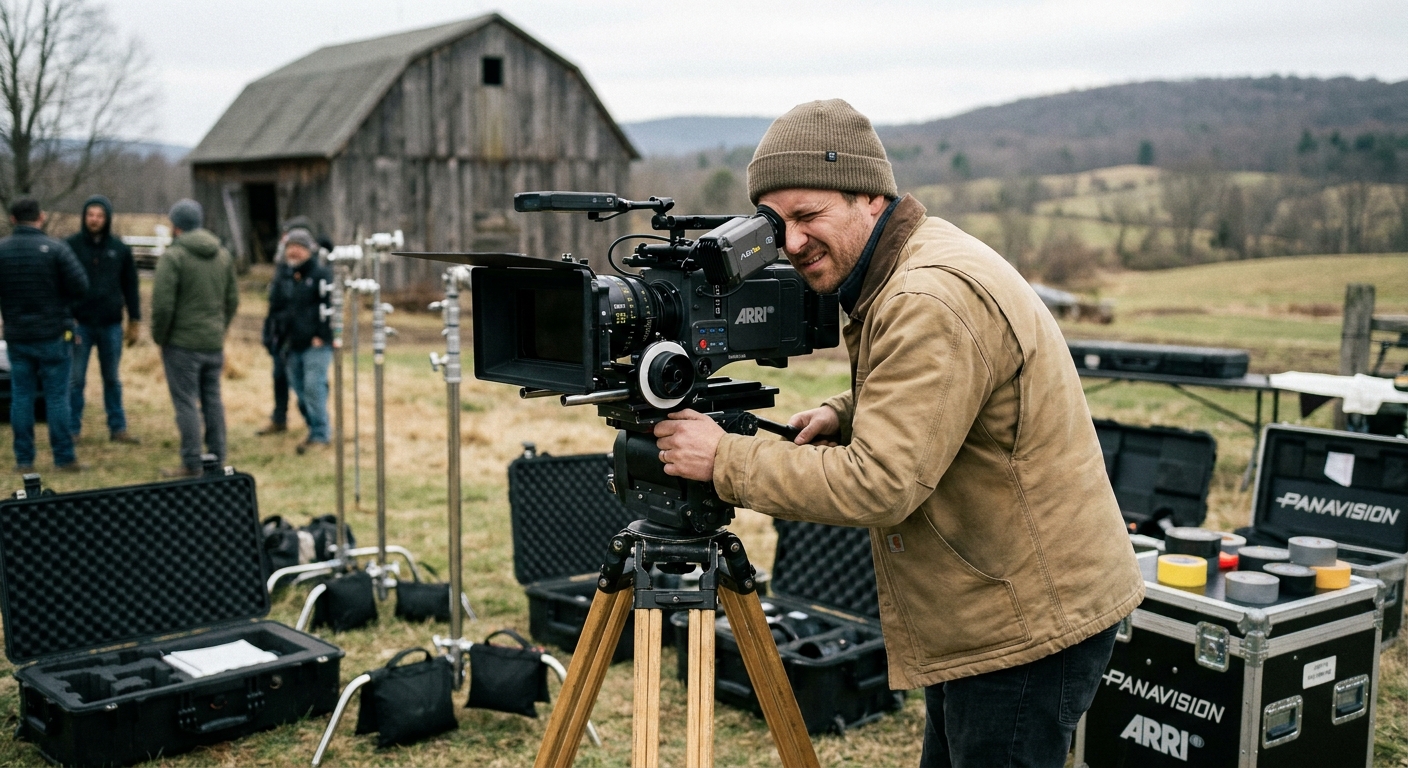
An ARRI Alexa Mini LF rents for $1,200 a day. The full camera package with lenses, matte box, and follow focus runs $3,500–$5,000/day. A complete grip and electric package for a feature shoot — HMIs, LED panels, dolly track, stands, sandbags, gel kits — easily clears $250,000 in replacement value. And the rental house holds you contractually responsible for every dollar of it from the moment you sign the gear out until it's checked back in.
This is the third spoke in our CT Film & Production Insurance cluster, building on the pillar guide to film production insurance and the GL coverage deep-dive. Equipment coverage — sometimes called Miscellaneous Equipment or "Rented Equipment Coverage" inside a production package — is the policy that lets the rental house hand you the gear without holding the producer's house as collateral.
What does film production equipment insurance cover?
Film production equipment insurance covers rented and owned camera, grip, lighting, and audio gear against theft, damage, and loss while in your production's care. It's a first-party property policy (covers your own gear, not third-party harm). Standard CT production limits run $250K–$1M with named perils plus coverage for transit, scheduled equipment, and reactive replacement at agreed value. 2026 premium ranges: $850 single-shoot to $6,500 annual for a multi-production company.
Equipment coverage is what fills the gap left by general liability's "Care, Custody, and Control" exclusion. GL covers the bystander tripped by your cable run; equipment coverage covers the $4,200 Cooke S4 lens you dropped on the cobblestones in Mystic. Both are essential; neither substitutes for the other.
At iConn Insurance Solutions, we underwrite production equipment coverage every week — and the same three structural mistakes show up repeatedly: under-scheduled gear values, missing transit coverage, and a deductible that's higher than most rental-house loss-and-damage waivers. Each one turns a routine claim into a five-figure out-of-pocket hit.
The four equipment categories your policy needs to cover
| Category | Typical replacement value (one production) | Loss frequency |
|---|---|---|
| Camera body, lenses, accessories | $25K – $400K+ | Moderate — drop/water/electrical damage |
| Grip (stands, flags, dolly, track, sandbags) | $15K – $80K | High — frequent minor damage, occasional theft |
| Electric (HMIs, LEDs, generators, cable) | $30K – $150K | Moderate — electrical, water, transit damage |
| Audio (mixers, boom kits, wireless lavs) | $5K – $40K | Lower — but theft-prone (small, valuable) |
For a typical mid-budget CT shoot, total equipment value in the production's care often runs $150K–$400K. Smaller documentary shoots might run $40K–$80K. Feature productions with multiple camera bodies and a full G&E package easily exceed $500K. Your policy limit needs to be sized against the largest single day's gear total — not the average.
2026 production equipment premium ranges in Connecticut
| Coverage limit | Production type | 2026 premium range |
|---|---|---|
| $100K limit | Documentary/commercial single shoot | $650 – $1,250 |
| $250K limit | Short film / mid commercial | $1,100 – $2,400 |
| $500K limit | Low-budget feature / large commercial | $2,200 – $4,800 |
| $1M+ limit | Feature production | $4,500 – $11,000 |
| Annual ($500K limit) | Multi-production company | $3,800 – $6,500 |
Carriers active in CT production equipment include Travelers (Travelers Entertainment), The Hartford, Chubb, Atain, Front Row Insurance, Markel, and the Lloyd's specialty markets via Allen Financial. Specialty entertainment markets (Front Row, Allen, Atain) typically write smaller productions more competitively; mainstream carriers compete better at the feature level.
The three structural mistakes that turn claims into out-of-pocket losses
Mistake 1: Under-scheduled values
Many policies require gear above a stated value ($25K, $50K, or $100K per item) to be specifically scheduled — meaning listed by serial number with stated value. Unscheduled gear is covered only up to the per-item sublimit (often $10K–$25K). A $50,000 Cooke S4 lens dropped on a documentary shoot is a $25K-coverage hit against a $50K replacement bill if the lens wasn't scheduled.
Mistake 2: Missing transit coverage
Equipment in transit — being driven from rental house to set, between locations, in storage between shooting days — needs explicit transit coverage. Some policies include it automatically; many sublimit it ($25K is common). For a feature production moving $300K of gear between New Haven and Litchfield Hills locations, that's a major exposure gap.
Mistake 3: Deductible higher than the rental house's loss-and-damage waiver (LDW)
Most CT rental houses offer a Loss & Damage Waiver — typically 10–15% of the rental cost — that caps your liability at a deductible-style amount ($1,000–$2,500 per claim). If your insurance policy has a $5,000 deductible and the rental house's LDW caps at $1,500, you're paying more per claim than necessary. Match the deductible to the LDW threshold for the gear you most frequently rent.
This is exactly where an independent broker earns the fee — matching the policy structure to your actual production workflow and rental relationships. Get a production equipment quote from iConn Insurance Solutions — we'll map your typical gear values, rental house relationships, and transit patterns against the right policy structure.
Special considerations: drones, owned cameras, and high-value lenses
Drones
Drone hulls are usually carved out of standard production equipment coverage and require either a drone endorsement or a separate aviation policy. Mavic 3 and Inspire 3 hulls are typically $3K–$10K to replace; cinema drones (Sony Airpeak, custom rigs) run $15K–$50K+. We cover this in detail in our drone coverage spoke.
Owned vs. rented gear
Most production policies cover both, but the values are reported differently. Owned gear is scheduled by description and agreed value; rented gear is typically scheduled by rental house and certificate. Some policies offer a "blanket rented" provision that covers any gear rented during the policy period up to a stated limit — useful for productions that rent across multiple houses.
Vintage and rare lenses
Cooke S4s, vintage Zeiss Super Speeds, anamorphic sets, and other specialty glass need stated-value coverage at the actual replacement cost — not a generic schedule. A 1970s Cooke Speed Panchro set might list at $40K used; new equivalent is $150K+. Underwriters need clear documentation of which value applies.
Why working with an independent broker matters for production equipment
The policy language across entertainment carriers varies more than producers realize. Some define "scheduled" by item; others by category. Some carve out drones; others include them up to a sublimit. Some apply the deductible per item; others per occurrence. Reading the policy form, mapping it against your actual rental contracts, and structuring the program to close the gaps — that's what an independent broker like iConn does. Captive agents handing you one carrier's policy can't.
Our sister agency Insure Connecticut LLC writes production equipment for producers shooting across CT, NY, NJ, MA, and 8 additional states — same independent multi-carrier model with broader regional reach.
Key takeaways
- Equipment coverage fills the "Care, Custody, and Control" gap that GL leaves open — covers rented and owned camera, grip, lighting, and audio gear.
- 2026 CT premiums: $650 (small docs, $100K limit) to $11,000 (features, $1M+ limit). Annual policies for multi-production companies run $3,800–$6,500.
- The three structural mistakes: under-scheduled high-value items, missing transit coverage, and deductibles higher than the rental house LDW threshold.
- Drones are usually carved out — need a separate endorsement or aviation policy.
- Match your policy limit to the largest single day's gear total — not the average.
Frequently Asked Questions About CT Film Production Equipment Insurance
How much does production equipment insurance cost in Connecticut?
CT 2026 production equipment premiums range from $650 (documentary, $100K limit) to $11,000 (feature, $1M+ limit). Most short film and commercial productions land in the $1,100–$2,400 range with a $250K limit. Annual policies for multi-production companies run $3,800–$6,500.
Does my general liability policy cover rented production equipment?
No. GL excludes damage to property in your "care, custody, or control" — meaning the rented equipment, the location interior, and props you've moved are NOT covered. That's what production equipment / inland marine coverage exists for. Both policies are essential; neither substitutes for the other.
What's the difference between scheduled and unscheduled equipment?
Scheduled equipment is listed by serial number with a stated value — covered up to that value. Unscheduled equipment is covered under the policy's per-item sublimit (often $10K–$25K). High-value items (typically $25K+) must be scheduled to get full replacement coverage.
Do production equipment policies cover drones?
Usually only via a specific endorsement or a separate aviation policy. Standard production equipment policies carve out aircraft (including drones) from the main coverage. Cinema drones are typically scheduled at agreed value; consumer drones (Mavic, Phantom) sometimes covered to a sublimit.
What's the deductible on a typical production equipment policy?
Standard deductibles range from $1,000 to $5,000 per claim. Match the deductible to the rental house's Loss & Damage Waiver threshold for the gear you most frequently rent — typically $1,000–$2,500 — to avoid paying more per claim than necessary.
Can I get one annual policy that covers multiple productions?
Yes. Production companies running 4+ shoots per year typically buy an annual policy with a $500K–$1M limit covering all gear in their care during the policy period. Premiums run $3,800–$6,500 and avoid the procurement scramble before each new project.
Get your production equipment coverage scoped right before the next rental house contract
Request a personalized production equipment quote from iConn Insurance Solutions — we'll map your gear values, rental relationships, and shoot schedule against the right limit and deductible structure across appointed entertainment carriers. Multi-state operators can also tap our sister agency Insure Connecticut LLC for broader regional reach.
Insure Connecticut LLC, iConn Insurance Solutions, and Wealth America, Inc. are independently operated companies under common ownership.