
How to File a Trucking Insurance Claim in Connecticut: Step-by-Step Guide
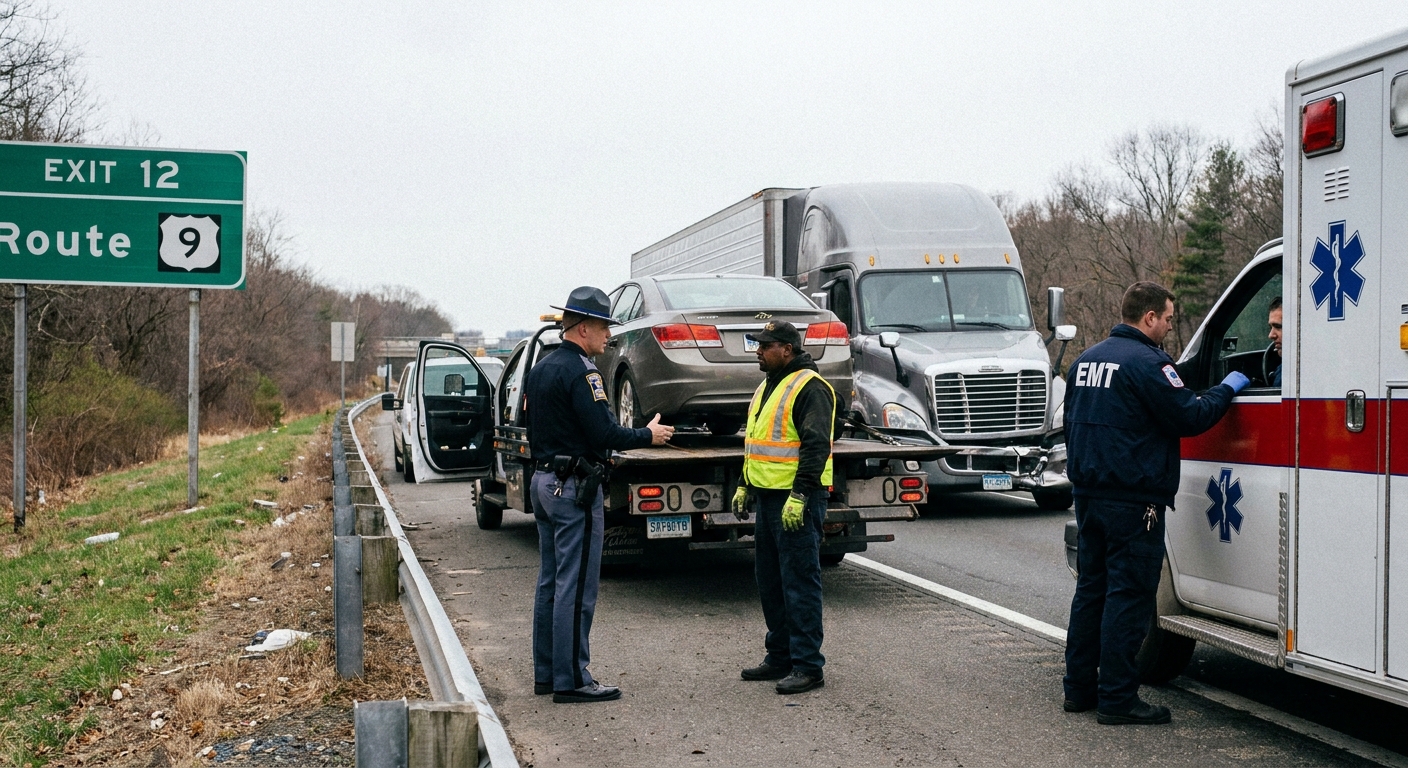
The first 24 hours after a trucking accident or cargo loss determine how the claim gets paid. Secure the scene, call 911 if needed, photograph everything, get witness info, do not discuss fault, notify your insurance carrier within 24 hours, complete a post-accident drug/alcohol test if FMCSA-required, and refer all communication from shippers, brokers, or other parties to your insurance carrier. Most Connecticut property damage claims settle in 30-60 days; bodily injury claims take 6-36 months. Documentation is everything — your ELD, dispatch records, and post-accident drug test results are pulled in the first review.
Over the past nine days we have walked through pricing, federal compliance, cargo, liability, bobtail, CSA scores, hot-shot, and workers' comp. Today we close the series with the post nobody wants to read until they need it: how to file a trucking insurance claim in Connecticut. Whether it is an I-95 accident, a cargo theft at a Hartford terminal, or a rollover on a snowy ramp, the steps below are the difference between a paid claim and a fight.
Insure Connecticut LLC handles trucking claims every week — from minor cargo damage on a Walmart Amazon delivery to multi-million-dollar bodily injury settlements following I-91 accidents. Here is the workflow we walk every client through, plus the legal and regulatory requirements that catch most operators off-guard.
Step-by-Step: What to Do in the First 24 Hours
Secure the Scene and Check for Injuries
Pull the truck out of traffic if safe to do so. Turn on hazard flashers. Deploy reflective triangles (three required by FMCSA, 100/200/100 feet behind the truck on a divided highway; differs on undivided and rural roads). Check yourself, passengers, and others for injuries.
Call 911 If Needed
Call 911 for any injuries, suspected injuries, significant property damage, or fuel/chemical spill. Connecticut law requires a police report for any accident with injury or property damage exceeding $1,000. Most commercial truck accidents trigger this threshold automatically.
Document the Scene
Photograph all vehicles from multiple angles (corners, license plates, damage, debris, position on road, skid marks, traffic signals). Get make/model/license/VIN/insurance info from every involved vehicle. Get names, addresses, phone numbers from every witness. Note weather, lighting, traffic conditions, time of day. Pull dashcam footage to a secure backup.
Do Not Discuss Fault
Connecticut is a fault state — admissions of liability at the scene are admissible against you in subsequent litigation. Cooperate with police, provide your information, and answer factual questions ("where were you headed," "what time did you leave the terminal"). Do not say "I'm sorry," "I didn't see them," or "I was running late." Do not speculate about what happened.
Complete Post-Accident Drug and Alcohol Test If Required
FMCSA requires post-accident testing in three scenarios (covered in detail below). The driver must be tested at an FMCSA-certified collection facility within 8 hours for alcohol and 32 hours for drugs. Many CT hospitals do not perform DOT-compliant collection — verify the facility is certified before sending the driver. Failure to test is treated as a refusal, which disqualifies the driver under FMCSA regs.
Notify Your Insurance Carrier
Call your broker or insurance carrier within 24 hours of the accident — sooner if injuries are involved. Insure Connecticut LLC's claims hotline is (860) 970-0977; we coordinate the carrier notification, assign the adjuster, and start the documentation process. Failure to notify timely can prejudice the claim or void coverage.
Preserve ELD and Dispatch Records
Pull and preserve ELD data for the 14 days preceding the accident. Pull dispatch records, bill of lading, and any communication logs (text messages, dispatch app messages) related to the load. These are the first records your carrier will request, and they are often the first records subpoenaed in litigation.
What Is a DOT-Recordable Accident?
FMCSA defines a DOT-recordable accident as a crash involving a commercial motor vehicle on a public road that results in any of the following:
- Fatality of any party involved
- Bodily injury requiring medical treatment away from the scene (transport to hospital, urgent care, etc.)
- Vehicle towed from the scene because it cannot be driven away under its own power
DOT-recordable accidents must be:
- Entered on the motor carrier's accident register within 30 days
- Reported to FMCSA if the carrier is subject to compliance review
- Tracked in the FMCSA Crash Indicator BASIC for 24 months
- Counted in CSA scoring (covered in Day 7)
Connecticut state law has separate reporting requirements through the CT DMV and DOT. The CT DOT requires reporting of any CMV accident with $1,000+ in damage within 5 days. Failure to file a Connecticut accident report can result in operating authority issues at the state level.
FMCSA Post-Accident Drug and Alcohol Testing
This is one of the most misunderstood FMCSA requirements. Post-accident testing is mandatory when:
| Accident Type | Drug Test Required? | Alcohol Test Required? |
|---|---|---|
| Fatality (any party) | Yes — always | Yes — always |
| Injury requiring medical treatment away from scene + driver received citation | Yes | Yes |
| Vehicle towed from scene + driver received citation | Yes | Yes |
| Property damage only, no citation | No (employer discretion) | No (employer discretion) |
Timing is critical:
- Alcohol test: must be completed within 8 hours of the accident
- Drug test: must be completed within 32 hours of the accident
- Tests must be conducted at FMCSA-certified collection facilities
- Failure to test is treated as a "refusal" — disqualifying the driver under federal regs
If a driver receives medical treatment that prevents timely testing, the employer must document the reason and complete the test as soon as practical. The clock keeps running — there is no extension for paperwork or logistics issues.
What Documents Will My Insurance Carrier Request?
Standard trucking claim documentation request at first notice of loss:
- Police report and incident number
- Photographs of all vehicles, scene, damages, debris field
- Witness statements and contact information
- Dashcam footage (front-facing and inward-facing if equipped)
- ELD records for the 14 days preceding the accident
- Dispatch records and load information for the trip in progress
- Bill of lading (BOL) for any cargo on board
- Post-accident drug and alcohol test results (or documentation of why testing was not required)
- Driver qualification file: CDL, medical card, MVR, drug test history, training records
- Vehicle maintenance records (last 12 months)
- Pre-trip inspection report for the day of the accident
- Hours of service logs and ELD edits
- Any communication with shippers, brokers, or motor carriers related to the load
Operators who do not have these records organized at the time of the accident typically spend the first week of the claim digging through paperwork. Insure Connecticut LLC clients receive a claim-ready documentation checklist as part of policy onboarding to avoid this.
How Long Does a Trucking Claim Take to Settle?
| Claim Type | Typical Settlement Window | Key Drivers |
|---|---|---|
| Property damage only, clear liability | 30-60 days | Documentation, appraisal, payment |
| Property damage only, disputed liability | 60-180 days | Liability investigation, witness interviews |
| Cargo claim, documented loss | 30-90 days | BOL, invoice, loss documentation |
| Cargo theft | 60-120 days | Police report, recovery investigation |
| Bodily injury, clear liability | 6-18 months | Medical treatment completion, lien resolution |
| Bodily injury, disputed liability | 12-36 months | Litigation, deposition, mediation |
| Multi-fatality, catastrophic | 24-48+ months | Litigation, policy limits negotiations, structured settlements |
Connecticut statutes of limitation:
- Personal injury: 2 years from date of accident
- Property damage: 3 years from date of accident
- Cargo claims (interstate, Carmack Amendment): 9 months to file written claim, 2 years to file lawsuit
- Wrongful death: 2 years from date of death
The Carmack Amendment and Cargo Liability
Interstate cargo claims fall under federal law — the Carmack Amendment (49 U.S.C. 14706) — not Connecticut state law. Key Carmack provisions:
- The motor carrier is strictly liable for cargo damage from pickup to delivery
- Limited defenses: act of God, act of public enemy, act of shipper, inherent vice of goods, act of public authority
- Standard measure of damages is the difference in fair market value at destination
- Cargo claim must be filed in writing within 9 months
- Lawsuit must be filed within 2 years of claim denial
- The BOL controls liability terms — Released Value vs Declared Value
Released Value bills of lading limit motor carrier liability to a stated value (typically $0.10 to $0.60 per pound). Declared Value BOLs hold the motor carrier liable for the full declared value, with corresponding premium adjustment on the cargo policy.
What If My Premium Goes Up After a Claim?
Claim-related premium increases (called "experience rating" in commercial lines) are common but not automatic:
| Claim Type | Typical Premium Impact |
|---|---|
| Small property damage, not-at-fault | Minimal (0-5%) |
| Small property damage, at-fault | 5-15% on renewal |
| Total-loss accident, at-fault | 15-30% on renewal |
| Bodily injury, settled under $50K | 15-25% on renewal |
| Bodily injury, settled $50K-$250K | 25-50% on renewal |
| Bodily injury, settled over $250K | 50-100% on renewal + possible non-renewal |
| Two or more at-fault claims in 36 months | Non-renewal in preferred markets |
Connecticut has no specific rate-increase cap for commercial trucking lines. The market is competitive — operators with mid-range claim histories typically have placement options even after surcharges. Operators with multiple severe claims in a 36-month window may end up in surplus-lines markets at 100-200% above standard pricing.
Working With Your Broker on a Claim
The role of Insure Connecticut LLC during a claim:
- Initial notification — we contact the carrier on your behalf and assign an adjuster
- Documentation coordination — we maintain a single documentation index so nothing falls through the cracks
- Adjuster communication — we serve as the buffer between you and the carrier, especially on disputed claims
- Coverage review — we verify the claim is being handled under the right policy form and endorsements
- Repair coordination — for physical damage, we work with preferred repair networks where available
- Settlement review — we review the settlement offer for fairness and accuracy before you accept
- Renewal preparation — we manage the claim presentation at renewal to minimize premium impact
Key Takeaways — Filing a Trucking Claim in CT
- First 24 hours: secure scene, photograph everything, do not discuss fault, notify your carrier
- FMCSA post-accident drug/alcohol testing required for fatalities or citations + injuries/tows
- Documentation matters more than anything: ELD, dispatch, BOL, MVR, maintenance records
- Property damage claims: 30-60 days; bodily injury: 6-36 months; catastrophic: 2+ years
- Carmack Amendment governs interstate cargo claims — strict 9-month filing window
- Claim-related premium increases are real but vary by severity and frequency
- Your broker (Insure Connecticut LLC) coordinates the claim end-to-end
Frequently Asked Questions
What is the FMCSA Crash Preventability Determination Program?
FMCSA reviews certain types of crashes to determine if they should count against the motor carrier's Crash Indicator BASIC. Eligible scenarios include rear-end collisions where the CMV was struck, struck-while-legally-stopped accidents, animal strikes, suicide-related crashes, and infrastructure failures. Approved preventability determinations remove the crash from CSA scoring even though it remains on the official record.
Do I report a no-damage accident to my insurance carrier?
Yes — report any accident, near-miss, or incident that could result in a claim against you, even if no damage is visible at the scene. Whiplash claims are common 24-72 hours after a low-speed rear-end collision. Reporting late or "monitoring" the situation can prejudice coverage if a claim is later filed.
Should I let the other party's insurance company record a statement?
No — refer all communication from the other party's insurance carrier to your own carrier or broker. Recorded statements can include leading questions designed to establish liability admissions. Connecticut law does not require you to give a statement to the other party's carrier — only to your own.
What is "first notice of loss" and when must I file it?
First Notice of Loss (FNOL) is the formal initiation of a claim with the insurance carrier. Most commercial trucking policies require FNOL "as soon as practical" — usually interpreted as within 24-72 hours. Late FNOL can be raised as a coverage defense, particularly if it prejudices the carrier's ability to investigate.
Can I pick my own collision repair shop?
Yes — Connecticut law gives the insured the right to choose any repair facility. Insurance carriers may have preferred networks (direct repair programs) that offer warranties and faster turnaround, but they cannot require you to use them. Specialty trucking repairs (frame, suspension, refrigeration unit) often need to go to specialty shops that are not in standard auto carrier networks.
That wraps the 10-part Connecticut trucking insurance series. We have covered pricing, federal compliance (MCS-90, BMC-91, BMC-32, BMC-84/85, USDOT/MC authority), liability sizing, cargo, bobtail, CSA, hot-shot, workers' comp, and claims. If you want the full series in a single PDF brief for your fleet's safety meeting or carrier vetting binder, drop us a note.
If you need a Connecticut trucking insurance broker who actually understands FMCSA filings, CSA management, and the layered programs that protect real assets — Insure Connecticut LLC is here. Call (860) 970-0977 or visit our trucking insurance page. We work with Progressive, Great West, Sentry, Northland, Canal, Hudson, Great American, The Hartford, Travelers, AIM, and the specialty surplus-lines markets. Owner-ops getting first authority through 100+ unit fleets running national lanes — same broker, same direct line, same callback when you need a COI before the load drops.