
How to Get Dealer Plates in Connecticut: The 2026 DMV & Insurance Walkthrough
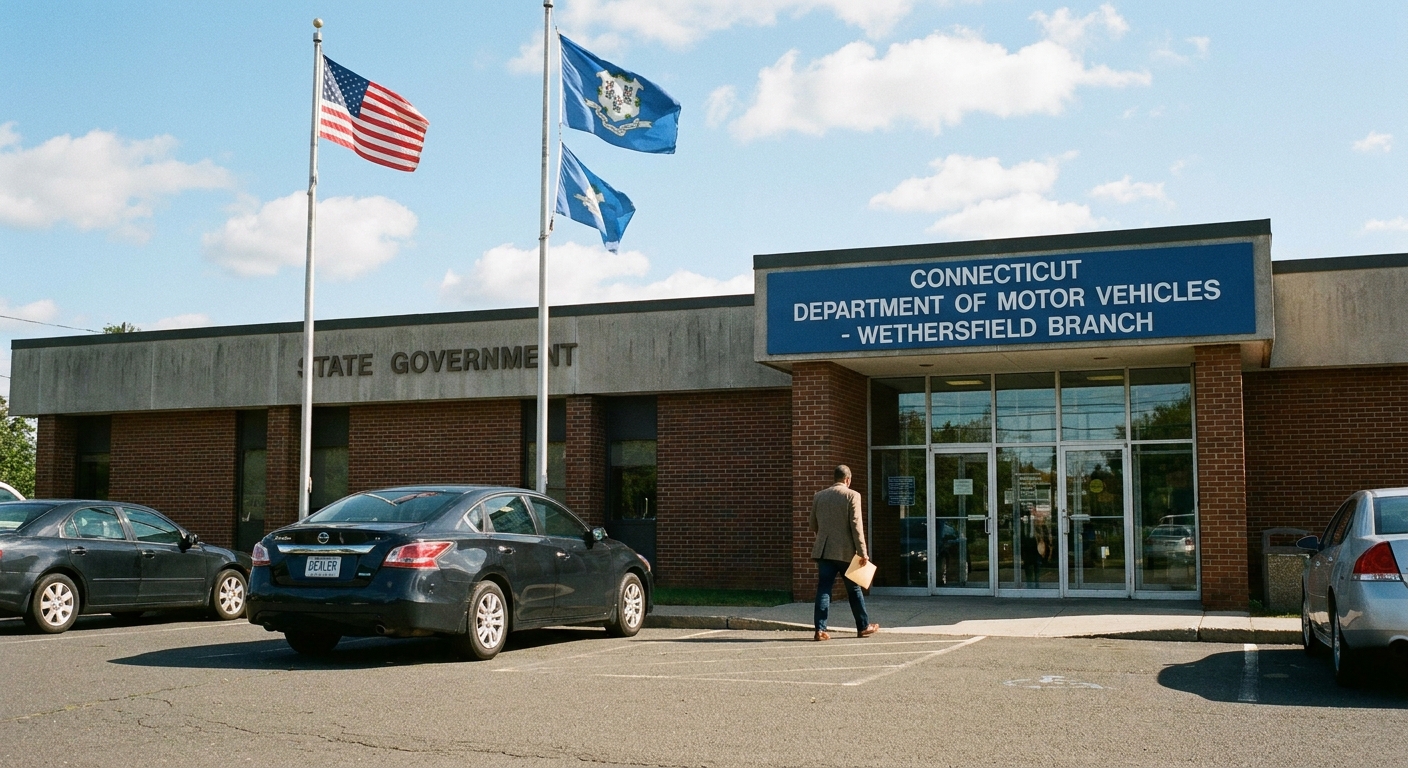
Quick answer: Getting Connecticut used car dealer plates in 2026 is a five-step sequence: (1) form your business entity and confirm zoning, (2) pass the CT DMV dealer license application with a $20,000 surety bond and certificate of insurance, (3) bind a dealer plates / garage liability policy with the right limits and the right policy form, (4) pay the per-plate fee for the number of dealer plates you actually need, and (5) keep the file current at annual renewal. The whole sequence typically takes 6–10 weeks from incorporation to plates-in-hand — faster if your zoning and lot inspection are already clean, slower if either gets flagged.
Opening a used car dealership in Connecticut is one of the more procedurally heavy small-business setups in the state. The Connecticut DMV's Dealers and Repairers Division (and its equivalents in New York and Pennsylvania) take a "trust but verify" approach: you have to prove zoning, prove insurance, post a surety bond, and let an inspector physically walk the lot before any plates get issued.
This is the walkthrough we wish every new dealer client had read before they called us. It is written for Connecticut specifically — with the New York and Pennsylvania differences flagged at the end — and the order matters. Skipping ahead almost always results in a step you have to redo. If you are coming from the pillar guide, this is the process spoke.
Step 1: Form Your Business Entity and Confirm Lot Zoning
Before any DMV paperwork, you need two things: a legal business entity and a confirmed location.
For the entity, most new dealers form an LLC through the Connecticut Secretary of State ($120 filing fee, name reservation optional). Sole proprietorships work technically but are rare in the dealer market because the surety bond and insurance underwriting price a corporation better than an individual. Pick a name that does not conflict with an existing CT entity, file the Certificate of Organization, get an EIN from the IRS, and register with the CT Department of Revenue Services (DRS) for sales and use tax.
The harder pre-flight check is zoning. Most Connecticut towns require a specific commercial zoning designation for used car sales — B2 / Business 2 / Commercial Highway is typical. A few towns prohibit used car lots outright in certain zones. Drive past your proposed location and look for any current or recent used car dealerships nearby; if there is none, that is a yellow flag worth confirming with the planning office before you sign a lease. Calling the town's zoning enforcement officer with the parcel address and asking "can I run a licensed used car dealer here under current zoning?" costs nothing and saves months.
You also need to confirm the lot meets the DMV's physical requirements: a permanent sign, a fenced or otherwise defined display area, lighting, parking for customers and inventory separate from public roadway, and (depending on classification) an enclosed office of minimum square footage.
Step 2: Apply for the CT Dealer License
The Connecticut DMV dealer license application sits with the Dealers and Repairers Division and is form K-7 (or its successor; check the current version at portal.ct.gov/DMV).
The application package includes:
- Completed application form with business entity information, EIN, principal officers, and address of operations
- Copy of the lease or deed for the dealership location
- Zoning compliance letter from the town
- $20,000 surety bond (Form K-208) — or $10,000 if licensing only as a repairer; see Step 3
- Certificate of insurance (ACORD 25 or equivalent) showing dealer plate liability, garage liability, and any required limits
- Fingerprinting and background check for the dealer principal and any other officers
- Pre-licensing seminar certificate (CT requires applicants to complete a DMV-approved dealer seminar before first license issuance)
- Application fee (currently around $700 for a new dealer license, plus separate per-plate fees once approved)
The DMV then schedules a physical inspection of the lot. The inspector confirms signage, office, display area, security, and lighting against the application. If anything is off, you fix it and reschedule — cycle time on a re-inspection is typically 2–4 weeks.

Step 3: Post the $20,000 Surety Bond
Connecticut requires a $20,000 surety bond for new and used car dealers. (Repairer-only licenses sit at $10,000.) The bond is not the same thing as insurance. It is a financial guarantee posted to the state of Connecticut promising that you will operate in compliance with state dealer laws — pay sales tax, honor warranties you sell, deliver clear title on every sale, and not commit fraud.
If you violate one of those obligations and a customer or the state files a claim against the bond, the bond company pays the claim and then sues you to recover it. So the bond protects the public and the state, not the dealer.
The cost of the bond is typically 1–3% of the face value per year for a dealer with good personal credit — meaning a $20,000 bond costs you $200–$600 annually. Bad credit, prior bond claims, or recent business problems push it higher; some applicants get declined entirely and have to use a collateralized program or partner with a stronger principal. We place bonds through specialty surety markets alongside the insurance program; doing both at once usually gets the dealer a better rate on each.
Step 4: Bind the Right Insurance Policy — Before You Submit the Application
This is the step most new dealers handle in the wrong order. The DMV requires a certificate of insurance with the dealer license application. Brokers can issue a certificate quickly, but only if the underlying policy is properly structured for a true dealer operation. Walking into a quick-quote site and binding a generic commercial auto policy will get you a piece of paper that says "insurance" on it — and will fail at the first claim.
What you actually need bound before you apply:
- Dealer plate liability — $1M combined single limit minimum (statutory minimum is $20K/$40K/$10K, which is meaningless for a working operator)
- Garage liability — premises and operations, including products and completed operations
- Garagekeepers — for any customer vehicles in your custody
- Dealer's open lot (physical damage on inventory) — matched to your average inventory value
- Hired and non-owned auto — for any employee using a personal car for business
- Workers' compensation — required as soon as you hire your first W-2 employee (CT has no minimum-employee exemption)
- Umbrella / excess liability — recommended on top of the primary BI/PD limits
Tell your broker, in writing, exactly what your operation will look like: number of plates you plan to run, anticipated annual unit sales, average inventory value, whether you will offer any loaner / courtesy car programs, whether you will haul cars yourself or contract that out, and your sales radius. Every one of those affects the policy form and the limits the broker needs to bind.
The full pricing breakdown for what these limits cost is in the Cost Spoke; the comparison of dealer vs. transporter vs. garage policy mechanics is in the Comparison Spoke.
Agent's pro tip: If a quick-quote site or generalist agent gives you a quote significantly under the bands in the Cost Spoke for your operator size, ask them which policy form they are using and which carrier is writing it. If the answer is not a dealer's package policy from Lancer, Universal Underwriters, GUARD, Federated, Sentry, or Wesco, the policy is almost certainly the wrong form for a working CT dealer.
Step 5: Pay the Per-Plate Fee and Receive Your Plates
Once the license is approved and the lot inspection clears, you pay the per-plate fee for the number of dealer plates you actually need. Connecticut charges per plate, on an annual cycle that aligns with the dealer license renewal. The DMV will not over-issue plates — you have to justify the count against your business plan, projected unit sales, and physical lot capacity.
The most common mistake first-time dealers make at this step is requesting more plates than they need "to be safe." Every plate carries an annual fee and an underwriting impact on your insurance premium. Carriers price the policy on plate count; ten unused plates is real money over a renewal cycle. Start with what you genuinely need and request more later if the operation grows.
The Tri-State Comparison: CT vs. NY vs. PA
| Requirement | Connecticut | New York | Pennsylvania |
|---|---|---|---|
| Licensing agency | CT DMV Dealers & Repairers | NYS DMV Vehicle Safety Services | PennDOT Bureau of Motor Vehicles |
| Pre-licensing course | Required (DMV-approved seminar) | Required for new applicants | Not required |
| Surety bond (used dealer) | $20,000 | $20,000 ($50,000 wholesale) | $30,000 ($50,000 wholesale) |
| Min. statutory liability | $20K/$40K/$10K (working: $1M CSL) | $25K/$50K/$10K (working: $1M CSL) | $15K/$30K/$5K (working: $1M CSL) |
| Physical lot inspection | Yes (pre-licensing) | Yes | Yes |
| License renewal cycle | Annual | Biennial | Annual |
| Typical full-process time | 6–10 weeks | 8–14 weeks | 6–12 weeks |
The structural difference: New York's process is slower but biennial; Pennsylvania's process is slightly faster but has a higher bond requirement; Connecticut sits in the middle on cost and runs annually. If you are operating across two of the three states, you need licensing in each, separate bonds in each, and a unified insurance policy that lists all three states on the declarations.
The Five Most Common Rejection Reasons We See
Of the new dealer applications we touch in any given year, the same five issues account for most of the rejections or "send-it-back-for-correction" returns:
- Zoning letter is wrong — the town issued a generic commercial use letter that does not specifically authorize used car sales.
- Certificate of insurance lists the wrong limits — usually statutory minimum on a policy form that does not match a dealer operation.
- Lot inspection fails on signage or office — sign too small, office not enclosed, or no separate customer parking.
- Surety bond names the wrong principal — the LLC was renamed mid-process and the bond still references the old entity.
- Background check flag on the dealer principal — an undisclosed prior conviction or out-of-state license discipline surfaces.
Every one of these is fixable, but every one of them adds 3–6 weeks to the timeline. The fix is doing the diligence in order: zoning first, entity second, bond and insurance third, application last.
Opening a used car lot in CT, NY, or PA?
We coordinate the surety bond, the dealer plates policy, the garage liability program, and the certificate of insurance the DMV needs — on one submission, across the carriers that actually write the class. Most new-dealer accounts go from quote to bound coverage in 5–10 business days.
Why an Independent Broker Matters for a New Dealer License
A captive agent or direct-to-carrier purchase will get you a policy. It will not get you the right policy, in the right form, with the right limits, from the right carrier for a brand-new dealer operation. Specialty markets like Lancer have minimum standards for new dealer accounts; some markets will not even quote a startup without three years of dealer principal experience elsewhere. Knowing which carriers will entertain a new account — and how to package the submission so they do — is half the work.
At iConn Insurance Solutions, we work with new dealer applicants as a regular part of our dealer book. Together with our sister agency at Insure Connecticut LLC, we cover the surety bond, the dealer plates policy, the garage liability program, workers' comp, and any commercial auto or umbrella the operation needs — on a single submission, with one point of contact through DMV approval.
More from this cluster
- Pillar: The Tri-State Operator's Guide to Dealer & Transporter Plates Insurance
- Cost: How Much Does Dealer Plates Insurance Cost in 2026?
- Comparisons: Dealer Plates vs. Transporter Plates vs. Garage Liability
- Mistakes: 7 Costly Mistakes Used Car Dealers Make With Their Plate Insurance
Key takeaways
- Connecticut dealer licensing is a 5-step sequence: entity + zoning → license application + lot inspection → surety bond → insurance → per-plate fees.
- The full process typically takes 6–10 weeks in CT (8–14 in NY, 6–12 in PA).
- The $20,000 surety bond costs $200–$600 annually for a dealer with good personal credit.
- Get insurance bound BEFORE you submit the application — the certificate of insurance is required at submission and must match a true dealer policy form.
- Working liability limits are $1M CSL, not the $20K/$40K/$10K statutory minimum.
- Request only the plates you need; every unused plate is a premium and fee carry.
Frequently Asked Questions About Getting Dealer Plates in Connecticut
How long does it take to get a Connecticut dealer license?
Typically 6–10 weeks from incorporation to plates-in-hand, assuming zoning is clean, the lot inspection passes on the first try, and the application file is complete at submission. Stalls on zoning, lot improvements, or background check flags can push the timeline to 12–16 weeks.
How much does a Connecticut dealer license cost in total?
Plan for $1,500–$3,000 in first-year cash outlay: $700 license application, $120 LLC formation, $200–$600 bond premium, per-plate fees ($50–$120 per plate), pre-licensing seminar, and miscellaneous. The annual insurance premium is on top of that — $4,500–$8,500 for a clean single-lot startup.
Do I need a physical lot to get a Connecticut dealer license?
Yes. Connecticut does not issue dealer licenses for online-only or address-less operations. You need a leased or owned commercial location that meets DMV physical requirements: enclosed office, defined display area, lighting, signage, separate customer parking. A residential address will not pass inspection.
What's the difference between a dealer surety bond and dealer insurance?
The surety bond is a financial guarantee posted to the state — it protects the public against dealer fraud, unpaid sales tax, or undelivered titles, and the dealer ultimately pays back any claim. Insurance is third-party protection for accidents, premises liability, and inventory loss. Both are required for a CT dealer license, and they cover entirely different exposures.
Can I get insurance for a brand-new dealer operation with no history?
Yes, but the carrier market is narrower for new operations. Specialty markets like Lancer, GUARD, and Wesco will quote new dealers under certain conditions (clean dealer principal MVR, business plan, sometimes prior dealership experience elsewhere). Standard carriers like Universal Underwriters and Federated typically want at least 12–36 months of operating history.
Do I need a separate transporter license if I haul my own inventory?
No. Movement of inventory you own falls under the dealer plate, not the transporter plate. You only need a CT transporter license if you are moving vehicles owned by someone else — auctions, finance company repossessions, manufacturer driveaway. The two are separate licenses with separate bonds and insurance requirements.
Just starting a used car lot in CT, NY, or PA?
We've done this dance hundreds of times. We'll get your dealer plates insurance and surety bond aligned with your DMV application timeline so nothing stalls at submission.
For broader Connecticut commercial-lines coverage that complements a dealer operation — workers' comp, cyber, EPLI, business interruption — our sister agency at Insure Connecticut LLC covers the full stack with 12-state reach. Insure Connecticut LLC, iConn Insurance Solutions, and Wealth America, Inc. are independently operated companies under common ownership.