
How to Insure a Truck-Mounted Jetter Without a Coverage Gap (2026 Process)
How to Insure a Truck-Mounted Jetter Without a Coverage Gap (2026 Process)
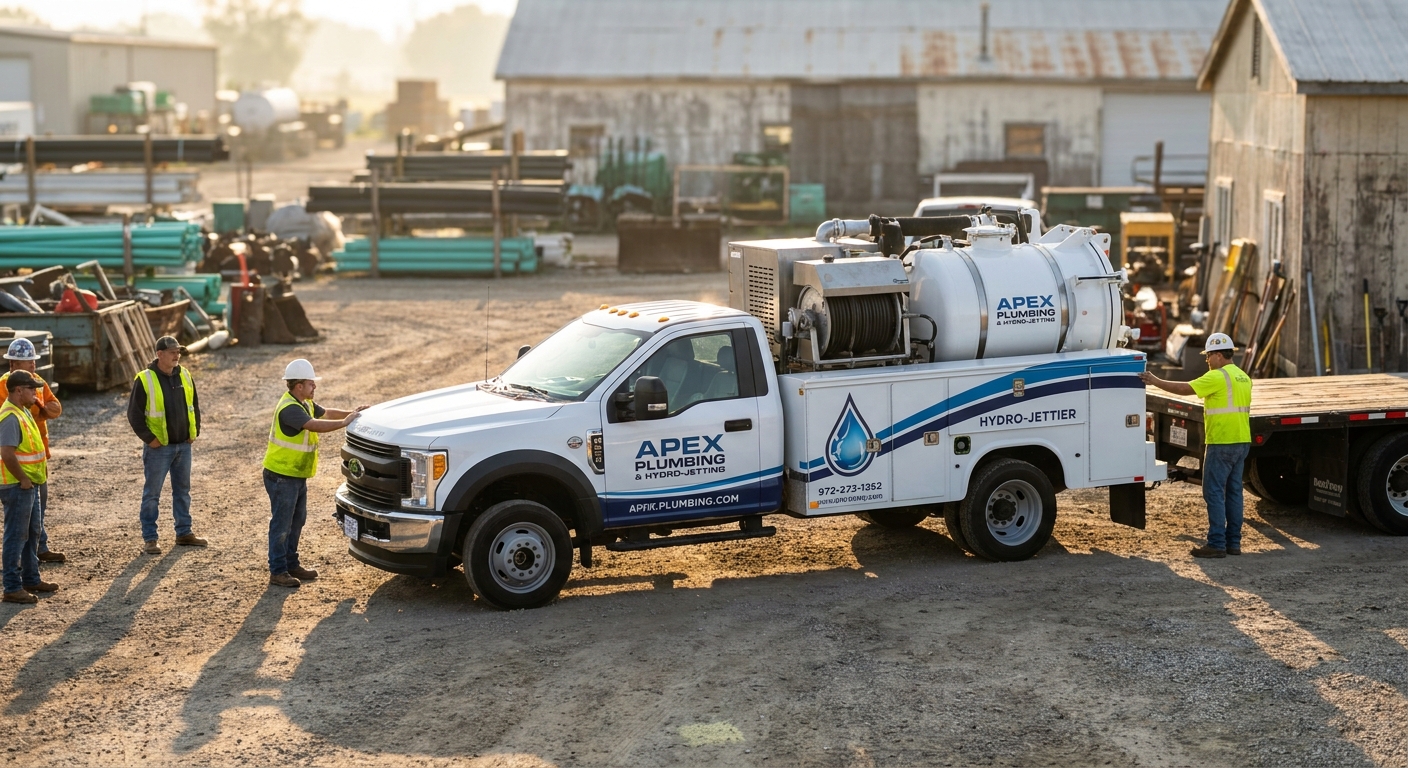
Short answer: A truck-mounted jetter needs three coverages, not one. The truck goes on your Business Auto Policy (BAP) with the jetter's value added to the declared value. The jetter itself goes on a contractor's equipment / inland marine policy — not the BAP — for blanket coverage anywhere it operates. And the pollution exposure from the work the jetter does (sewer backups, ejected debris, contaminated water) goes on Contractor's Pollution Liability (CPL). Missing any one of these three is the most common jetter coverage gap in the industry.
Why a Jetter Is an Insurance Problem That Most Plumbers Get Wrong
A truck-mounted sewer jetter is one of the most expensive and risk-loaded pieces of equipment a plumbing contractor will ever buy. A new mid-size unit — Spartan, US Jetting, Harben, Sewer Equipment Co. — runs $18,000 to $45,000 for the jetter package alone, mounted on a $55,000 to $95,000 service truck or chassis. Premium units like a Vactor or Vac-Con go well into six figures.
It's expensive. It's mobile. It moves between job sites daily. It operates at 4,000 PSI with 18 GPM of water flow. And the work it does — clearing sewer lines, breaking up roots, pushing waste downstream — creates a pollution exposure that no Business Auto Policy or General Liability policy is designed to cover.
Most plumbers buy a jetter, ask their agent to "add it to the truck policy," and assume they're done. They're not. Here's the right process.
Step 1: Determine the Total Insurable Value of the Jetter Unit
Before any policy decision happens, document exactly what you have. For a truck-mounted jetter, the total insurable value is the sum of:
- The chassis / truck — VIN, year, make, model, mileage, ACV or replacement cost
- The jetter package — brand, model, engine HP, pump GPM/PSI rating, hose reel size, hose length, water tank capacity
- Mounted accessories — nozzles, locator equipment, work lights, hose guides, generator, water-heater if equipped
- Auxiliary equipment carried on the truck — sewer camera, locator, smaller hand-snake units, tools
For a typical fleet plumbing jetter rig, you'll arrive at something like:
| Component | Typical Value |
|---|---|
| 2024 Ram 5500 chassis with utility body | $72,000 |
| US Jetting 4018 trailer-mount jetter package (truck-mounted) | $38,000 |
| Ridgid SeeSnake Compact C40 camera with monitor | $8,500 |
| Locator (Rycom or RIDGID NaviTrack) | $3,200 |
| Nozzles, hose guides, lights, accessories | $2,800 |
| Total insurable value | $124,500 |
Write this down. You'll reference it three times before the policies are in force.
Step 2: Cover the Truck Chassis on Your Business Auto Policy
The chassis — the truck itself — goes on your Business Auto Policy (BAP) like any other vehicle in your fleet. Add it with:
- Symbol 7 — specifically scheduled owned auto
- Liability limits matching your fleet standard (typically $1M CSL minimum for plumbing fleets)
- Physical damage — comprehensive and collision with $1,000–$2,500 deductible
- Declared value at chassis replacement cost (NOT chassis + jetter — see step 3)
This part is straightforward. Your agent adds the VIN to the schedule, the BAP rates it as a heavy service vehicle, and you get an ID card. Where plumbers go wrong is when they try to also insure the jetter on the BAP.
Why you should NOT put the jetter value on the BAP
You can list a higher declared value on the BAP and technically cover the jetter as "permanently attached equipment" — but you shouldn't, for four reasons:
- Coverage geography — BAP physical damage only triggers when the truck is operating as a vehicle. If the truck is parked at a job site and the jetter is stolen off the bed, or if vandalism destroys the jetter while the truck is in the shop yard, your BAP claim gets contested.
- Off-truck coverage — many jetter units come off the truck for service, repair, or to be transferred between vehicles. Inland marine covers the equipment wherever it is; BAP doesn't.
- Replacement-cost vs ACV — most BAP physical damage policies pay actual cash value. Most inland marine policies pay replacement cost. On a 5-year-old jetter, that's a $15K–$25K coverage difference at the moment of loss.
- Claims complexity — when the truck and jetter are damaged in the same incident (collision rolls the truck and destroys the jetter), splitting the BAP and inland marine claims runs cleaner with two carriers / two policies than trying to pull a $124K total loss out of a single BAP.
Step 3: Schedule the Jetter on a Contractor's Equipment / Inland Marine Policy
This is where most plumbers leave money on the table — or, more accurately, leave their jetter uninsured against the most likely loss scenarios.
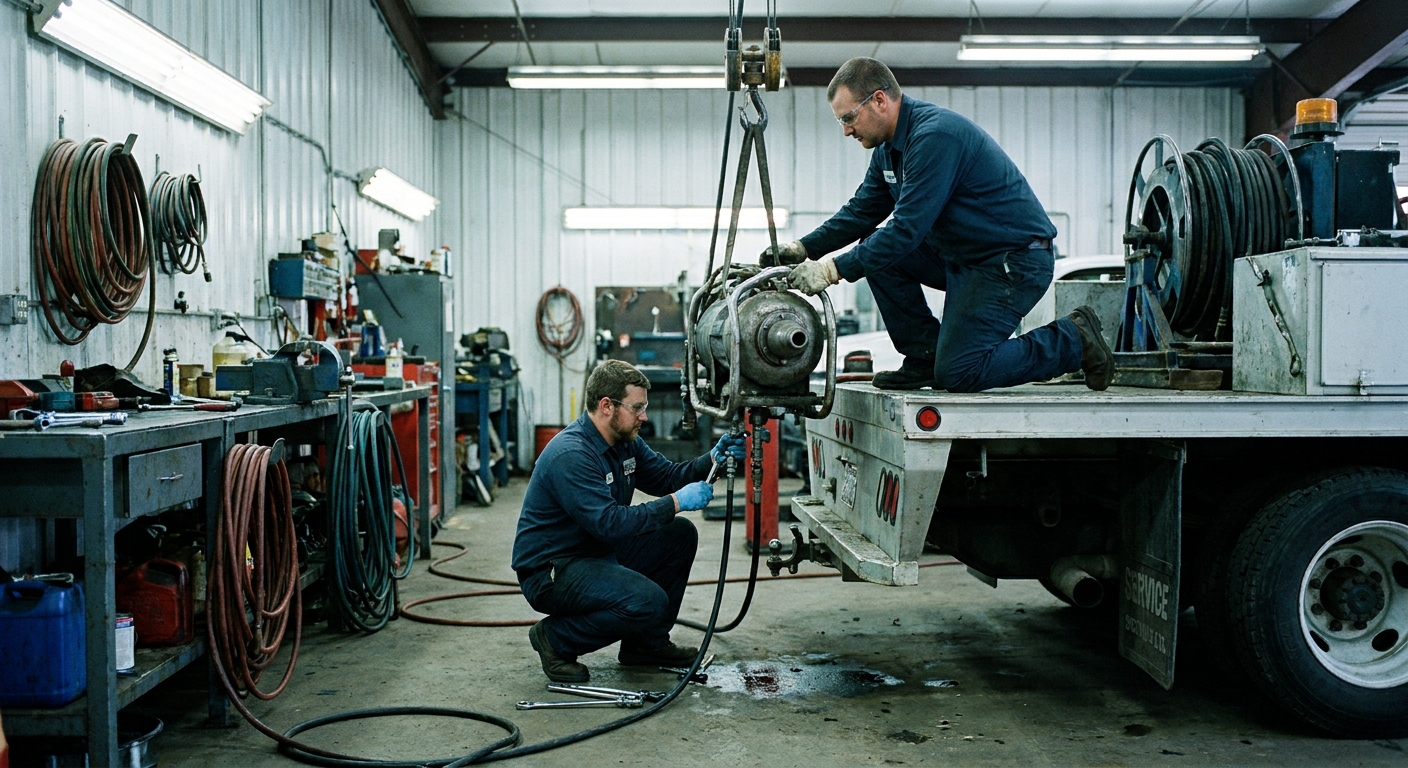
A contractor's equipment floater (a type of inland marine policy) covers mobile equipment wherever it is — on the truck, off the truck, in the yard, at a job site, in transit, being repaired, or temporarily stored.
For a plumbing fleet running 1–3 jetters, you have two options:
Option A: Scheduled inland marine — list each item by description and value
Best for plumbing shops with a small number of high-value pieces. Each jetter, camera, and locator is listed by serial number, with its individual replacement-cost value. The policy covers exactly what's scheduled.
Pricing: roughly $0.75 to $1.50 per $100 of insured value. A $40,000 scheduled jetter runs $300–$600/year.
Option B: Blanket inland marine with sub-limits
Best for larger plumbing fleets with multiple jetters, multiple cameras, multiple locators, and hundreds of smaller tools. Set a blanket limit (e.g. $500,000 total) with sub-limits per item ($50K max per scheduled item, $5K max per unscheduled tool).
Pricing: roughly $0.50 to $0.90 per $100 of blanket limit. A $500K blanket runs $2,500–$4,500/year and covers your entire equipment program.
What the inland marine policy should specifically include
- Replacement-cost valuation — not ACV
- Worldwide coverage territory (or at minimum U.S. + Canada)
- Theft, vandalism, fire, collision, overturn, and flood as covered perils
- Off-truck coverage — equipment is covered when removed from the vehicle
- Newly acquired equipment endorsement — automatic 30–60 days of coverage on new equipment up to a sub-limit (typically $25K–$50K) before formal scheduling
- Borrowed/leased/rented equipment endorsement — coverage for jetters rented from a peer or rented while yours is in repair
- Equipment breakdown — optional but worth considering for high-cycle jetters (pump failure, engine seizure)
Step 4: Close the Pollution Gap With Contractor's Pollution Liability
This is the step almost no plumber gets right on the first policy renewal.
Your BAP covers the truck. Your inland marine covers the jetter. Neither covers the work the jetter does. When a jetter operates inside a customer's sewer line and something goes wrong — back-flow into a basement, ejected debris into a yard, a damaged line that leaks waste into groundwater — the resulting claim is a pollution claim. And the standard GL policy excludes pollution via the absolute pollution exclusion in the ISO CG 00 01 form.
The fix is a Contractor's Pollution Liability (CPL) policy. For a plumbing fleet operating jetters, the CPL needs to specifically include:
- Sudden and accidental pollution events caused by sewer/drain cleaning operations
- Backup and overflow of sewage at customer locations
- Property damage from ejected waste, debris, or contaminated water
- Bodily injury from exposure to sewage or contaminated water
- Cleanup costs — third-party and first-party (your own remediation expenses)
- Defense costs outside the limit ideally — pollution defenses are expensive and you don't want them eroding the limit
Pricing for a plumbing fleet CPL runs $2,500 to $7,500/year for a $1M occurrence / $2M aggregate limit, depending on revenue size, jetter operations frequency, and prior loss history. For deeper detail on CPL specifically, see our CPL for plumbers deep dive.
Step 5: Verify the Three Policies Don't Overlap or Leave Gaps
Once you have the BAP, inland marine, and CPL bound, do a coverage-mapping exercise. For each of the following scenarios, identify which policy responds:
| Scenario | Policy That Responds |
|---|---|
| Truck collision damages truck and jetter | BAP (truck) + Inland Marine (jetter) |
| Jetter stolen overnight from job-site truck | Inland Marine |
| Jetter pump catastrophic failure from overload | Inland Marine (if equipment breakdown is endorsed) |
| Sewer backup into customer's basement during jetting | CPL |
| Operator slips on wet pavement on a customer's driveway | WC (operator injury) + GL (customer property damage) |
| Jetter hose whip injures a bystander | GL (bodily injury — non-pollution) |
| Vandalism damages jetter at customer site | Inland Marine |
| Diesel fuel spill from chassis tank into a storm drain | CPL (some states) + BAP MCS-90 endorsement (if hazmat-rated) |
If any scenario above produces a "not sure" or "I'd have to check," that's a coverage gap. Fix it before the renewal pays the agent a commission.
Step 6: Verify Driver Qualifications and Endorsements
A truck-mounted jetter rig often crosses into CDL territory depending on chassis GVWR, water tank size, and trailer status. A Ram 5500 with a full water tank can hit 19,500 lbs GVWR — under the 26,001 lb federal CDL threshold but pushing local commercial-license requirements in some states.
Before the policy binds, confirm:
- Every driver assigned to the jetter truck has the correct license class for the state of operation
- The driver's MVR is acceptable to the carrier (typically no major violations in 3 years, no DUI in 5)
- The driver has documented training on jetter operation, hose handling, and confined-space safety
- You've added the driver to the BAP driver schedule within the carrier's notification window (usually 30 days)
Most "we never thought of that" coverage gaps on jetter claims trace back to an unauthorized driver behind the wheel, not a policy form problem.
Step 7: Document Operating Procedures (Required by Some Carriers)
Carriers like Federated and Travelers will request written operating procedures for jetter-equipped plumbing fleets, especially above 3 units. The procedures should cover:
- Pre-job site survey (locate clean-outs, check vent stacks, identify low fixtures)
- Pressure ramp-up protocol (start at 1,500 PSI, increase as needed)
- Backflow prevention practices (using a downstream block, monitoring for backup)
- Customer communication and warning (notify before starting, identify floor drains and fixtures at risk)
- Spill response protocol if a backup occurs
- Post-job verification and customer sign-off
Having this in writing produces underwriting credits at most carriers (typically 5–10% off the GL and CPL) and substantially improves claim outcomes if a sewer backup loss does occur.
The Complete Jetter Insurance Stack — Recap
| Coverage | What It Insures | Typical Annual Cost |
|---|---|---|
| BAP (truck portion) | Chassis liability and physical damage | $1,800–$2,400 per vehicle |
| Inland Marine (jetter scheduled) | The jetter itself, anywhere, replacement cost | $300–$600 per $40K scheduled |
| CPL ($1M / $2M) | Pollution liability from sewer/drain work | $2,500–$7,500 for the fleet |
| GL (general liability) | Non-pollution third-party BI and PD | Already in fleet program |
| WC (workers' comp) | Operator injuries | Already in fleet program |
For a single jetter truck added to an existing 10-truck plumbing fleet, the marginal annual cost is roughly $2,500–$3,500 when you do it properly: $2,000 of BAP, $500 of inland marine, and a $500–$1,000 incremental bump to the CPL (since the CPL is usually already in force for the fleet).
Doing it wrong — putting the jetter on the BAP only and skipping CPL — saves about $1,000/year. The first sewer backup claim that lands on a CPL-less plumbing fleet erases 10 years of that savings in a single afternoon.
Want Someone To Build the Stack For You?
The team at iConn Insurance Solutions places contractor's equipment / inland marine, BAP, GL, and CPL for plumbing fleets across the Northeast. We've built dozens of jetter coverage stacks across Federated, Travelers, Liberty Mutual, Hartford, and Scottsdale, and we can quote yours alongside two or three competing structures. Reach out and we'll send you a sample stack for your specific equipment list.
Frequently Asked Questions
Can I just add the jetter value to my Business Auto Policy?
Technically yes, practically no. The BAP only triggers when the truck is operating as a vehicle. If the jetter is stolen off the truck, vandalized while parked, or damaged off-truck during repair, the BAP claim will be contested. Inland marine covers the equipment wherever it is — that's the correct policy.
Does general liability cover a sewer backup caused by a jetter?
No. The standard ISO CG 00 01 GL form contains an absolute pollution exclusion that excludes coverage for sewage backups, ejected waste, and contaminated water releases. You need Contractor's Pollution Liability (CPL) to cover the work the jetter does.
How much does it cost to insure a $40,000 jetter?
About $300–$600 per year on a contractor's equipment / inland marine policy with replacement-cost valuation. The jetter coverage is one of the smaller line items on a plumbing fleet program — the CPL exposure tied to the jetter's operations is the bigger cost driver.
Do I need a CDL to operate a truck-mounted jetter?
Depends on the chassis GVWR and the state. A Ram 5500 or F-550 with a full water tank can hit 19,000–19,500 lbs GVWR — under the 26,001 lb federal CDL threshold but subject to state-specific commercial-license rules. Verify with your state DMV and your insurance carrier before assigning drivers.
What's the difference between scheduled and blanket inland marine?
Scheduled lists each piece of equipment by serial number and value — better for small fleets with few high-value items. Blanket sets a total policy limit (with per-item sub-limits) — better for larger fleets with many tools and pieces of equipment. Both pay replacement cost; the structure choice depends on equipment count.
Does inland marine cover a jetter while it's being repaired?
Yes — that's one of the main reasons not to insure it on the BAP. Inland marine covers the equipment wherever it is, including at a repair facility, in transit, in storage, or temporarily off the truck. Confirm this is included in the policy you bind.
Continue the Plumbing Fleet Insurance Series
- Pillar: Commercial Auto Insurance for Plumbing Contractor Fleets — The Complete 2026 Guide
- How Much Does Commercial Auto Insurance Cost for a Plumbing Fleet?
- 7 Insurance Mistakes Plumbing Fleets Make
- BAP vs Contractor's Pollution Liability vs Sewer Backup Endorsements
- Best Insurance Carriers for Plumbing Contractors With Fleets
- Federated Insurance Review: The Plumbing Contractor's View
- Contractor's Pollution Liability for Plumbers — The Coverage Most Plumbers Skip
- Sewer Backup Claim Walkthrough: 5 Policies, One Plumber