
CT Restaurant Insurance Cost Breakdown 2026: Line-by-Line Budget Guide
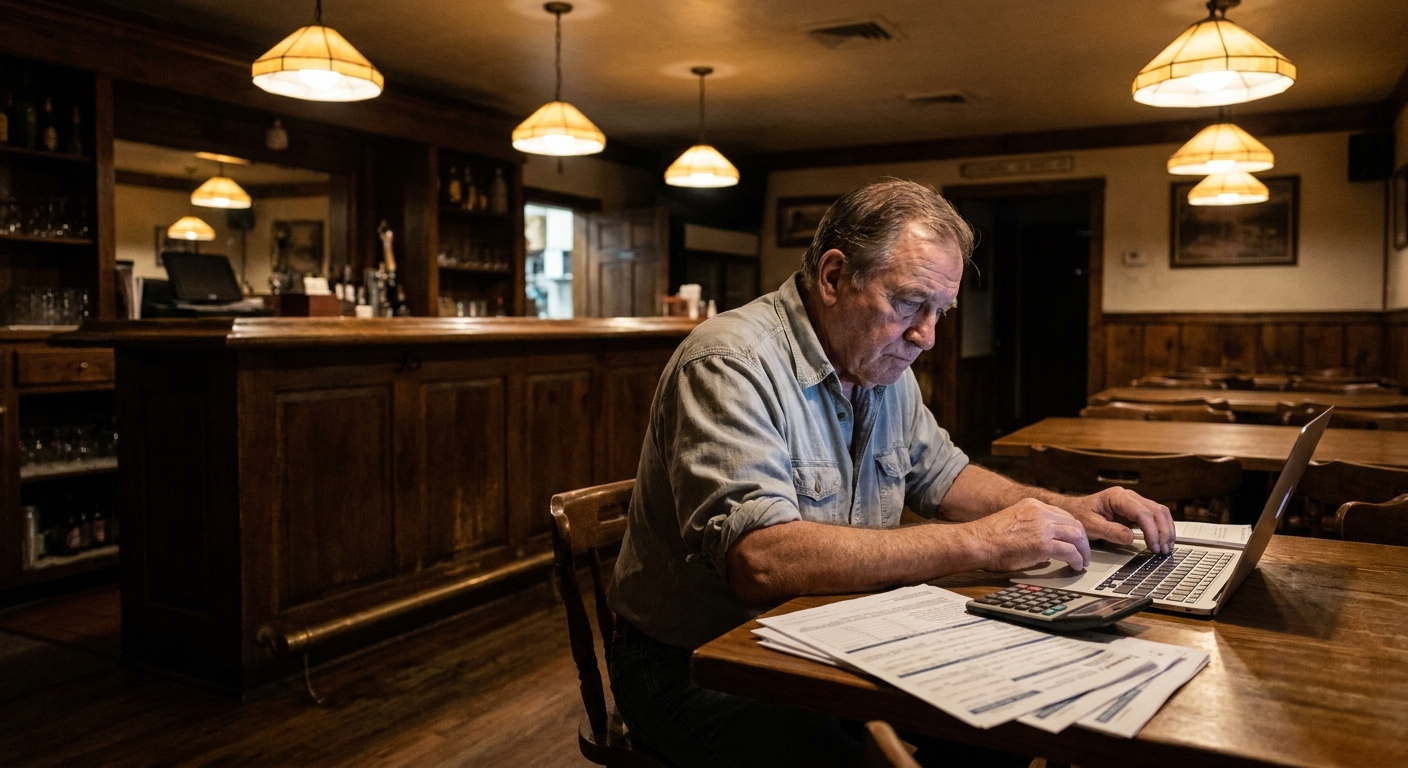
Two Hartford-area restaurants, both opened in 2024, both doing $2.4M in 2025 revenue, both serving full-bar dinner with limited delivery. One pays $9,400/year for insurance. The other pays $18,600. Same revenue, same menu type, same town. The difference isn't luck or carrier — it's coverage decisions made or skipped at the binding stage, claim history from one fryer fire in the higher-cost restaurant's first year, and a workers comp X-Mod that landed at 1.18 versus 0.86. After 40+ CT restaurant placements in 2024-2026, the pattern is consistent: same restaurant profile can pay 1.5-2x the premium of a peer based on choices that are entirely within the owner's control.
This is the case-study cost breakdown for CT restaurant insurance in 2026 — every line item, what drives ranges, and a worked example for a representative $2.4M Hartford-area restaurant. Use it to benchmark your current spend, identify lines that are over- or under-bought, and prepare for renewal conversations with real numbers.
The 2026 CT restaurant insurance cost framework
The 7 line items every CT restaurant needs
| Coverage | 2026 CT range | Drives cost up | Drives cost down |
|---|---|---|---|
| General Liability | $1,800 – $4,200 | High guest count, full-bar, outdoor seating, prior claims | Smaller capacity, dinner-only, no outdoor seating, clean history |
| Property + Business Interruption | $3,200 – $8,500 | Older buildings, basement kitchens, flood zone proximity | Newer construction, fire-suppression in place, generator |
| Liquor Liability (Dram Shop) | $1,600 – $5,800 | Liquor as % of revenue, bar atmosphere, late hours | Wine/beer only, food-driven, server training documented |
| Workers Compensation | $2,400 – $11,500 | Payroll size, X-Mod, mix of class codes | Documented safety program, X-Mod under 0.92, low staff turnover |
| Hired & Non-Owned Auto | $340 – $2,400 | In-house delivery, multiple drivers, longer radius | Pickup-only, no delivery, single occasional driver |
| Cyber Liability | $800 – $3,200 | POS storing card data, customer email lists, online ordering | Cash-heavy, tokenized payments, minimal customer data storage |
| Employment Practices (EPLI) | $800 – $3,500 | Larger staff, prior claims, multi-location | Smaller staff, documented HR policies, employee handbook |
Add specialty coverages where applicable: equipment breakdown ($280-$580), food spoilage ($180-$420), spoilage of refrigerated stock, sign coverage ($120-$320), and umbrella/excess liability ($1,200-$3,200 for $3M-$5M excess).
Case Study: $2.4M Hartford-area restaurant, full-bar dinner concept
The restaurant: 72 seats inside, 24 seats on a patio, full liquor license, $2.4M in 2025 revenue with 28% liquor mix, 14 W-2 employees plus 2 part-time delivery drivers, 8 years in operation, no major claims in the last 5 years (one minor slip-and-fall settled in year 3 for $4,200), Class A POS with PCI-compliant tokenized payment, modest online ordering. Located in a 1962 building with original electrical updated in 2018, full fire-suppression in the kitchen, ANSUL system inspected annually.
The full insurance budget placed by iConn Insurance Solutions for the 2026 policy year:
| Line item | Carrier | Coverage detail | 2026 premium |
|---|---|---|---|
| General Liability | The Hartford | $2M / $4M aggregate; products-completed ops included | $2,950 |
| Property + BI | The Hartford | $680K building + contents + $200K BI (12-month); replacement cost | $4,800 |
| Liquor Liability | Travelers | $1M / $2M dram shop; assault & battery sublimit $500K | $3,400 |
| Workers Compensation | The Hartford | NCCI 9082 + 9083 mix; $480K payroll; X-Mod 0.88 | $5,800 |
| Hired & Non-Owned Auto | The Hartford (BOP-bundled) | $1M H&NO with driver-screening credit | $680 |
| Cyber Liability | Coalition | $1M aggregate; PCI sublimit $500K; first-party BI included | $1,400 |
| EPLI | The Hartford (BOP-bundled) | $500K limit; defense outside limit | $1,150 |
| Equipment Breakdown | The Hartford (endorsed) | Bundled with property; $1M limit | $340 |
| Food Spoilage | The Hartford (endorsed) | $30K limit; 12-hour waiting period | $220 |
| Umbrella | RLI | $3M excess over GL, liquor, H&NO | $1,800 |
| TOTAL | $22,540 |
$22,540 ÷ $2.4M revenue = 0.94% of revenue. Slightly above the typical 0.4%-0.7% range — the liquor liability and umbrella push the total because the concept is full-bar with $672K in annual liquor sales. A wine-and-beer-only restaurant with the same revenue would land closer to $15,500-$17,000 (0.65%-0.71%). A full-bar concept with a prior assault & battery claim would land closer to $32,000-$38,000.
What this case study illustrates
- Workers comp ($5,800) and property+BI ($4,800) are the two largest line items on most CT restaurants — together they're 47% of the package.
- Liquor liability ($3,400) is the most volatile line — same restaurant with a single prior incident can be 2-3x more.
- Cyber ($1,400) and EPLI ($1,150) are often skipped — they're the two coverages that protect against the fastest-growing claim types.
- Umbrella coverage ($1,800 for $3M excess) is the strongest dollar-per-protection ratio in the entire package.
- X-Mod at 0.88 saves roughly $1,400-$1,800 versus 1.00 baseline on this payroll size.
- BOP-bundled coverages (H&NO, EPLI, equipment breakdown) cost dramatically less when bundled into the restaurant package versus standalone.
Where restaurant budgets typically go wrong on insurance
1. Underbuying business interruption limits
Most CT restaurants carry $100K-$150K of BI when the actual exposure (12 months of operating expenses including fixed payroll, rent, utilities, and lost margin) is $300K-$600K. Fire claim shuts you down for 9 months — your $100K BI runs out in month 3, the rest is out of pocket. Get the BI worksheet completed correctly, not the carrier's default.
2. Skipping cyber coverage on "we don't store cards"
Even tokenized-payment restaurants store customer email addresses, loyalty data, and reservation history. CT Public Act 21-59 triggers notification on any breach of personal info — not just card data. Cyber coverage at $800-$1,400 protects against $50K-$200K of notification and response costs.
3. Bare-minimum liquor liability
Full-bar restaurants frequently carry $300K of liquor liability when CT court awards on serious DUI cases settle at $750K-$2M. Match liquor liability limit to actual revenue exposure — for restaurants with $500K+ in annual liquor sales, $1M-$2M is the right number.
4. EPLI skipped because "we're a small team"
Wrongful termination and discrimination claims hit small restaurants disproportionately because they often lack written HR policies. Defense costs alone on a typical EPLI claim run $35K-$80K in CT — the $1,000-$1,500 annual premium pays for itself on the first claim.
5. Buying property at ACV (actual cash value) instead of replacement cost
ACV pays current depreciated value of the equipment — a 12-year-old walk-in cooler gets ACV at $1,800 when the replacement cost is $8,500. Pay the small premium upcharge for replacement cost; the recovery difference on a real claim is 3-5x the annual premium difference.
How to use this for your own 2026 restaurant budget
- Benchmark your current spend against 0.5%-0.7% of revenue (food-only) or 0.7%-1.0% (full-bar). If you're above, identify the line items driving it up — bad claim history, undersized limits, unbundled placements.
- Run a 4-carrier comparison every 24 months, not annually. Annual movement disrupts X-Mod and claim handling continuity; biennial gives a renewal cycle to settle.
- Map your 7 coverage lines against this checklist — if any are missing, add them before next renewal.
- Build a 5-year claim narrative — what you've done to reduce claim risk (safety training, fire suppression upgrades, MVR screening). This is the language carriers want to see for schedule rating credits.
- Use the case study as a starting calibration — your restaurant might land 30% above or below it, but the line-item ratios should look similar.
How CT compares to other Northeast states on restaurant insurance cost
| State | WC class code 9082 rate | GL premium index | Liquor liability index | Overall package vs. CT |
|---|---|---|---|---|
| Connecticut | $2.45 – $3.20 | 100 (baseline) | 100 (baseline) | 100 (baseline) |
| New York (Upstate) | $3.85 – $5.20 | 108 | 120 | 112-118 |
| New York (NYC) | $3.85 – $5.20 | 135 | 145 | 135-145 |
| Massachusetts | $2.80 – $3.65 | 106 | 110 | 106-112 |
| Rhode Island | $2.50 – $3.30 | 102 | 105 | 101-106 |
| New Jersey | $3.20 – $4.10 | 112 | 118 | 110-118 |
CT restaurants are reasonably positioned versus the surrounding region. NYC is dramatically more expensive on both liquor liability and overall coverage; CT typically prices 20-30% under NYC and 8-12% under MA and NJ. For multi-state operators, CT-domiciled restaurants frequently anchor the cheaper end of the regional package.
Why independent brokers matter for restaurant insurance
The 1.5x-2x premium spread we cited at the start of this post is almost entirely driven by broker quality. Captive agents writing one or two restaurant packages per quarter default to whatever their carrier offers, miss the bundling opportunities, leave coverage gaps, and don't push for schedule rating credits on documented safety programs.
At iConn Insurance Solutions, we work CT restaurant placements with a structured 7-coverage benchmark, 4-carrier comparison, and disciplined documentation review. Our sister agency Insure Connecticut LLC at myinsurect.com handles broader business insurance for CT restaurant groups across 12 states.
Frequently Asked Questions About CT Restaurant Insurance Cost
What percentage of my CT restaurant revenue should I budget for insurance?
0.4%-0.7% for food-focused restaurants without significant alcohol; 0.7%-1.0% for full-bar concepts with $300K+ in annual liquor sales. Multi-location operations and concepts with high-risk profiles (late-night, nightclub-adjacent) can run higher. Below 0.4% usually means coverage gaps.
What's the cheapest way to lower my restaurant insurance premium?
Three highest-ROI moves: (1) document your safety program in writing to unlock 10-15% workers comp schedule credits, (2) install a tested ANSUL fire-suppression system if you don't have one (premium credit + claim avoidance), (3) bundle your coverages into a single restaurant BOP rather than standalone policies (8-15% bundling discount).
How much will my premium increase after one liquor liability incident?
Significantly. A single assault & battery or DUI-related liquor liability claim that settles or pays defense over $25K typically increases your liquor premium 35-80% at next renewal, and may force placement into the excess and surplus market for 2-3 years. Server training, ID-check protocols, and incident logs are the most cost-effective claim-prevention investments.
Should I carry an umbrella policy as a restaurant?
Yes — for restaurants doing $1.5M+ in revenue, a $2M-$5M umbrella is usually $1,200-$3,200 and is the single strongest dollar-per-protection coverage in your package. CT court awards on serious slip-and-fall, liquor, and assault claims regularly exceed underlying primary limits; the umbrella keeps the gap from being personal.
What's a realistic timeline to lower my restaurant insurance costs?
One renewal cycle for bundling and documentation improvements (8-15% savings). Three renewal cycles for X-Mod improvements through safety programs (12-22% workers comp savings). Carrier switching alone rarely saves more than 5-10% — the real savings come from coverage decisions and claim history improvements that compound over years.
Do CT restaurants need standalone cyber insurance, or is the BOP-bundled cyber enough?
For most CT restaurants under $5M revenue, BOP-bundled cyber at $250K-$500K limits is adequate. For restaurants with online ordering platforms, customer loyalty programs, or multi-location POS networks, standalone cyber at $1M+ is increasingly the right answer — particularly under CT Public Act 21-59 notification requirements.
Take the next step
If you haven't benchmarked your CT restaurant insurance against the 7-coverage framework in the last 24 months, you're likely either over-paying by 15-25% or carrying gaps in 1-2 critical coverages. Request a complimentary restaurant policy review with iConn Insurance Solutions. We'll score your current coverage against the benchmark, run a 4-carrier comparison, and identify schedule rating credits worth 10-20% of premium. Our sister agency Insure Connecticut LLC handles broader business insurance for CT restaurant groups.