The Ridiculous Specifics File: 12 Weirdly Specific Connecticut Cannabis Insurance Questions With Real Answers

The Ridiculous Specifics File, Vol. 1: 12 Hyper-Specific Connecticut Cannabis Insurance Questions With Real Answers
The Connecticut cannabis insurance cluster we just wrapped covered the big topics. It did not cover the questions that haunt operators at 11 p.m. on a Tuesday — the hyper-niche, weirdly specific edge cases that aren't quite big enough to be their own blog post but show up in real broker conversations all the time.
Here are twelve of them. Each one gets a short answer, a longer "why," and a flag for when the answer might be different than you expect.
The 12 questions
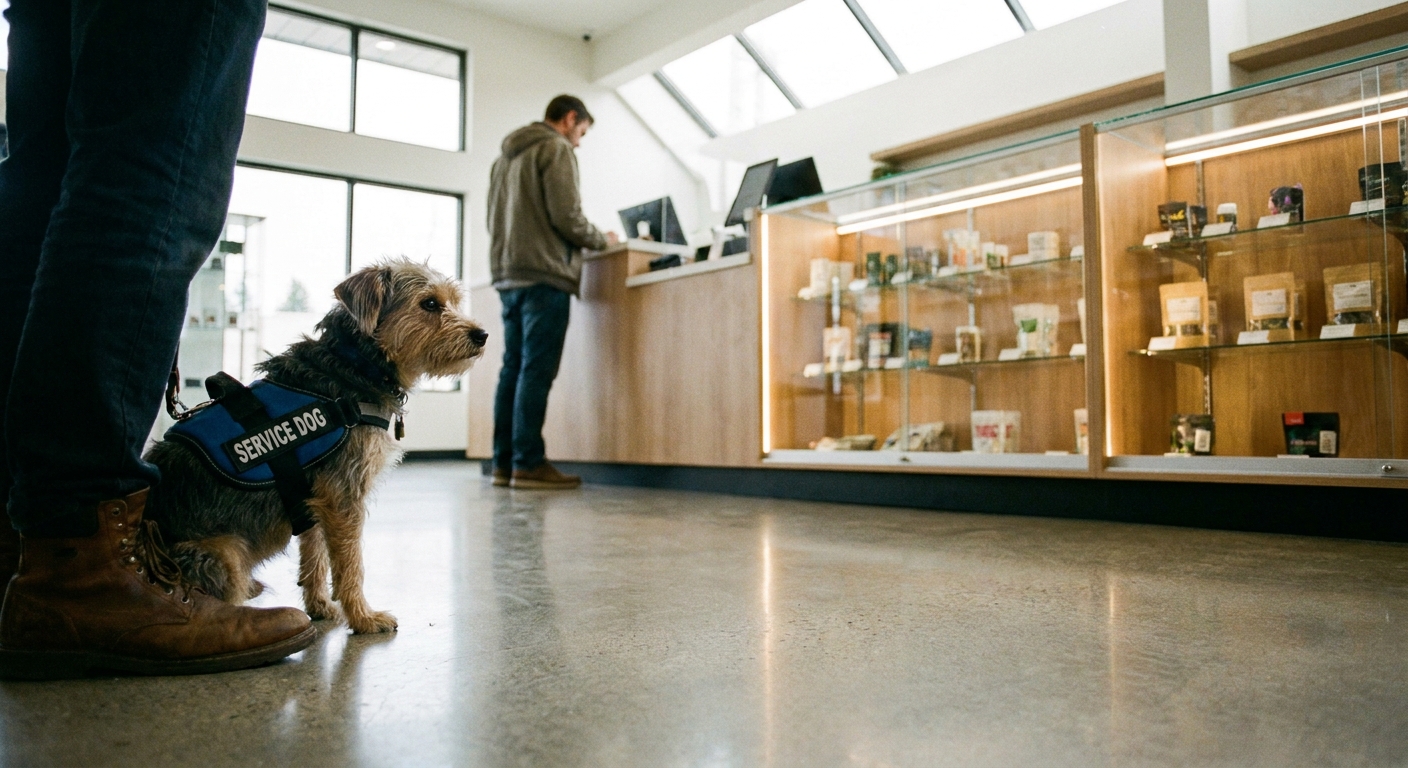
If a customer's service dog slips on the dispensary floor, is that a general liability claim, a workers comp claim, or something else entirely?
Short answer: Almost always general liability (third-party bodily injury, or in some policy forms, "care, custody, and control" if applicable). Not workers comp — the dog is a customer's animal, not an employee or an employee's animal.
Why it matters: The pet-friendly framing matters less than the "third party on premises" framing. If a customer's leashed service dog is injured on your floor because of a wet spot you didn't sign, your premises liability is in play the same way it would be for the customer themselves.
Is the part-time kief-sweeper an employee or a contractor for workers comp purposes?
Short answer: Almost certainly an employee in Connecticut, regardless of what you call them on paper.1
Why it matters: Connecticut applies the "ABC test" for many worker-classification questions, and the kief-sweeper typically fails it: they work on your premises, with your tools, on your schedule, doing work that's part of your usual business. The "1099 kief person" is one of the highest-frequency mis-classifications we see in CT cannabis operations.
A delivery driver takes a 20-minute detour through Rhode Island to drop off a friend. Is the cannabis cargo still covered?
Short answer: Probably not, and the entire trip's cargo coverage is at risk — not just the detour portion.
Why it matters: Cargo and product transit endorsements on cannabis policies are typically tied to Connecticut-only transit within the state's regulated supply chain. Crossing a state line — even briefly — can void coverage for the trip, and crossing into a federally-uniform-handling state with different cannabis status complicates the federal-illegality posture of the cargo.
If a vape pen battery arc-welds itself shut inside a finished-goods cabinet and starts a small fire, is that a product liability claim or a property claim?
Short answer: Almost certainly a property claim first (your finished goods damaged on your premises) and a product liability claim later (if a customer who bought the same SKU complains).
Why it matters: Cannabis vape battery defects are one of the more common product-liability fact patterns nationally, and Connecticut hasn't been exempt. The same incident can trigger two different coverage parts of your policy at different times — the property claim might be handled and closed before the first product complaint shows up.
The dispensary Wi-Fi gets compromised and a hacker accesses the POS system. Cyber coverage or general liability?
Short answer: Cyber, full stop. Standard general liability almost never covers data breach response, notification costs, or regulatory fines.
Why it matters: Cannabis retail collects a lot of personally identifiable information (PII) — IDs scanned at check-in, loyalty data, payment data where allowed. A breach in Connecticut triggers state breach-notification obligations.2 If you don't have a dedicated cyber policy or a cyber endorsement on your package, you eat the response costs personally.
An employee slips on spilled rosin in the back room and breaks a wrist. Workers comp covers it, sure — but does the same incident also raise your general liability premium next year?
Short answer: No. Workers comp losses go on your workers comp loss runs and affect your workers comp experience modifier. They do not raise GL premium directly. Indirectly, a pattern of workplace-safety issues can affect overall underwriter perception.
Why it matters: Operators often assume any claim raises every premium. That's not how it works — but underwriters do read across coverage parts when they're deciding whether to renew or non-renew.
A celebrity influencer comes to the dispensary, livestreams the visit, and a product is incorrectly described on camera. Is that a media liability claim or product liability?
Short answer: Neither, usually — unless a viewer relies on the misdescription to their detriment, in which case a product liability or false-advertising claim becomes possible.
Why it matters: The mere fact of a misstatement on a livestream isn't itself a loss. Damages require harm. But cannabis is a particularly regulated category for advertising claims in Connecticut, and a viral misstatement can attract DCP regulatory attention even if no civil claim follows.
The cultivation facility's HVAC fails and three weeks of plants die. Property claim, business interruption, or both?
Short answer: Property for the plants themselves (if covered as "growing crops" or under a cannabis-specific crop endorsement) and business interruption for the lost revenue from those plants. Different sub-limits, often different deductibles.
Why it matters: Cannabis "growing crop" coverage is one of the most negotiated sub-limits on a cultivation policy. Standard property forms often exclude it entirely — you need explicit endorsement language and a sub-limit that matches your actual canopy value at any given moment in the grow cycle.
The landlord's HVAC contractor mishandles refrigerant in the grow room and contaminates a batch. Whose insurance pays?
Short answer: Several possibilities. The contractor's general liability (third-party property damage), the landlord's liability (if they hired and supervised the contractor), and your own first-party property if the chain of liability falls through. Often all three get tendered.
Why it matters: Sub-tenant cannabis operations often have weak contractual risk-transfer language in the lease. The default outcome is that you eat the loss while three sets of carriers point at each other. The fix is a strong lease + a "named additional insured" endorsement against the landlord and major vendors.
An employee with a Connecticut medical-cannabis card uses on premises during a break and then drives the delivery van. Workers comp implications?
Short answer: Substantial. A claim from an accident on that drive is almost certain to face an intoxication-defense by the carrier, and even if workers comp eventually pays, the auto-liability insurer for the van may exclude or pursue subrogation.
Why it matters: Possessing a Connecticut medical-cannabis card does not give an employee a right to use during work hours or while operating equipment.3 Your employee handbook and SOPs need explicit policies on this — and your auto policy underwriter cares deeply about whether you have them.
The dispensary hosts a community event with food, music, and a local non-cannabis vendor. Special event coverage or just your standard policy?
Short answer: Usually a separate special-event endorsement, even if the event is on your premises. Some carriers will accept the event under the base policy with prior notice; many will exclude any "non-routine activity."
Why it matters: Bringing in a third-party food vendor, a band, alcohol (if permitted), or a larger-than-usual crowd materially changes your premises risk. Carriers want to know in advance and may want to underwrite the event separately. The "we'll just do it under our existing policy" assumption is how operators end up uninsured for the one event of the year that actually had a loss.
A customer claims a dispensary product caused a medical reaction. The dispensary tested the product but did not manufacture it. Who's on the hook?
Short answer: Both, almost certainly. The manufacturer faces product liability for the alleged defect. The dispensary faces product liability under "seller in the stream of commerce" doctrine, and arguably premises liability if the reaction occurred on the dispensary's property.
Why it matters: Dispensaries often assume that selling a third-party manufactured product insulates them from product liability. It does not — at least not in Connecticut. The protection comes from having the manufacturer name the dispensary as an additional insured on the manufacturer's product liability policy, with an indemnification agreement. That's a contract question, not a coverage question.
The patterns across the twelve questions
- Most "weird" cannabis losses split across two or more coverage parts. One incident, multiple claim files. Plan for that organizationally.
- Worker classification is the single highest-frequency mistake we see. When in doubt, classify as employee.
- Standard policy language doesn't anticipate cannabis-specific edge cases. Endorsements and sub-limits do the actual work. Read them.
- Documentation determines outcome. SOPs, written employee policies, written vendor agreements, contemporaneous photos and notes. The operator who documents wins more claims.
FAQs about this list
Will there be a Vol. 2?
Yes — we maintain a running list of edge-case questions that come up in broker conversations and audit calls. When it gets to twelve again, it'll publish.
Are any of these based on real claims?
The fact patterns are realistic-but-composite. None of the twelve corresponds to a specific operator, claim file, or carrier negotiation we've been part of. They reflect the categories of edge cases that come up — not specific incidents.
Can I send you my weird question?
Please. Email or message us — the weirder the better. We log them and the most common ones become future Q's in the next volume.
Sources, footnotes & further reading
- Connecticut Department of Labor — worker classification ("ABC test") general guidance: portal.ct.gov/dol. For workers comp classification specifically, see the Connecticut Workers' Compensation Commission: portal.ct.gov/wcc.
- Connecticut Attorney General — data breach notification & consumer protection: portal.ct.gov/AG. Connecticut General Statutes §36a-701b governs breach notification obligations.
- Connecticut Department of Consumer Protection — Medical Marijuana Program: portal.ct.gov/DCP — Medical Marijuana Program. Connecticut General Statutes §21a-408p addresses employment-related provisions.
- Connecticut Department of Consumer Protection — Adult-Use Cannabis: portal.ct.gov/DCP — Adult-Use Cannabis.
- Connecticut Insurance Department — consumer resources: portal.ct.gov/cid.
Disclosures & Compliance Notes
- Educational purpose only. This article is general business education for Connecticut cannabis operators and their advisors. It is not legal advice, tax advice, or a specific insurance recommendation. The "short answer" provided in each scenario reflects the most common general outcome based on typical policy language and Connecticut law — your situation may differ.
- Hypothetical scenarios. All twelve scenarios above are hypothetical or composite. None describes a specific operator, employee, customer, claim file, carrier position, or pending litigation.
- No coverage opinion. Whether any specific incident is covered under your specific policy depends on your policy's full text, applicable endorsements, exclusions, sub-limits, retentions, and the facts of the loss. Always read your policy and consult your broker and counsel for any actual coverage question.
- Worker classification. Classification of any individual as an "employee" or "independent contractor" depends on a multi-factor analysis under Connecticut and federal law. The general guidance in Q2 and elsewhere is not a substitute for an actual classification review.
- Regulatory citations. CT DCP, CT DOL, CT WCC, and Connecticut General Statutes references reflect rules in effect at the time of writing. Verify current rules with the relevant agency.
- Licensing. iConn Insurance Solutions is a licensed Connecticut insurance producer.
- Last reviewed. July 22, 2026.