
7 Insurance Mistakes Electrical Contractors With Fleets Keep Making (And How to Fix Them)
7 Insurance Mistakes Electrical Contractors With Fleets Keep Making (And How to Fix Them)
Why these mistakes happen
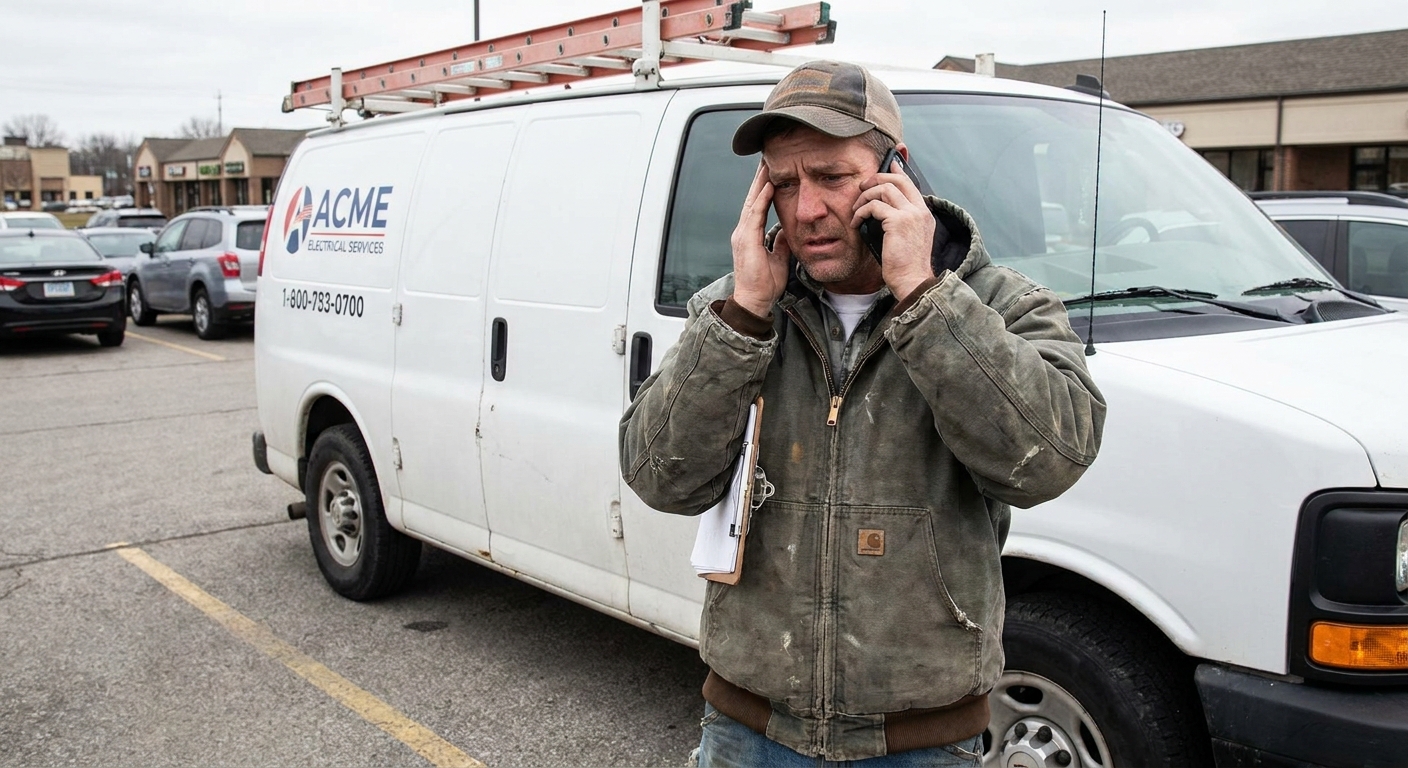
Electrical contractors don't make these mistakes because they're careless. They make them because the program was set up when the shop was small — one van, one or two employees — and never re-built when the business grew. The policy that fit a 2-van service shop in 2019 does not fit the 7-van fleet running commercial accounts in 2026. Nobody re-opens the box until something breaks.
Below: the seven mistakes we see most often when we audit a new electrical contractor's existing program. In order of how much they actually cost when they bite.
1Apprentices not on the driver schedule
Every BAP has a driver schedule — the list of employees authorized to operate company-owned vehicles. When you hire a 19-year-old apprentice and put him in a van the next morning to run jobs with a journeyman, his name needs to be on the schedule that day. If it's not and he crashes, the carrier can issue a reservation of rights — particularly if his MVR has issues the underwriter didn't get to evaluate before binding.
We see this constantly. Owner hires the kid Monday, schedule update gets added to the "things to call the broker about" list, three weeks later there's a fender-bender, and now there's a coverage argument.
2Tools severely under-insured on inland marine
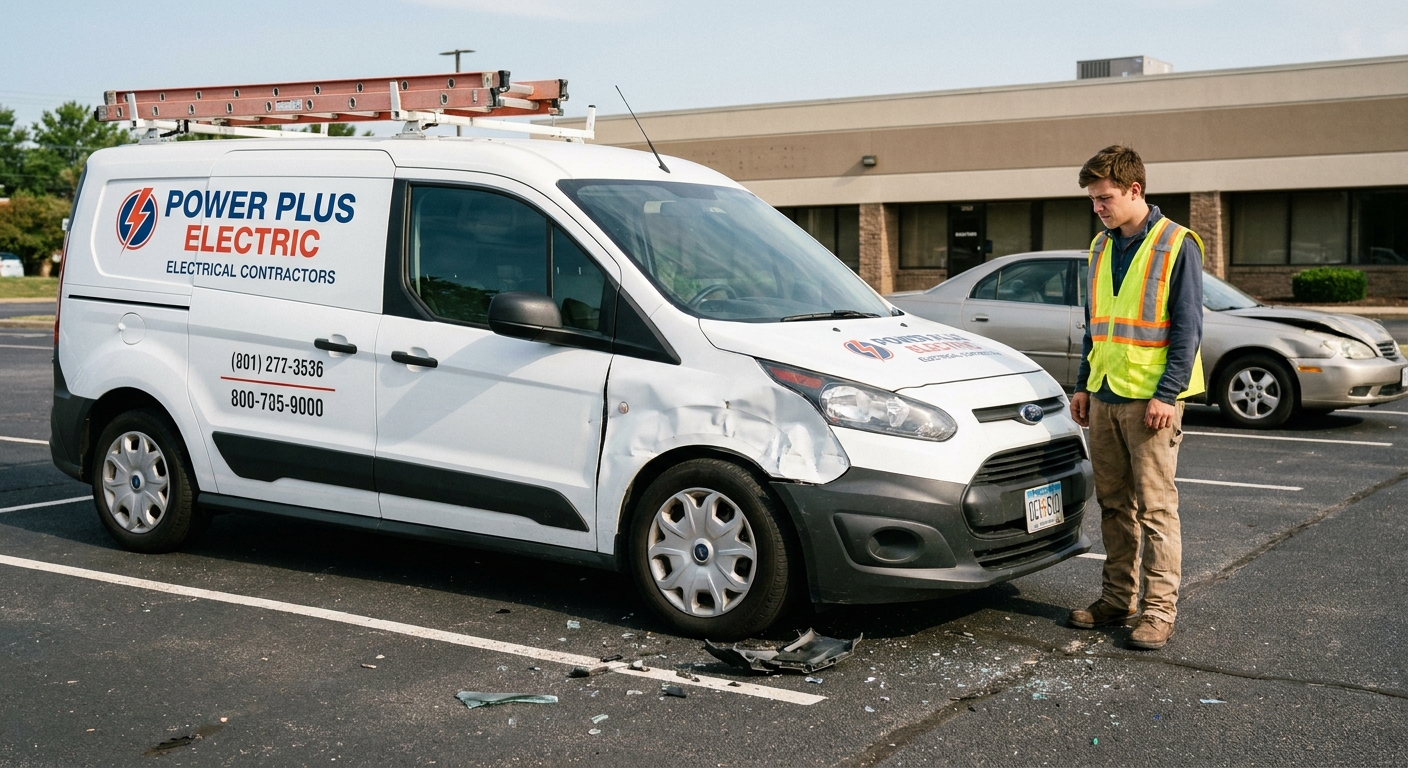
Every electrical service van carries $20,000–$60,000 of tools, materials, ladders, meters, and equipment. The number most fleet owners quote when we ask "what's in the van?" is the original purchase price — often from 5+ years ago. Replacement cost in 2026 is 2.5–3.2x that number.
Example: a typical service van has a Fluke 1587 insulation tester ($1,800 new), an industrial multimeter ($600), a thermal imager ($2,500), a Megger ($1,200), conduit benders ($800), drills/impacts/saws ($3,500), wire spools and material ($4,000+), plus ladders, racks, and incidentals. That's $14,000+ in a van the owner remembers buying for "about $5,000." Multiply that across 5 vans and you have $70K of exposure insured at $25K.
3No hired & non-owned auto (HNOA)
The silent gap in this trade. HNOA covers two scenarios: (a) a rented or borrowed vehicle the company uses for a job, and (b) an employee using their personal vehicle on company business — picking up parts at Graybar, driving between job sites in their own truck, running to a customer's house to drop off paperwork.
If an apprentice picks up a panel at the supply house in his personal pickup and rear-ends a school bus, the carrier of his personal auto policy will pay up to that policy's limit, then walk away. Anything above the personal limit — settlements, judgments — comes to the company. Without HNOA, that exposure has no insurance.
HNOA typically runs $300–$700/year. It's the single cheapest gap closure in the program.
4Workers' comp class codes lumped together
Office staff don't belong at class 5190 rates. Apprentices in some states qualify for class 5191 (or have an apprentice rate). Yet a stunning number of contractor WC policies lump everyone at the journeyman class — paying $4.85/$100 of payroll on a bookkeeper who should be at $0.30/$100.
We pulled three new-account audits in the last 6 months that turned up bookkeepers, dispatchers, and material handlers all sitting in class 5190. Reclassifying them saved an average of $2,800/year per shop with zero coverage reduction.
5Umbrella too low for the work being done
$1M umbrella on a contractor doing residential service work is borderline acceptable in 2026 — barely. $1M umbrella on a contractor running hospital wiring, school district work, multi-family commercial, or industrial accounts is asking to be the next nuclear-verdict cautionary tale.
Tri-state juries in 2025 returned multiple $5M+ verdicts against contractors for losses that ten years ago would have settled at $750K. Settlement inflation is real. The math: a $5M umbrella over a $1M BAP and $2M GL costs roughly $2,500–$4,000/year. The cost of being $3M short on a $5.5M settlement is the rest of your business.
6BAP symbol stack restricted
This one is a policy-form detail most owners have never heard of. Every BAP has a series of symbols on the dec page that define what vehicles are covered. The symbols you want for a full-coverage program:
| Symbol | What it covers | Should you have it? |
|---|---|---|
| 1 — Any auto | All owned, hired, non-owned (broadest) | Yes, on liability |
| 7 — Specifically described autos | Owned vehicles listed by VIN | Yes, on physical damage |
| 8 — Hired autos | Rented or borrowed | Yes |
| 9 — Non-owned autos | Employee personal vehicles on company business | Yes |
If your dec page only shows symbol 7 on liability, you have a gap. We see this on cheap quotes constantly — the "cheap" comes from restricting the symbol stack.
7Treating insurance as one annual decision
The biggest meta-mistake. Most shops shop insurance once a year, sign the renewal, and don't think about it again until the next renewal. In between, the fleet grew by 2 vans, payroll grew by $120K, you took on a school district contract, and three apprentices joined. None of that hit the policy until renewal — which means 9 months of underwriting drift and a giant retro-audit.
Key Takeaways
- The expensive mistakes are policy-design mistakes, not premium-shopping mistakes.
- Apprentices on the driver schedule is the #1 silent claim-denier in this trade.
- Tools are under-insured by 2.5–3.2x in the majority of policies we review.
- HNOA is the cheapest gap closure available — and the most commonly missing endorsement.
- WC class code splits routinely save $2,000–$3,500/year per shop.
- $1M umbrella is no longer adequate for any contractor doing commercial or institutional work.
Frequently Asked Questions
How often should I review my electrical contractor insurance?
Every 6 months at minimum. Fleet size, payroll, contract scope, and drivers all change faster than annual-only reviews can keep up with.
Do all 7 of these mistakes apply to every fleet contractor?
Not always all 7. But in our last 24 months of new-account audits, the median electrical fleet had 4 of the 7. The most common are apprentices off the driver schedule, under-insured tools, and missing HNOA.
Can I fix all 7 with my current carrier?
Usually yes — most fixes are endorsements, not market moves. If your current carrier won't accommodate the fixes (e.g., they won't add HNOA or won't expand symbol stack), that's information about whether you're with the right carrier.
How much will fixing all 7 add to my premium?
For a typical 5-van shop, fixing all 7 issues usually adds $1,800–$3,500 to annual premium. The protection delta is typically $1M–$3M of additional covered exposure. The math is straightforward.
What if my workers' comp e-mod is over 1.20?
You're paying a 20%+ tax on payroll for past loss history. The path back to 1.00 takes 2–3 years and runs through loss-control, return-to-work programs, and safety-meeting documentation. Worth every minute. Travelers and Federated both have strong dealer-side loss-control resources that come included.
Can Progressive Commercial fix all 7?
Progressive is excellent for BAP/HNOA fixes (mistakes #3 and #6). For workers' comp, GL, and umbrella adjustments, you'll typically pair Progressive with a package carrier like Travelers, Hartford, or Liberty Mutual.
Continue the cluster
Want a 30-minute audit?
Send us your current dec page. We'll mark up exactly which of the 7 mistakes apply and what closing each one would cost.
Request a free policy audit →Related Content
AI Payment Fraud Incident Response: What to Do First
The first hour after a fraudulent wire can decide whether funds are frozen or lost. Follow this practical response guide for banks, insurers, evidence, law enforcement, and recovery.
Read post →
Hotel and Commercial Property Insurance: Where Should Renewal Savings Go?
A practical guide for hotel and commercial-property owners deciding whether to keep renewal savings, lower deductibles, increase limits or restore coverage.
Read post →AI Fraud Insurance Exclusions: Where Coverage Can Break
A large cyber limit can hide a small social engineering sublimit. Learn how voluntary-transfer language, verification conditions, and overlapping crime coverage can affect AI fraud claims.
Read post →
Connecticut Builders Risk Insurance: 2026 Buyer’s Guide
Connecticut builders risk buyers should update project values, timelines and controls. Learn what to prepare and compare for a 2026 placement.
Read post →