
Food Spoilage & Equipment Breakdown Coverage for CT Restaurants 2026
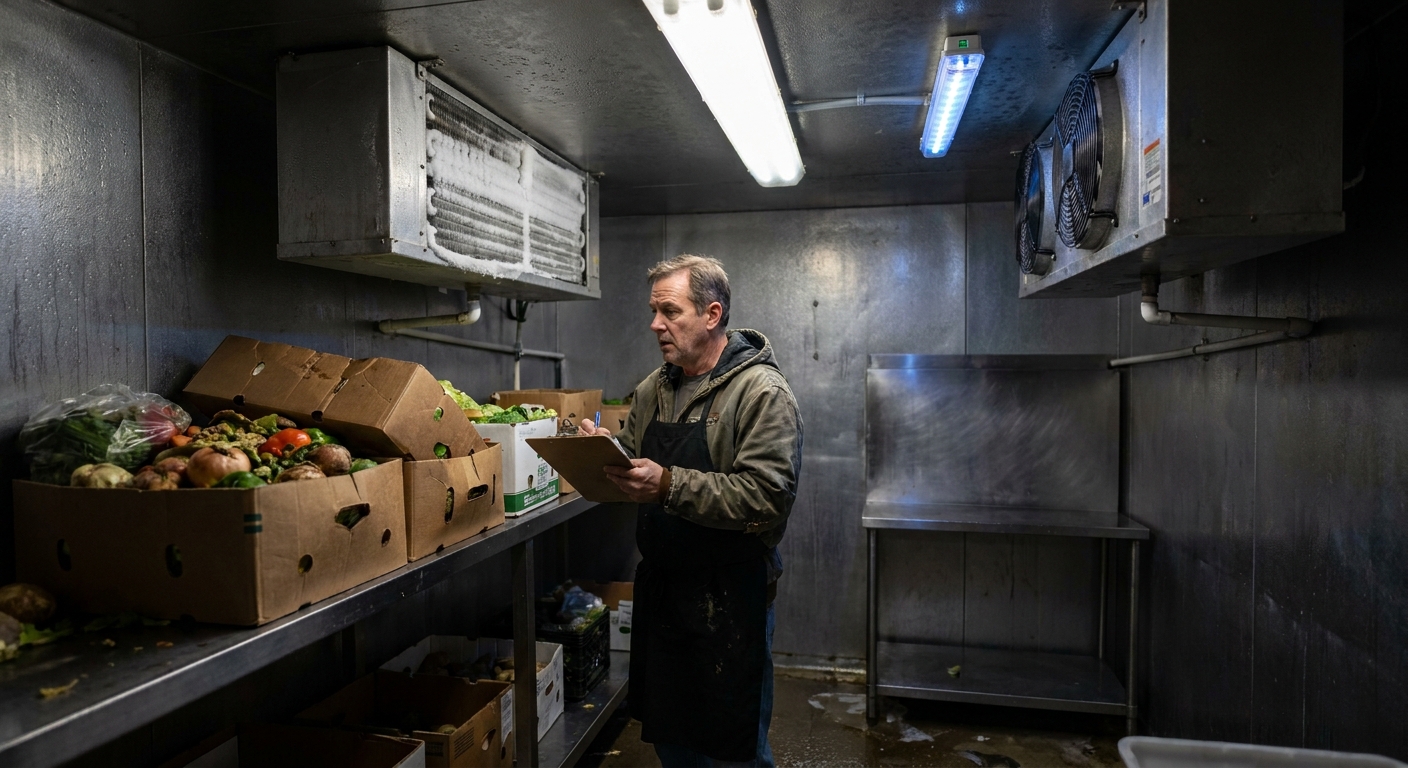
At 4:17 AM on a Tuesday in February, a compressor fails in the walk-in cooler of a 70-seat Italian restaurant in West Hartford. By the time the morning prep cook arrives at 6:30 AM, the cooler interior is at 51°F. Twelve thousand dollars of inventory — veal, fresh fish, prepped sauces, fresh pasta — is below the FDA safe-temperature threshold. The restaurant's standard property policy has a $5,000 sublimit for spoilage. The compressor itself costs $8,400 to replace. The restaurant is closed for 4 days waiting on the part.
Without the right coverage stack — spoilage coverage, equipment breakdown, and business interruption all working together — that single compressor failure becomes a $34,000+ event. With it, the restaurant covers their $1,500 deductible and gets back to service in under a week.
Spoilage claims hit fast — the 4-hour FDA safe-temperature rule means inventory is unrecoverable before staff arrives.
What Does Food Spoilage Insurance Cover for Connecticut Restaurants?
The Three-Coverage Stack That Actually Protects a Restaurant Kitchen
Most restaurant owners think of "spoilage" as one coverage. In reality, three separate (but related) coverages must work together for a clean recovery on a refrigeration loss. If any one of them is missing or sublimited, the restaurant absorbs the gap.
| Coverage | What It Covers | Typical CT Limit Range | Typical CT Premium |
|---|---|---|---|
| Food Spoilage | Inventory destroyed by refrigeration failure, power loss >4 hours, or contamination | $10,000 – $50,000 | $150 – $650/yr |
| Equipment Breakdown | Repair/replacement of the failed mechanical or electrical equipment (compressor, motor, control board) | $100,000 – $500,000 | $280 – $1,400/yr |
| Business Interruption | Lost net income + continuing expenses while the kitchen is shut down for repairs | 12 months ALS (actual loss sustained) | Bundled into property premium |
| Utility Service Interruption | Income loss from off-premises utility failure (Eversource transformer, gas main rupture) | Optional endorsement, $10K–$100K | $120 – $480/yr |
The most expensive gap in a CT restaurant policy isn't usually the spoilage limit — it's the absence of equipment breakdown coverage. Standard property policies exclude "mechanical breakdown" as a covered cause of loss. A compressor that simply fails (no fire, no flood, no theft) is not a property claim. Without an equipment breakdown endorsement, the restaurant pays for the compressor repair out of pocket AND files only the spoilage claim — and the carrier may dispute the spoilage claim because the proximate cause of loss (mechanical breakdown) isn't covered under the base policy.
Equipment Breakdown — The Hidden Multiplier on Every Kitchen Asset
Equipment breakdown coverage (formerly called "boiler & machinery") is the modern endorsement that fills the mechanical-failure gap. A properly written policy covers:
- Refrigeration: walk-in coolers, walk-in freezers, reach-ins, ice machines, prep tables with built-in refrigeration
- Cooking equipment: commercial ranges, ovens, fryers, char-broilers, combi-ovens, sous-vide circulators
- HVAC: rooftop units, makeup air units, exhaust hood motors
- Electrical: service panels, transformers, breaker boxes, control boards in any of the above
- Computer / POS systems: server hardware, POS terminals, KDS screens — yes, these qualify as "electronic" equipment under most endorsements
Equipment breakdown also typically includes "expediting expense" coverage — the extra cost to get a replacement compressor on overnight freight rather than waiting 4-6 days for ground shipping. This single feature can pay for the endorsement on its own in a single claim.
Power Outage Coverage — The CT Eversource Reality
Connecticut had 14 major Eversource outages affecting more than 50,000 customers between 2020 and 2025. Restaurants in the shoreline towns (Old Saybrook, Madison, Branford), the Litchfield Hills, and the Quiet Corner experience extended outages from hurricanes, ice storms, and Nor'easters with more regularity than the state average.
Standard spoilage coverage covers power outage only if the outage occurred on-premises (a building electrical fault, a damaged service panel). An off-premises outage — Eversource transformer blown two blocks away, downed power lines from a storm — is excluded unless you specifically add the utility service interruption endorsement.
This is the single most common coverage gap iConn sees on CT restaurant audits. The owner thinks they have spoilage coverage. They do — but only for on-premises causes. The storm-driven Eversource outage that takes out the block isn't covered. Premium for the utility service interruption endorsement runs $120-$480/year on a typical mid-market restaurant.
Business Interruption on Equipment Failure — How the Math Actually Works
Business interruption coverage doesn't just kick in for fires and floods. A covered equipment breakdown that shuts the kitchen down for 3-5 days triggers BI just like any other covered cause of loss. For a typical CT mid-market restaurant doing $1.8M in annual revenue with a 14% net margin, BI math looks like this:
| Line Item | Daily Average | 4-Day Compressor Repair |
|---|---|---|
| Gross Revenue | $4,932 | $19,726 |
| Variable Costs Saved (food, hourly labor) | $2,367 | $9,468 |
| Lost Net Income | $691 | $2,762 |
| Continuing Expenses (rent, salaried labor, utilities, insurance) | $1,874 | $7,496 |
| Total BI Claim Value | — | $10,258 |
Add the $12,000 inventory loss + $8,400 compressor replacement + $10,258 BI = $30,658 total claim. With proper coverage and a $2,500 combined deductible, the restaurant recovers $28,158. Without equipment breakdown, the restaurant absorbs the $8,400 compressor cost AND faces a potentially declined spoilage/BI claim. Without utility interruption coverage (if it was an Eversource outage rather than internal failure), the restaurant absorbs the entire $30,658.
The 4 endorsements every CT restaurant needs on the property side
- Spoilage coverage at minimum $25,000 — not the BOP default of $5K-$10K
- Equipment breakdown — non-negotiable. The single highest-value endorsement on a restaurant policy.
- Utility service interruption — covers off-premises Eversource/gas-main outages
- Selling price valuation for inventory — claims paid at retail value rather than wholesale cost, recovering the lost gross margin
Selling Price vs. Cost Valuation — The Math That Recovers Gross Margin
Default spoilage and inventory coverage pays out at actual cash value (wholesale cost). A $12,000 inventory loss at wholesale represents roughly $30,000-$36,000 in retail menu value at typical 60-67% food cost margins. Selling-price valuation endorsements pay claims at retail menu pricing rather than wholesale cost — recovering the gross margin the restaurant would have earned on that inventory.
This endorsement adds $100-$280/year to a typical restaurant policy and can triple the recovery on a major inventory loss. It's particularly valuable for restaurants with high food cost percentages on premium proteins (steakhouses, seafood concepts, high-end Italian) where wholesale-to-retail multiples are largest.
Why Independent Brokers Matter for Restaurant Property Coverage
Restaurant property and equipment breakdown markets are surprisingly fragmented. Hartford and Travelers offer competitive base policies. Hartford Steam Boiler (HSB) is the dominant equipment-breakdown specialty carrier. Society Insurance, Markel, and CNA write strong restaurant programs with built-in EB at competitive rates. Captive agents see one of these. Independents quote all of them and structure the policy around your specific kitchen footprint.
At iConn Insurance Solutions, we structure restaurant property policies with equipment breakdown, utility service interruption, and selling-price valuation as standard inclusions — not optional add-ons most owners learn about after their first claim. Our sister agency, Insure Connecticut LLC, serves multi-state restaurant groups across the Northeast.
Audit Your Restaurant Property Coverage
If you don't know your spoilage limit, equipment breakdown deductible, or whether you have utility service interruption coverage, you're one Eversource storm away from a $25,000-$50,000 uninsured loss. Request a restaurant coverage audit at iConn Insurance Solutions — we'll review your current policy line-by-line and identify the gaps before your next claim. Restaurant groups with multi-state locations can also work with Insure Connecticut LLC across the 12-state Northeast region.
Frequently Asked Questions About CT Restaurant Spoilage & Equipment Coverage
Does my BOP automatically cover food spoilage?
Most CT restaurant BOP policies include $5,000-$10,000 of spoilage coverage as default. This is rarely enough for a mid-market restaurant — a single walk-in cooler typically holds $8,000-$15,000 of inventory at any time. Endorse spoilage to $25,000-$50,000 to match your actual inventory exposure.
What's the difference between equipment breakdown and a manufacturer warranty?
Warranties cover defective parts and workmanship from the manufacturer, usually 1-3 years. Equipment breakdown covers mechanical/electrical failure regardless of cause, age, or warranty status — and includes expediting expense (overnight freight), spoilage from the failure, and business interruption. They serve different purposes; both matter.
If an Eversource outage spoils my inventory, am I covered?
Only if your policy includes utility service interruption coverage. Standard spoilage coverage applies to on-premises power failures (your building's electrical system). Off-premises utility outages — Eversource transformer failures, downed power lines — require a separate endorsement, typically $120-$480/year.
How long does spoilage coverage take to trigger?
Most policies require the power/refrigeration to be out for at least 4 consecutive hours before spoilage coverage triggers — aligned with the FDA's 4-hour rule for food safety. Brief outages under 4 hours don't qualify even if inventory was technically above 40°F briefly.
Does equipment breakdown cover POS systems and computers?
Yes — modern equipment breakdown endorsements cover "electronic equipment" including POS terminals, KDS screens, back-of-house servers, and digital signage. Some carriers add "data restoration" coverage that pays for re-entering lost sales/inventory data after a hardware failure.
What deductible should I set on spoilage and equipment breakdown?
Spoilage deductibles typically run $500-$1,500. Equipment breakdown deductibles are usually $1,000-$2,500. Higher deductibles save 10-20% on premium but increase out-of-pocket on small claims. For mid-market CT restaurants, the $1,500 spoilage / $2,500 EB combination usually produces the best premium-to-protection ratio.
Final Word
Property coverage is the silent line item on most restaurant insurance policies — until it isn't. A compressor failure, an Eversource outage, or a hood-vent motor that finally gives up after 14 years can produce $25,000-$50,000 losses that should be insured events but become out-of-pocket disasters because of three missing endorsements that would have cost less than $1,000/year combined.
Tomorrow's post covers third-party cyber liability — the supply-chain exposure most CT mid-market firms are still ignoring.
Related Content
AI Payment Fraud Incident Response: What to Do First
The first hour after a fraudulent wire can decide whether funds are frozen or lost. Follow this practical response guide for banks, insurers, evidence, law enforcement, and recovery.
Read post →
Hotel and Commercial Property Insurance: Where Should Renewal Savings Go?
A practical guide for hotel and commercial-property owners deciding whether to keep renewal savings, lower deductibles, increase limits or restore coverage.
Read post →AI Fraud Insurance Exclusions: Where Coverage Can Break
A large cyber limit can hide a small social engineering sublimit. Learn how voluntary-transfer language, verification conditions, and overlapping crime coverage can affect AI fraud claims.
Read post →
Connecticut Builders Risk Insurance: 2026 Buyer’s Guide
Connecticut builders risk buyers should update project values, timelines and controls. Learn what to prepare and compare for a 2026 placement.
Read post →