
How to Get Cannabis Business Insurance in CT: The Underwriting Walkthrough from DCP License to Bound Policy
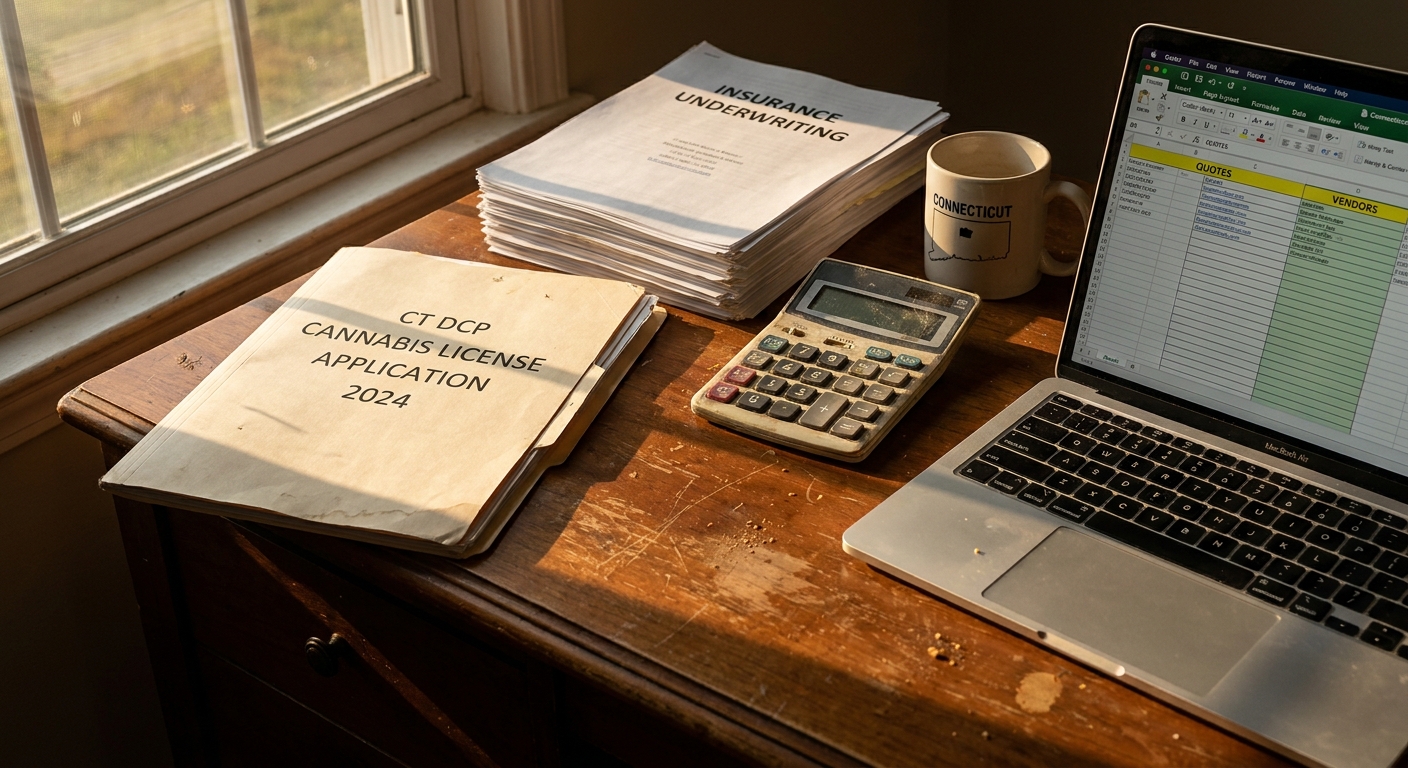
Getting cannabis business insurance bound in Connecticut is not the same as buying a homeowners policy online in 20 minutes. It's a real underwriting process — closer to commercial real estate financing than to retail insurance — and the operators who treat it that way get better terms, faster turnarounds, and far fewer surprises at policy issue. This is the working walkthrough: what happens between "I have a DCP license" and "I have a bound policy and a Certificate of Insurance in my inbox."
If you've been quoted on a CT cannabis policy and felt like the carrier asked for too much paperwork, the answer is that they didn't ask for too much — they asked for exactly what specialty cannabis underwriters need to bind a policy they'll honor at claim time. Skip a step and the policy still issues, but the coverage gaps it leaves behind can be ruinous.
How Long Does It Take to Get Cannabis Insurance Placed in CT?
The Cannabis Insurance Underwriting Process, Start to Finish
There are eight discrete steps from intake to bound policy. None of them is optional, but several can run in parallel if the broker and the operator coordinate. Here's the sequence we follow on every CT cannabis placement at iConn Insurance Solutions.
Step 1
Intake call and operations mapping
Before any application gets filled out, the broker maps the operation: license type (cultivator, manufacturer, retailer, hybrid, micro-cultivator, transporter, delivery), facility addresses, square footage, projected revenue, employee count, hours of operation, security infrastructure, vault details, and any planned operational changes in the next 12 months. This conversation typically takes 45–60 minutes. Operators who try to skip it get quoted on the wrong appetite tier and pay 20–40% more in premium than necessary.
Step 2
Document collection — the underwriting package
Every CT cannabis carrier — Lancer, Continental Heritage, Admiral, Golden Bear, Atain, CannGen, NEXT — wants substantially the same package. The checklist below covers 90% of submissions; specialty operations (extraction, delivery fleets, multi-state operators) add a few items.
Standard CT Cannabis Insurance Document Checklist
- Connecticut DCP cannabis establishment license (current, not pending)
- Municipality zoning approval and Certificate of Occupancy
- Property lease or deed (with cannabis use explicitly permitted)
- Floor plan with vault, sales floor, back-of-house, and access points labeled
- Security plan: camera coverage map, alarm vendor and certificate, vault specs, access-control list
- Employee count, payroll detail, hours of operation, and any 24/7 operations notes
- Projected gross sales (next 12 months) and revenue mix by product category
- Standard Operating Procedures (SOPs) — at minimum receiving, vault, cash handling, and waste disposal
- Inventory peak value at vault (single highest snapshot)
- Resume of owner(s) and any prior cannabis or regulated-industry experience
- Prior insurance loss runs (5 years) if any prior coverage exists
- For delivery/transport: vehicle list with VINs, driver MVRs, telematics vendor
- For cultivation: HVAC specs, fire suppression details, water/electrical layout
The two items that most often slow placements: an out-of-date security plan that doesn't match the actual camera and alarm setup, and a lease that's silent on cannabis use. Both can be fixed, but neither gets fixed in 48 hours.
Step 3
Market selection and submission
The broker selects the carriers most likely to write the operation profitably and submits the package to 3–6 markets. CT cannabis is almost entirely written through Excess & Surplus (E&S) wholesalers — Amwins, Ryan Specialty, and a handful of cannabis-dedicated wholesalers like CannGen — which means the retail agent's submission goes to a wholesaler before it reaches the underwriting carrier. Building the right submission list at this step is the single biggest determinant of price. Submit to the wrong carriers and you waste two weeks waiting for declinations.
Step 4
Underwriter Q&A and supplemental requests
Even with a complete submission, underwriters come back with questions — sometimes substantive (asking about cash drop frequency, third-party security audits, or specific endorsements), sometimes routine (clarifying square footage allocation between sales floor and back-of-house). This phase typically runs 3–7 business days. Operators who respond same-day move to the front of the underwriting queue; those who go silent for a week often see their submission "declined for incomplete information" — which is rarely the truth, but it's what shows up in the file.

Step 5
Quote review and policy form comparison
When 3–6 quotes come back, comparing premium alone is a trap. A 15% cheaper premium with a $50,000 Living Plant sub-limit and a Crime exclusion is a worse deal than a 15% higher premium with full Living Plant and Crime included. The broker should produce a side-by-side policy-form comparison showing: General Liability limits, Product Liability sub-limits and triggers, Crime form coverage, Living Plant sub-limit, deductible structure, and any cannabis-specific exclusions endorsed back in or left out. We covered the major endorsements operators should insist on in our spoke on why cannabis claims get denied.
Step 6
Subjectivities and pre-bind requirements
Cannabis carriers almost always issue quotes "subject to" certain conditions before they'll bind. Common subjectivities: confirmation of UL-listed safe specs, third-party security audit completion, signed warranty of security controls, proof of fire suppression in cultivation, payroll verification, or installation of a specific alarm-monitoring service. These need to be resolved before binding — not after — or the policy issues with subjectivities still outstanding and the carrier may deny the first claim on those grounds. Plan for 5–10 days to resolve subjectivities on a complex placement.
Step 7
Binding and policy issuance
Once subjectivities clear and the operator signs the binder request, the broker requests bind. The carrier issues a binder letter (the legally enforceable promise of coverage) within 24–48 hours and the full policy form within 30 days. Premium is typically due at binding for surplus lines placements, though some carriers offer premium-financed monthly payment terms through third-party premium-finance lenders. Effective dates should match the operator's actual go-live or renewal date — never backdate.
Step 8
Certificates of Insurance and downstream compliance
After binding, the broker issues Certificates of Insurance (COIs) to: the property landlord, the municipality (if required by local ordinance), any vendors with contractual COI requirements, and the operator's banking partner. Some CT municipalities specifically require evidence of General Liability and Product Liability coverage as a condition of operating. Get the COI list from operations, send the requests in writing to the broker, and follow up — landlord COIs in particular tend to fall through the cracks and cause lease defaults later.
Timeline at a Glance: 14-Day vs. 60-Day Placements
| Phase | Clean placement | Slow placement |
|---|---|---|
| Intake + document collection | Days 1–3 | Days 1–14 |
| Submission to markets | Day 4 | Day 15 |
| Underwriter Q&A | Days 5–8 | Days 16–28 |
| Quotes received | Day 9 | Day 30 |
| Quote comparison + selection | Days 10–11 | Days 31–35 |
| Subjectivities cleared | Days 12–14 | Days 36–55 |
| Bind + binder letter issued | Day 14 | Day 60 |
The 14-day path is achievable when documentation is ready on day one and the operator is responsive to underwriter questions within 24 hours. The 60-day path is what happens when documents trickle in, security plans need rewriting, or the lease has to be amended for cannabis use. Both happen routinely; the difference is preparation, not luck.
What CT Operators Get Wrong About the Underwriting Process
The three most common mistakes we see operators make before submission:
- Treating the broker as a quote engine. Operators who hand a broker a copy of their license and ask for "the cheapest quote" get exactly that — a thin policy from the carrier with the loosest underwriting, which becomes a problem on the first claim. The broker is supposed to be the operator's underwriting advocate, not a price-shopping intermediary.
- Underestimating peak inventory value. "We never have more than $200,000 in the vault" — except on the Tuesday after a delivery from a wholesaler when the vault holds $480,000 of finished product. Underwriters need the peak number, not the average, or the Crime sub-limit will be wrong and the policy won't pay a real loss.
- Not disclosing planned operational changes. If the operator plans to add delivery, open a second location, or stand up an extraction line in the next 12 months, the underwriter needs to know on day one. Material changes that aren't disclosed at binding can void coverage; disclosed changes get priced into the renewal cleanly.
What the Broker Should Do for You at Each Stage
A working broker — not a quote-jockey — does specific things at each step. Here's the short version of what to expect:
- Intake: Maps the operation to carrier appetite. Identifies the 3–6 markets most likely to bind. Flags any operational issues that will cost premium before submission goes out.
- Submission: Builds a complete narrative submission — not just the application form. Includes a cover letter explaining the risk profile and any underwriting positives the carrier should weight.
- Quote review: Produces a written policy-form comparison, not just a premium comparison. Calls out coverage gaps, sub-limit traps, and exclusions that need to be endorsed back in.
- Subjectivities: Coordinates with the operator's security vendor, alarm company, and any third parties needed to clear pre-bind conditions.
- Post-bind: Issues COIs proactively for landlord, municipality, and vendors. Tracks the policy through renewal and flags rate changes 90 days out, not at renewal day.
Frequently Asked Questions
Can I get cannabis insurance before my DCP license is issued?
No. Almost every CT cannabis carrier requires a current, active DCP cannabis establishment license at submission. A pending application isn't sufficient. Some carriers will pre-underwrite a file in parallel with the license review so the policy can bind the day the license issues, but no policy will be bound until the license is in hand.
How much does the underwriting process itself cost?
The underwriting process is free to the operator. Brokers are paid commission by the carrier — built into the premium — not by the client. There are no submission fees, application fees, or "underwriting fees" on standard cannabis placements. Beware any broker who tries to charge separate intake or service fees in addition to commission.
What happens if my submission is declined?
A declination from one carrier is normal — most CT cannabis placements see at least one declination before binding. The broker should resubmit to alternative markets, address whatever the declining carrier flagged (often security or financials), and continue placement. Multiple declinations on the same submission usually means the operation needs operational changes (security upgrade, financial restructuring, lease amendment) before it's insurable at standard terms.
Do I need to submit financials to get insurance?
Yes for most placements over $25,000 in annual premium. Carriers want to see projected revenue, gross sales trend, and (for established operators) two years of P&Ls. Startups submit a business plan with revenue projections. Financials are reviewed under confidentiality and do not affect coverage availability — they affect premium and limits offered.
Can I switch carriers mid-policy if I find a better quote?
Yes, but it's rarely worth it mid-term. Cancelling a cannabis policy early triggers a short-rate penalty (typically 10% of the unearned premium) and creates a coverage gap if the new policy doesn't bind the same day. Time market shopping to your renewal date — start 90 days before renewal, get fresh quotes, and replace at renewal if a better fit exists.
Key Takeaways
- A clean CT cannabis insurance placement runs 14–21 days from submission to bound policy
- Document readiness on day one is the single biggest variable separating fast placements from slow ones
- The standard CT cannabis underwriting package is consistent across carriers — Lancer, Continental Heritage, Admiral, Golden Bear, Atain, CannGen, NEXT all want substantially the same documents
- Submission market selection — not premium negotiation — is where the broker adds the most value
- Compare policy forms line-by-line, not just premium against premium — sub-limit traps and exclusions matter more than the headline number
- Resolve subjectivities before binding, not after, or the policy issues with conditions unmet and claims become vulnerable
Working With a CT Cannabis Insurance Broker
At iConn Insurance Solutions we walk every CT cannabis operator through this exact eight-step process — intake to bind to COIs to renewal — and we do it on the schedule the operation actually needs, not the schedule a generic agent can manage. Whether you're a first-time micro-cultivator preparing your initial submission or a multi-location retailer shopping the renewal, the discipline is the same: complete documentation, smart market selection, line-by-line form comparison, and proactive subjectivity management. That's how 14-day placements happen.
For more on the Connecticut cannabis market specifically, our pillar covers cannabis insurance requirements by CT license type and our spokes go deep on premium ranges, the seven carriers writing CT cannabis, and a detailed carrier-by-carrier review.
For non-cannabis Connecticut commercial coverage, our sister site MyInsureCT covers BOP, workers' comp, commercial auto, and umbrella across the broader CT small-business market.
Related Content
AI Payment Fraud Incident Response: What to Do First
The first hour after a fraudulent wire can decide whether funds are frozen or lost. Follow this practical response guide for banks, insurers, evidence, law enforcement, and recovery.
Read post →
Hotel and Commercial Property Insurance: Where Should Renewal Savings Go?
A practical guide for hotel and commercial-property owners deciding whether to keep renewal savings, lower deductibles, increase limits or restore coverage.
Read post →AI Fraud Insurance Exclusions: Where Coverage Can Break
A large cyber limit can hide a small social engineering sublimit. Learn how voluntary-transfer language, verification conditions, and overlapping crime coverage can affect AI fraud claims.
Read post →
Connecticut Builders Risk Insurance: 2026 Buyer’s Guide
Connecticut builders risk buyers should update project values, timelines and controls. Learn what to prepare and compare for a 2026 placement.
Read post →