
A $180K Robbery at a CT Dispensary: What the Claim Looked Like and What the Policy Actually Paid
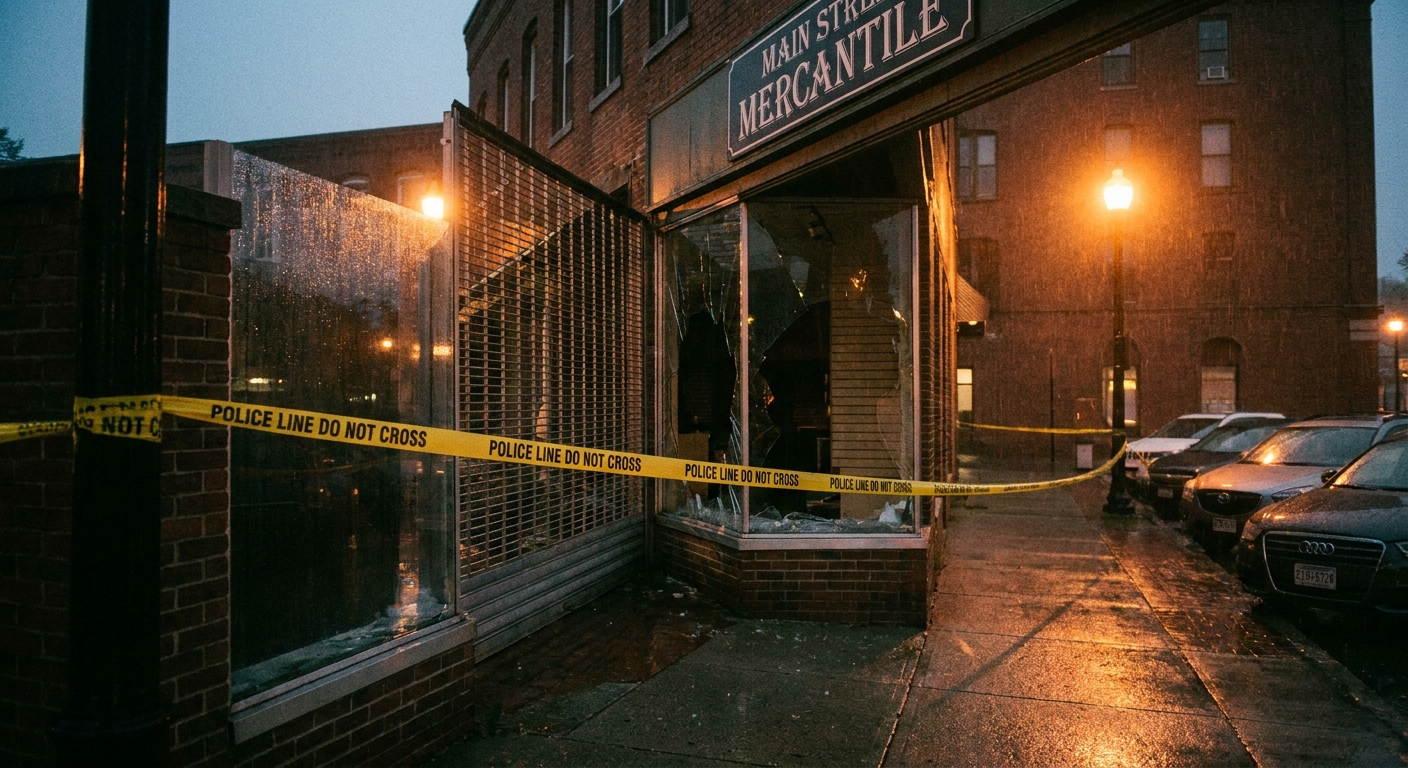
The most useful insurance education isn't a coverage chart. It's a working claim — the kind that arrives at 11pm on a Tuesday, gets reported by the operator the next morning, and runs through 90 days of adjuster review before any check is cut. This post walks through one of those: a robbery at a Connecticut cannabis dispensary that resulted in a $180,000 gross loss and a $112,000 net insurance payment. The $68,000 gap is the whole point.
What Happened at "Riverbend Wellness"
The Operation Before the Loss
- License type: Adult-use retail dispensary, Connecticut DCP license
- Location: Tier-3 CT municipality (population 25,000–40,000), retail mixed-use storefront
- Square footage: 2,400 sq ft retail + 800 sq ft vault/back-of-house
- Annual revenue: ~$4.2M (year-2 of operations)
- Employees: 11 full-time, 4 part-time
- Vault peak inventory value: $310,000 (Tuesday after wholesaler delivery)
- Cash handling: Daily drop, third-party armored pickup 2x weekly
- Security: 24/7 monitored alarm, 16-camera DVR system, vault with UL-listed safe
This is a typical mid-sized CT dispensary — neither a flagship operation nor a struggling one. The owners had done most things right. They were appointed through a wholesale broker, placed with one of the carriers we covered in our best cannabis carriers in CT review, and renewed annually with modest growth. Their policy was structured around what they thought were reasonable assumptions about their exposure.
The Insurance Program at Binding
| Coverage | Limit | Deductible | Annual premium share |
|---|---|---|---|
| General Liability | $1M / $2M | $2,500 | $11,400 |
| Product Liability | $1M / $2M | $2,500 | $6,800 |
| Property — building contents | $420,000 | $5,000 | $8,200 |
| Inventory (finished product) | $200,000 | $5,000 | $14,600 |
| Crime (theft + burglary) | $100,000 | $5,000 | $4,400 |
| Business Income | $350,000 (12 mo) | 72-hour waiting period | $5,200 |
| Cyber + Privacy | $250,000 | $10,000 | $2,100 |
| Total annual premium | $52,700 |
Two structural decisions on this program drove the gap that emerged at claim time: the Crime limit of $100,000 — set at the carrier's quoted default rather than upsized to match peak vault inventory — and the 72-hour Business Income waiting period, which is standard but not negotiated down at binding.
The Loss Event
After-hours forced entry, Tuesday night
Three masked individuals breached the rear service entrance at approximately 11:47pm Tuesday by defeating the rear door's commercial lock and disabling a single camera covering the loading area. The alarm system was triggered at 11:48pm; police response time was 14 minutes. The suspects were inside for approximately 9 minutes before fleeing on foot.
Inventory taken included approximately $168,000 in finished cannabis product (flower, pre-rolls, edibles, vape cartridges) and approximately $12,000 in equipment (POS terminals, display tablets, two laptops). The vault — separately UL-listed and time-delayed — was attempted but not breached. The vault contents (an additional ~$140,000) were preserved.
The dispensary closed for 6 calendar days while law enforcement processed the scene, the rear entry was rebuilt, the alarm system was audited, and an inventory reconciliation was completed under DCP supervision. State Police Connecticut and the local department both opened active investigations.

The Claim Timeline
- Day 0 (Tuesday 11:47pm): Forced entry, alarm activation, police response.
- Day 1 (Wednesday morning): Operator notifies broker. Broker submits First Notice of Loss to carrier.
- Day 2: Carrier assigns adjuster. On-site inspection scheduled.
- Day 4: Adjuster visits site. Police report not yet finalized. Initial reserves set.
- Day 7: Dispensary reopens. Business Income clock starts at hour 73 of closure (not hour 1).
- Day 14: Inventory loss documentation submitted — including DCP-witnessed reconciliation, vendor invoices, and a 24-month seed-to-sale inventory ledger reconciliation.
- Day 21: Adjuster requests alarm-monitoring certificate and 12 months of monitoring records. A 4-day monitoring lapse (carrier hadn't received billing) is identified.
- Day 30: Carrier issues partial reservation of rights on security warranty grounds, pending review of the monitoring gap.
- Day 45: Broker negotiates resolution — the monitoring gap was not coincident with the loss date and was an administrative billing issue, not an actual lapse in monitoring. Reservation withdrawn.
- Day 60: First partial payment issued — $42,000 against Crime and Property coverage.
- Day 78: Business Income claim partially settled at $18,000 (against $32,000 claimed) due to 72-hour waiting period and a question on the revenue baseline.
- Day 91: Final settlement — total net recovery $112,000.
What Got Paid vs. What Was Lost
| Loss category | Loss amount | Insurance paid | Gap |
|---|---|---|---|
| Stolen finished product inventory | $168,000 | $95,000 | $73,000 |
| Stolen equipment (POS, laptops) | $12,000 | $7,000 | $5,000 |
| Physical damage (door, frames, alarm) | $14,000 | $9,000 | $5,000 |
| Business income (6 days closed) | $32,000 | $18,000 | $14,000 |
| Security upgrade required by carrier | $11,000 | $0 (not covered) | $11,000 |
| Legal and claims-prep costs | $8,000 | $0 (not covered) | $8,000 |
| Deductibles paid by operator | — | — | $15,000 |
| Totals | $245,000+ | $129,000 gross |
After deductibles netted against the gross payment, the operator's net recovery from insurance was approximately $112,000 against an out-of-pocket loss closer to $180,000 once secondary costs (security upgrades, legal, deductibles, downstream supplier credit issues) were included. The reported "$180K loss / $112K paid" headline is a simplification — the real gap is wider once secondary expenses are counted.
Why the Gap Existed — Four Specific Reasons
Gap 1: Crime sub-limit set at default, not peak exposure
The Crime coverage was bound at $100,000 — the carrier's quoted default — without a structured analysis of peak vault inventory or worst-case after-hours exposure. Actual peak vault inventory at this dispensary regularly hit $300,000+. A correctly-sized Crime limit at $250,000 would have added approximately $5,000 to annual premium and recovered an additional $35,000–$50,000 on this loss.
Gap 2: Living Plant vs. finished inventory categorization confusion
Some of the stolen product — flower in display jars — was categorized under the policy as Living Plant inventory rather than finished retail inventory, and Living Plant had a separate, lower sub-limit ($25,000) that applied. The policy form, read carefully, was ambiguous on this point and the adjuster initially applied the more restrictive interpretation. The broker negotiated partial reclassification but not the full amount. This is a definitional trap operators rarely discover until claim time.
Gap 3: Business Income 72-hour waiting period
The Business Income policy had a 72-hour waiting period — standard, but unmodified. The dispensary was closed for 6 calendar days (~144 hours), so half the closure period was uncovered. Negotiating the waiting period down to 24 hours at binding would have added roughly $1,800 in annual premium and recovered an additional $14,000 on this specific loss.
Gap 4: Security warranty + monitoring records administration
The 30-day reservation of rights cost the operator nearly a month of float on the claim payment. The underlying issue — an administrative billing gap with the alarm-monitoring vendor that created a paper record of "non-coverage" even though monitoring continued — was avoidable. Carriers can and do invoke security warranty language even when the monitoring lapse is administrative, not operational. A monthly check on monitoring billing and a quarterly download of monitoring records would have eliminated this risk entirely.
What the Operator Did Differently at Renewal
Six months after the claim, at policy renewal, the program was restructured with specific upgrades targeted at the gaps:
- Crime sub-limit raised from $100K to $300K — added ~$6,800 in annual premium.
- Business Income waiting period reduced from 72 hours to 24 hours — added ~$1,900 in annual premium.
- Living Plant sub-limit and finished-inventory categorization clarified by endorsement — at no additional premium.
- Mid-year inventory and security-records audit added to broker's service calendar — at no additional premium.
- Excess Property and Crime layer added through a second carrier — $250,000 layer for ~$3,400 annual premium, providing an additional capacity buffer for catastrophic events.
Net program premium increased approximately $12,100 annually. The next claim — whenever it happens — will be recovered substantially better. The operator's framing changed: insurance moved from "cost of doing business" to "infrastructure decision."
What Every CT Cannabis Operator Should Take From This
- The default quote is the wrong quote. Carrier-quoted limits are starting points, not recommendations. Crime, Living Plant, Business Income waiting period, and equipment sub-limits all need to be specifically sized to the operation's actual exposure.
- Peak inventory matters more than average inventory. Underwriters need the worst-case dollar amount in the vault at any given moment, not the typical-Wednesday number.
- Definitional language matters in cannabis policies. Living Plant vs. finished inventory, ingestion vs. topical, occurrence vs. claims-made — these distinctions decide claim outcomes.
- Administrative discipline on warranties and monitoring records prevents claim delay. A monthly check costs nothing and saves a month of float on a real claim.
- The broker's value shows up at claim time. The 91-day timeline above included 30+ days of broker-side negotiation that materially shifted the carrier's coverage position. A broker without claims-handling experience leaves money on the table.
Frequently Asked Questions
Is this case study a real claim?
It is a composite case study — anonymized and assembled from elements of multiple real Connecticut cannabis claim files to preserve operator privacy. The dollar figures, structural decisions, gaps, and outcomes are realistic to actual CT cannabis claim experience in 2025–2026. The operator name, location, exact dates, and identifying details have been changed.
How common are armed burglaries at CT cannabis dispensaries?
Less common than national headlines suggest, but not rare. Connecticut has experienced a handful of after-hours dispensary burglaries per year since adult-use launch in 2023, with rates declining as security standards have tightened. Insurance carriers price the risk in — which is part of why cannabis Crime coverage is more expensive per dollar of limit than retail Crime coverage in other industries.
Why didn't the policy pay the full inventory value?
Three reasons stack: the Crime sub-limit was lower than peak inventory; some inventory was classified under a lower Living Plant sub-limit; and the deductible applied. Each of these is fixable at the next renewal, but not retroactively to this loss.
Would a bigger Property limit have helped?
No — Property coverage on a cannabis policy responds to building and equipment damage, not stolen inventory. The relevant limits for theft of finished product are the Crime sub-limit and (depending on form) an Inventory or Stock sub-limit. This is one of the most common misunderstandings in the line.
What's the typical timeline from loss to payment on a CT cannabis claim?
60–120 days for a mid-sized cannabis claim with documentation in good order. Faster is possible (30–45 days for small, well-documented losses); slower is common when subjectivity issues, monitoring records, or coverage interpretation disputes arise. Operators should budget cash flow assuming insurance won't fully fund recovery for at least 90 days post-loss.
Key Takeaways
- A $180,000 robbery loss recovered approximately $112,000 net — the $68,000 gap was structural, not bad luck
- Four specific binding-day decisions caused the gap: default Crime sub-limit, Living Plant categorization, 72-hour BI waiting period, and a monitoring records issue
- Right-sizing Crime coverage to peak inventory (not average) is the single most leveraged change available to most CT dispensaries
- Definitional language — Living Plant vs. finished inventory, sub-limits vs. aggregate — decides claim outcomes more than the headline limit
- Broker claims-handling experience materially shifts payment outcomes; the 91-day timeline included 30+ days of broker-side negotiation
- Insurance is best framed as infrastructure, not cost-of-business — the renewal program upgrade for this operator added ~$12K in annual premium and substantially better next-claim outcomes
Working With a CT Cannabis Broker on Claim-Ready Coverage
At iConn Insurance Solutions we structure CT cannabis programs against worst-case loss scenarios — not against carrier-default quotes — because the only test that matters is what the policy actually does at claim time. That's true at binding, at renewal, and in the broker-side advocacy that shapes how a claim gets paid. If you're a CT cannabis operator and you haven't stress-tested your current program against a realistic loss scenario, that's the conversation to have before the loss, not after.
This case study closes our Cluster B series on cannabis insurance by license type in Connecticut. The full series: the pillar, cost ranges, why claims get denied, cannabis vs. standard BOP, best carriers writing CT, the carrier-by-carrier review, the underwriting walkthrough, and product liability for manufacturers.
For non-cannabis Connecticut commercial coverage — BOP, workers' comp, commercial property, retail Crime coverage — see our sister site MyInsureCT.