
Cannabis Lessors Risk vs. Standard Commercial Property in Connecticut: Why Your Existing Policy Won't Cover a Cannabis Tenant
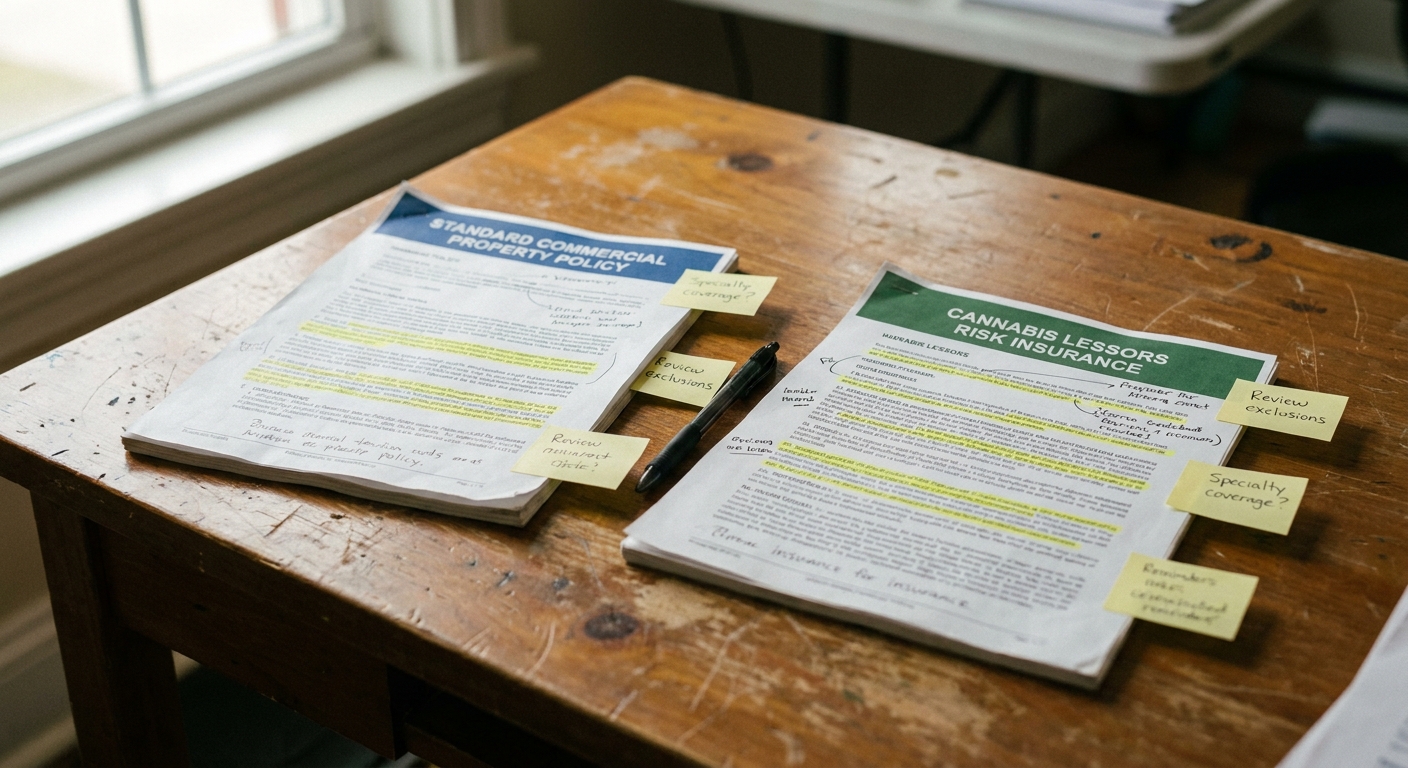
A Connecticut commercial property owner walks into a cannabis lease with the same insurance policy that's covered the building for the past decade. The policy is in force. The building hasn't changed. The math is straightforward — except the policy form, when read carefully, almost certainly contains a "controlled substances" or "illegal use" exclusion broad enough to wipe out coverage for any loss connected to the new tenant's operation. The landlord isn't underinsured; they're effectively uninsured for the new tenant's exposure, even though they're still paying the premium.
This post compares cannabis lessors risk to standard commercial property in Connecticut, line by line — exclusions, sub-limits, premium, and the structural differences that explain why one policy genuinely cannot substitute for the other. The two policies look similar on the certificate. They are not the same product.
Can a Standard Commercial Property Policy Cover a Cannabis Tenant?
Side-by-Side: The Two Policy Forms Compared
| Coverage element | Standard commercial property / lessors risk | Cannabis lessors risk (specialty E&S) |
|---|---|---|
| Controlled substances exclusion | Standard — applies to any cannabis-connected loss | Removed or explicitly waived for state-licensed cannabis |
| Illegal acts exclusion | Broad; federal status invocable | Narrowed to actual illegal conduct, not state-compliant cannabis |
| Carrier appetite | 20+ standard markets compete | 5–7 specialty E&S markets |
| Rating basis | $0.10 – $0.55 per $100 of building value | $0.85 – $3.50 per $100 of building value |
| Loss-of-rents (Business Income) | Standard coverage, 12-month limit typical | Available but often sub-limited; review carefully |
| Tenant improvements coverage | Built into most forms | Available but may require specific endorsement |
| Federal forfeiture protection | Not addressed (excluded by default) | Not insurable, but lease indemnification clauses address residual risk |
| Lender/mortgagee acceptance | Universally accepted | Most lenders accept; some require lender-specific endorsements |
| Wholesale market access | Direct or general retail | Specialty wholesaler required (Amwins, Ryan Specialty, cannabis-dedicated) |
| Claims handling experience | Mature, well-trained adjuster pool | Smaller adjuster pool; cannabis-specific expertise varies |
Why Standard Property Forms Exclude Cannabis Even When Connecticut-Legal
Three converging reasons:
- Federal status. Cannabis remains a Schedule I controlled substance under the federal Controlled Substances Act. Standard commercial property carriers, most of which are domiciled in jurisdictions that look to federal law for "legality" definitions, draft policy language that treats federal status as controlling — regardless of state legalization.
- Reinsurance treaty structure. Most standard carriers operate under reinsurance treaties that exclude cannabis exposures. Even if a primary carrier wanted to write the risk, the reinsurer effectively prohibits it. Specialty E&S carriers operate under different reinsurance arrangements that accept the line.
- Underwriting expertise. Standard property underwriting teams are not trained to evaluate cannabis-specific operational risks (cultivation HVAC, vault construction, extraction Class-1 Div-1, security warranties). Even if the policy form permitted coverage, the underwriting bandwidth wouldn't.
For more on why cannabis insurance generally diverges from standard commercial coverage — operator-side, not landlord-side — see our spoke on cannabis insurance vs. standard BOP.
What the "Cannabis Endorsement" on a Standard Policy Actually Does
Some standard carriers offer a "cannabis endorsement" or "cannabis tenant rider" that nominally permits coverage when a cannabis tenant occupies the building. In practice, these endorsements typically:
- Narrow the controlled-substances exclusion only as it relates to the specifically-named tenant's state-licensed activity
- Add cannabis-specific sub-limits (Living Plant sub-limit, often $25,000–$50,000) that wouldn't apply on a specialty form
- Carry significant premium loadings on top of the base policy — often 100–300% increases
- Reserve broad carrier discretion to cancel or non-renew if the tenant's operation changes
- Maintain other restrictive exclusions (mold, water damage from cultivation, electrical from grow operations) that specialty forms would not
In most CT landlord placements, the cannabis endorsement on a standard form costs more, covers less, and is more fragile at claim time than a placement in a specialty cannabis market. We've never recommended a standard-form endorsement over a specialty placement at iConn Insurance Solutions — and our default is to move the landlord's coverage entirely once a cannabis tenant is in the building, not to bolt on an endorsement.

Premium Comparison — Real Numbers
Three sample placements showing the standard vs. specialty premium delta:
| Building profile | Standard property (no cannabis tenant) | Standard + cannabis endorsement | Specialty cannabis lessors risk |
|---|---|---|---|
| 12,000 sq ft strip plaza ($1.85M) | $3,200/yr | $11,800/yr | $9,500/yr |
| 22,000 sq ft mixed-use ($3.2M) | $5,400/yr | $24,500/yr | $18,500/yr |
| 42,000 sq ft industrial cultivation ($4.6M) | $11,200/yr | Not available (carrier declines) | $42,000/yr |
| 110,000 sq ft cultivation + manufacturing ($9.8M) | $24,500/yr | Not available | $88,000/yr |
Two takeaways from these numbers. First, the specialty market is more expensive than the original standard policy in absolute terms — that's not avoidable. Second, the specialty placement is usually cheaper than the standard policy with a cannabis endorsement, when the endorsement is available at all (which it often isn't for larger or cultivation placements).
Coverage Element Comparison — What Each Policy Actually Does
Building Coverage
Both policies cover damage to the building itself from named perils (fire, wind, hail, water damage from accidental discharge, vandalism). The key difference: the standard policy's controlled-substances exclusion can be invoked when a covered peril is connected to cannabis activity (a fire originating in cultivation equipment, for example), denying coverage for what would otherwise be a standard property loss. The specialty form does not invoke that exclusion.
Loss of Rents (Business Income)
Both policies cover rental income lost while the building is untenantable due to a covered cause of loss. Standard policies typically provide 12-month coverage with a 72-hour waiting period. Specialty cannabis policies often match this but may sub-limit certain triggers (e.g., loss-of-rents arising from regulatory action separate from physical damage). Read the form carefully.
Tenant Improvements and Betterments
Standard policies cover tenant improvements as part of building coverage when the landlord owns them. Specialty cannabis policies handle this similarly but often require explicit endorsement to clarify which improvements are landlord-owned vs. tenant-owned, particularly for cultivation buildouts (HVAC, electrical, grow lighting) that can run six figures.
Equipment Breakdown
Both forms can include equipment breakdown coverage (boilers, HVAC, electrical systems). Specialty cannabis forms often broaden this to include cultivation-specific equipment failures and the resulting moisture/electrical damage. Standard forms typically do not.
Ordinance or Law Coverage
Most modern lessors risk policies include some Ordinance or Law coverage — providing for increased cost of construction when local code changes between original construction and a rebuild after loss. Cannabis lessors risk policies may sub-limit this and may exclude regulatory-driven changes specifically related to cannabis operations. Verify at binding.
When a Standard Policy Might Still Make Sense
In two narrow scenarios, a landlord can keep a standard policy in force:
- Multi-tenant building with one small ancillary cannabis use. If the cannabis tenant occupies less than ~10–15% of the building and the operation is delivery-only or low-risk retail (not cultivation or manufacturing), some specialty carriers will write the building under a "cannabis-aware" form that still allows standard treatment of the rest of the building.
- Cannabis tenant carries Cannabis Liability with landlord as additional insured at high limits. When the tenant maintains $5M+ of General Liability with the landlord listed as additional insured and the lease shifts substantially all liability and property risk to the tenant, some specialty markets accept the landlord building under a near-standard form. This is rare and only works in specific configurations.
Outside these narrow cases, the right answer is replacing the standard policy with a specialty cannabis lessors risk placement.
Frequently Asked Questions
If I don't tell my insurance carrier about the cannabis tenant, what happens?
If a loss occurs and the carrier discovers the cannabis tenant during claim investigation (which they do — adjusters routinely review tenant lists), the policy may be voided on misrepresentation grounds, with no coverage and likely retroactive premium liability. This is the worst outcome and not worth the risk. Disclose, accept the policy will need to be moved, and shop a specialty placement.
Can I keep my standard policy for the rest of the building and just exclude the cannabis tenant's space?
In theory yes, in practice rarely. Most standard carriers will not write a partial-building policy that excludes a known cannabis tenant's space — they treat the building as a whole risk. A handful of specialty markets do offer this configuration for very specific multi-tenant scenarios; it's not the default placement structure.
How long does it take to move from a standard policy to a specialty cannabis placement?
Typically 14–28 days from broker engagement to bound specialty policy, assuming the building documentation (appraisal, sprinkler records, electrical inspection, lease) is current. Plan to begin the placement 30–45 days before the cannabis tenant occupies — not the day of move-in.
Does my lender care which policy form I'm on?
Yes — sometimes meaningfully. Most lenders accept specialty cannabis lessors risk as long as their standard mortgagee clause, lender's loss-payable endorsement, and minimum-limit requirements are honored. A few lenders, particularly traditional banks rather than specialty cannabis lenders, will not accept a specialty E&S placement and may require the borrower to refinance. Confirm before placing.
Is the specialty cannabis policy "real" insurance with the same regulatory protections?
Yes. Excess & Surplus lines insurers are licensed in their state of domicile and registered as surplus lines in Connecticut. They are regulated, financially-rated, and pay claims under the same legal framework as standard carriers. The "surplus lines" designation refers to how the coverage is placed, not the quality of the insurance.
Key Takeaways
- Standard commercial property and cannabis lessors risk are not interchangeable products — they differ in exclusions, sub-limits, and claims handling
- The controlled-substances exclusion on standard forms can wipe out coverage even on losses that look unrelated to the tenant's cannabis operation
- Cannabis endorsements on standard policies cost more, cover less, and are more fragile at claim time than specialty placements
- Specialty cannabis lessors risk costs 4x–10x standard property — but is the correct product, not an upgrade
- Failure to disclose a cannabis tenant to a standard carrier can void the entire policy, not just the cannabis-related portion
- The placement decision should be made before the tenant moves in, not after a loss
Working With a CT Cannabis Lessors Risk Broker
At iConn Insurance Solutions we place CT landlord coverage in the right market the first time — specialty cannabis lessors risk with carriers that explicitly accept state-licensed cannabis, with policy forms that don't carry residual controlled-substances language, and with lender-acceptable endorsement structures. For landlords negotiating a new cannabis lease, the time to evaluate the placement choice is during lease negotiation, not at the first renewal.
For more, see our landlord guide pillar, lessors risk premium ranges, and our spoke on why landlord cannabis claims get denied.
For non-cannabis CT commercial property and lessors risk, see our sister site MyInsureCT.
Related Content
AI Payment Fraud Incident Response: What to Do First
The first hour after a fraudulent wire can decide whether funds are frozen or lost. Follow this practical response guide for banks, insurers, evidence, law enforcement, and recovery.
Read post →
Hotel and Commercial Property Insurance: Where Should Renewal Savings Go?
A practical guide for hotel and commercial-property owners deciding whether to keep renewal savings, lower deductibles, increase limits or restore coverage.
Read post →AI Fraud Insurance Exclusions: Where Coverage Can Break
A large cyber limit can hide a small social engineering sublimit. Learn how voluntary-transfer language, verification conditions, and overlapping crime coverage can affect AI fraud claims.
Read post →
Connecticut Builders Risk Insurance: 2026 Buyer’s Guide
Connecticut builders risk buyers should update project values, timelines and controls. Learn what to prepare and compare for a 2026 placement.
Read post →